Saturday, October 30, 2010

The Tower, the Zoo and the Tortoise


The title: The Tower, the Zoo and the Tortoise
The author: Julia Stewart
Publication: Doubleday, 2010
Got it from: The library


Balthazar Jones is a Beefeater in the Tower of London, living with his Greek wife Hebe and their 106-year-old tortoise (the oldest in the world, so they've heard). Husband and wife are still grieving the loss of their son Milo when Balthazar is given the chance to be caretaker of the Queen's animals, who are being moved to the Tower for safekeeping. Meanwhile, Hebe is busy working in the London Underground's Lost Property Office while her co-worker Valerie is falling in love with a ticket inspector. Other characters rounding out this zany tale are the tower's resident clergyman, who secretly writes principled erotica under a female pseudenom and is in love; Ruby, the barkeeper who was born and raised within the tower and has just discovered she's pregnant; and the wicked Ravenmaster who's as shifty-eyed and sneaky as the birds he keeps.

This book is more fast-paced and kookier than Amelie, with tons of quirky historical asides and amusing back stories of minor characters, like the tower doctor who was so intent on playing Monopoly that the baby he's supposed to be delivering just shoots out and slides across the floor. There were many genuinely laugh-out-loud moments and it's clear the author has carefully crafted her work. However, there was something about this book that I just couldn't warm up to. The protagonist of the story, Balthazar, was the most uninteresting character and I found I couldn't bring myself to emotionally respond to the loss he and his wife are experiencing. There was so much insanity, so many little asides and back stories, that the main characters just got muddled up in the narrative. I almost would have preferred if it had been a bird's eye view of the tower's kooks without ever really touching too much on one particular couple. I found the periodic heaviness of the death of the son jarring compared to the lighthearted whimsy of the rest of the story. But I would not shy away from recommending this book to anyone with an interest in the Tower of London and an amusing read.

Sunday, October 24, 2010

The magic of reading


It was early on a Saturday morning in late winter years ago. Breakfast was just over but a girl of ten had withdrawn to the parlor with a book...Then followed one never-to-be-forgotten day, a day filled to the brim with bliss, surprise and high excitement. The reading of this book was a revelation. She had not known before that one could by reading be transported so deeply into another world.

The book was
Little Women. That special joy and delight have been had since from books, and from books only. There has been deep pleasure in solitary places in woods, near the sea, or in the country. There has been joy in friendship and love, and satisfaction in creative work. But the joy and delight in books have gathered all these other joys and carried one into a wider, richer, freer existence; they have re-vitalized life.

Bertha Mahony Miller
Horn Book November/December 1935 Editorial

Monday, October 18, 2010

Mr. Shakespeare's Bastard

The title: Mr. Shakespeare's Bastard
The author: Richard B. Wright
Publication: Phyllis Bruce Books, 2010
Got it from: The library

I found this book interesting because I'm not usually a big fan of the Tudor era - too many beheadings for my liking. But I read this because I knew I was going to meet the author through my job and I wanted to prepare myself. I actually ended up being pleasantly surprised. The story was far more gentle and far less gritty than I was bracing myself for.

This tale is really about two women. The first is Aerlene, an old woman living around the time of the Restoration, who is telling her life story and how she is secretly Shakespeare's daughter. The second woman is Aerlene's mother Elizabeth and through Aerlene we hear how Elizabeth met and had an affair with Shakespeare as a young woman in London. Reading this book, I almost felt that I was dealing with characters who possessed Victorian sensibilities - I had to keep reminding myself that everything was taking place in the 17th century, not the 19th. It certainly provided a more refreshing and realistic portrayal of humanity than the oversexed and overbloody depictions of the era in current media (think the Tudors TV show). It is also far superior to the movie Shakespeare in Love, which of course the storyline is similar to. I can't help disliking Shakespeare in Love more and more with each passing year for the whole "sexy Shakespeare" trend it started. Mr. Shakespeare's Bastard is a nice anecdote for those weary of the blood-and-sex Tudors and looking for more complex and well-rounded Elizabethan characters.


Sunday, September 26, 2010

The Grand Design

The title: The Grand Design
The author: Stephen Hawking (and Leonard Mlodinow)
Publication: Bantam, 2010
Got it from: The library

Ha! I just realized this book and my last one I reviewed start with "The Grand." And two very dissimilar books, too. Funny!

Stephen Hawking's newest book promises to answer the "ultimate questions of life," such as: how did the universe begin? Why are we here? Does the grand design of the universe prove there is a creator? Not bad for a book less than 200 pages long, and that includes the index and glossary too!

Does he answer these questions so fundamental to human life? The answer is yes - as far as we know. And don't read too quickly, or you'll miss it. Perhaps a disappointing answer, but then if you read this book, you'll learn that the easy answer - or the most obvious - is not always right. I was repeatedly reminded of the quotation from the astronomer Sir Arthur Eddington: "Not only is the universe stranger than we imagine, it is stranger than we can imagine." Even though Stephen Hawking states in this book that the universe is not actually so difficult to understand, I'd like to add, "yes - if you're Stephen Hawking."

Believe me, reading this book is a total head trip. If it makes sense to you, you're probably either insane or an astrophysicist. Not that I don't believe every word is true, I just can't wrap my mind around it. For instance, did you know there are actually believed to be eleven - eleven! - dimensions? That time did not exist before the Big Bang but was created by it? Or - hold on to your seats, because this is going to get weirder than you've ever thought possible - not only are there alternate histories, but that every single alternate history exists, simultaneously, right now. Seriously. For real.

Don't let the big ideas scare you. This is important stuff, but it's good stuff, and even if you can't follow everything you can at least be amused by Hawking's writing style and sense of humour. Just when you think an analogy is going to be dry, he comes out with gems like these: "In physics a system is said to have symmetry if its properties are unaffected by a certain transformation such as rotating it in space or taking a mirror image. For example, if you flip a donut over, it looks exactly the same (unless it has a chocolate topping, in which case it is better just to eat it)." Scientists have such a great sense of humour. That's why everyone laughed at a Neil deGrasse Tyson talk I attended when he said, "the universe is trying to kill you." It would be scary if it wasn't so funny.

To sum up:
Universe - crazy to puny humans and our puny minds
Stephen Hawking - brilliant and funny
Chocolate donuts - delicious

Sunday, September 12, 2010

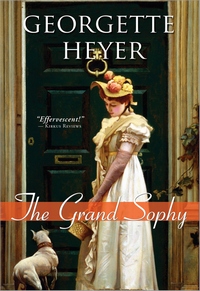
The Grand Sophy


The title: The Grand Sophy
The author: Georgette Heyer
Publication: Sourcebooks, 2009 (originally 1950)
Got it from: Jane Austen Today/Sourcebooks

Last year I was the lucky winner of The Grand Sophy giveaway from Sourcebooks via the excellent website Jane Austen Today (see sidebar for link). And I must say, Sourcebooks totally rocks my world! Not only have they redesigned all the Georgette Heyers with beautiful new covers, they were also awesome enough to send me a copy of The Grand Sophy in the mail, for free! Maybe other book reviewers get free books all the time, but it was a totally novel (heh) experience for me. Believe me, the only thing better than reading this book was having it delivered to my home without having to do a thing.

The Grand Sophy is considered one of Heyer's finest works, and it's easy to understand why. Sophy Stanton-Lacy is one of those fearless heroines, similar to Mma Ramotswe in The #1 Ladies Detective Agency or Amelia Peabody, who will let nothing stand in her way and cares little about the opinion of others. Sophy's hoydenish ways can be largely attributed to her father's careless upbringing on the Continent, and when she arrives on English soil she finds that the rules of propriety in that country are much more restrictive than she's used to.

The story revolves around the Rivenhalls, Sophy's aunt's family, and their various romantic and financial entanglements. Of course, only Sophy has what it takes to straighten them out and she does so in unconventional and hilarious ways. If you can get used to the idea of the hero of the story being Sophy's cousin (it was acceptable at the time!) you will enjoy this. I particularly enjoyed a passage that so perfectly explains the difference between one of her cousin's suitors, a poet, and another more prosy but far more suitable man:

Mr. Fawnhope's handsome face and engaging smile might dazzle the female eye, but Mr. Fawnhope had not yet learned the art of conveying to a lady the gratifying impression that he considered her a fragile creature, to be cherished, and in every way considered. Lord Charlbury might be constitutionally incapable of addressing her as Nymph, or of comparing bluebells unfavourably with her eyes, but Lord Charlbury would infallibly provide a cloak for her if the weather was inclement, lift her over obstacles she could well climb without assistance, and in every way convince her that in his eyes she was a precious being whom it was impossible to guard too carefully. - p.269

Of course, this sort of cherishing applies far more to delicate Cecilia than to Sophy herself, whose temperament is far more suited to her cousin Charles' headstrong and argumentative personality, and it's with particular glee that we see how Sophy wins his affections away from Eugenia, Charles' prissy, boring and self-righteous fiancee (a long-lost twin of Mary Bennett from Pride and Prejudice?). It's the well-drawn characters, more than anything, that make this story come alive. Long after the book is done and the plot forgotten, you'll remember Sophy, and no author could ask more of her heroine.

A Little Book of Language

The title: A Little Book of Language
The author: David Crystal
Publication: Yale University Press, 2010
Got it from: The library


Two years ago I read another book by linguist David Crystal that I thoroughly enjoyed, so I thought I would pick this up for a skim-through. In the end the book caught my interest so much I read it the whole way through.

This book is written as an introduction to language for young people, but anybody who is curious about language can read it. I loved Crystal's charming, unpretentious writing and after reading it, I walked away with a better appreciation for speech and language. I have encountered many things in this book before, but the way he wrote gave me a different perspective. For instance, I hadn't thought much about what an amazing thing it is for a baby to learn language, yet most are fluent within two years - and the first two years of life, no less!

As usual, I was most fascinated by the history of language, and Crystal does a good job hypothesizing how speech developed and what the first languages would have sounded like. He makes the interesting point that language is about more than communication. It actually shapes the way we think and allows us to tell stories from the past as well as predict the future. I was also interested in his take on spelling. Crystal is a big proponent of the philosophy that language is fluid, and that it is pointless to try to "preserve" language. In that respect, he is fascinated by the speech of the younger generations and the language of texting, which he sees not as a deterioration of spelling but as a new and important branch. In fact, he theorizes that texters can spell just as well as everyone else, and to create shorthand such as "C U L8R" requires an advanced understanding of language that can then be played with.

While some readers may balk at the idea of the evolution of language, Crystal is quick to point out that before the printing press, spellings were more or less arbitrary. Because of the written word, we have ended up spelling things as they were pronounced hundreds of years ago - for instance, we once said the "k" in "knife." As the rules of English were chosen randomly by various printers over the centuries, there is no need to cling so dogmatically to spelling and grammar. What is right for one person at one time need not apply to all English speakers for all time. If that were the case, we'd all be speaking Shakespeare's language - or the language of Chaucer, for that matter!

Random postscript - you may have noticed that the header on this blog has been changing a lot lately. It's because I have been playing around with it, trying to find something I can live with. I've finally decided to stick to something simple, in keeping with my philosophy that my blog shouldn't be weighted down with weird fonts, tons of graphics or general clutter. I hope that this works for everyone and that you continue to enjoy reading my reviews as much as I enjoy writing them!

ETA: I've updated the links for my favourite book websites with some new sites, including a few of my favourite e-book stores. Please check them out!

Sunday, September 5, 2010

A Noble Captive

The title: A Noble Captive
The author: Michelle Styles
Publication: Harlequin, 2010
Got it from: The library


Author Michelle Styles has bemoaned the fact that historical romances are extremely limited in time settings and that the golden age of Rome, so rich is possibility, is barely ever used as a setting. Man, I hear that. For a hormonal woman focused university student like me, my Roman history classes in university were made all the sweeter thinking about hunky centurions. Plus, they have those awesome helmets that can double as brooms if you turn them upside down.

So that is why I think it's awesome that Michelle Styles is writing romances set in the Roman world. Her research and attention to detail is extraordinary, and while the characters do sometimes slip into modern speech, it doesn't detract from the story at all.

The hero of A Noble Captive, as you may have guessed from the cover, is a centurion named Marcus Livius Tullio, who is simply called Tullio in the Roman fashion. He and the men he leads have been captured by pirates - this is the age of the Republic, a more wild and lawless time before the Augustan Empire (I knew those university classes would come in handy some day! Thank you Dr. Goud!*) The island where the pirates come from is also the home of the sibyl, a priestess of the goddess Kybele and a powerful religious leader who the pirates (mostly) respect. When Tullio and his men arrive as captives, exhausted and near death, he is able to invoke the protection of the sibyl. What he doesn't know is that the "sibyl" is actually the real priestesses' beautiful niece Helena, taking the place of her sick aunt to fool the suspicious pirates.

There's a lot of political maneuvering and historical detail here, so don't expect this to be one of those romances where you can just turn your brain off and be done. The pace of the book is also slow - sometimes too slow - and there isn't a whole lot of action, at least until the very end. The primary conflict of the book is if Helena will trust Tullio, a hated Roman. Of course we, the readers, know Tullio is really an honorable and noble man. But screaming, "What's the matter with you woman? Are you blind?" at the heroine seems to be di rigeur these days. Not my favourite book this year by any means, but hopefully this augurs the start of many more Roman-themed romances.

*I also felt extremely proud that I knew the difference between a tribute, a tribune and a trireme before reading this. I think I deserve a cookie.