Showing posts with label Re-reads. Show all posts

Wednesday, January 4, 2017

Christmas with Anne


The title: Christmas with Anne and Other Holiday Stories
The author: L.M. Montgomery
Publication: McClelland and Stewart, 1995
Got it from: Mom and dad, Christmas 1996

I reviewed this one before, back when I first started this blog, and reread it again this holiday season.  As I mentioned in my original post, the stories definitely lean on the predictable side, especially if you've read other LM works.  However, if you're looking for gentle, feel-good stories, this is your book.  There's lots of tales of quarreling family members being reunited at Christmas, people learning to be generous to those less fortunate, and mistaken identities inadvertently saving Christmas. 

There are two standout stories in this collection (not mentioning Anne's puffed sleeve dress chapter, which Anne fans will all be familiar with.)  The first is Katherine Brooke Comes to Green Gables, taken from Anne of Windy Poplars.  I love the original story of Katherine Brooke, even more than the version portrayed in the Megan Follows adaptation Anne of Green Gables the Sequel.  There's something very Blue Castle-y about Katherine's transformation from bitter spinster to mellow, happy woman, even if it's through Anne's help rather than for herself.  It's a nice reminder to enjoy the pleasures of life, and not let unhappiness define us. 

The second is a sad story, but its poignancy makes it memorable.  In The Unforgotten One, a young maid is grieving the loss of a family member she served, and thinks no one remembers her as the family reunites at Christmas.  She slips outside to visit the grave, only to overhear each family member, one by one, visit the dead woman and explain how much they miss her.  Montgomery, and Victorian in general, were always close to death, and this story speaks to universal emotion of the bittersweetness of loss.

Monday, August 8, 2016

At the Altar: Matrimonial Tales

The title: At the Altar: Matrimonial Tales
The author: L.M. Montgomery
Publication: McClelland & Stewart, 1994
Got it from: NB, 1995

On days when I just want a feel-good, happy ending story, I re-read one of L.M. Montgomery's books and everything feels right again. They are my comfort stories, and I have loved rediscovering them after first reading them about twenty years ago.  Of course there's nothing I love more than a good romance and these 18 stories have them aplenty.  What I especially love about them is that most of the characters aren't the "romantic" sorts that the characters themselves dream of.  Often they are middle aged and practical, but Montgomery somehow manages to bring out their romantic sides.

Stories I particularly love in this anthology: "Jessamine": a woman languishing in the city is visited by a farmer who restores her soul by taking her out to see his farm.  He rescues her from having to move west by his proposal.  "Miss Cordelia's Accomodation": an old maid takes a group of factory children to the country for a holiday, and meets a rather accommodating farmer.  "A Dinner of Herbs": a 33-year-old woman who faces having to share a room with a stupid teenaged relative makes a desperate proposal to a reclusive neighbour to avoid having to marry an unpalatable widower.  "The Dissipation of Miss Ponsonby" (my favourite): a 35-year-old woman who was separated from the man she loved 15 years earlier by her father is aided in making a daring escape to a dance when he returns from the west, helped by two younger neighbours who give her a makeover. 

Of course some of these stories were better than others, but every single one was enjoyable.  What can I say about Montgomery's works that I haven't already?  I'll let the editor describe it herself from the afterward: "I read them year in and year out, again and again.  I never tired of their apparent simplicity, finding them more complex than they seemed, their emotions true and believable.  They were part of my innermost being.  But there weren't enough of them."

Sunday, February 21, 2016

Jonathan Strange & Mr. Norrell

The title: Jonathan Strange & Mr. Norrell
The author: Susanna Clarke
Publication: Bloomsbury, 2004
Got it from: NB, 2007

I had originally read JS&MN almost ten years ago, back in 2007.  But last year the TV mini-series came out, my husband wanted to read it, and I thought it was time to dust off my paperback and re-read.

My impressions are going to be mostly about my experience reading it for a second time, and inevitably it will be compared to the first time.  In order to understand why I loved this book back then, you have to also understand that I was deep into my Regency-loving phase, as well as my magic realism phase.  I also read it swiftly and deeply.  This time the demands of work and other responsibilities meant I read this in a five-month stretch, divided in chunks.

Unfortunately the book didn't hold up as well the second time around.  Maybe I was just feeling impatient, but the whole thing just felt too darn long.  The first time I think I was projecting emotions on the characters that weren't there.  With a few minor exceptions, I didn't connect emotionally with any of the characters.  At all.   Having read the Mrs. Quent series in the last five years, which was probably 2/3 longer than JS&MN's hefty 1000 pages (although divided over three volumes), I feel the former series did it so much better.  Fantasy world building and 19th century manners are fine, but if I can't relate to the characters, forget it.  The Mrs. Quent series had me turning the pages because I cared about the people and felt involved in their lives.  Clarke's writing feels remote and standoffish in comparison.  It's a deliberate choice on the author's part to make it feel more like writing from the era, but it doesn't sit well with my modern sensibilities.  Mrs. Quent had a formal Victorian feel, but the characters felt modern enough to make me feel I was experiencing everything with them.

The other thing that the Mrs. Quent books had was an actual female heroine.  JS&MN didn't, and it bothered me so much more this time around.  It shouldn't be surprising - I mean, the book has two dudes in the title, but I wish the women had been more than just passive, helpless victims.  I know The Ladies of Grace Adieu helps make up for this, but it's a separate book and by the end of JS&MN I was totally sick of reading about dude magicians, dude ministers, dude dandies, dude servants, dude soldiers and dude fairies. 

There's no doubt that Clarke did an enormous amount of research in terms of historical detail - events, people and places are all accurate, with the addition of magic.  The book is actually at its best when it diverts from the main plot for witty, amusing footnotes of magical history grounded in England's real past.  (And an anecdote about Napoleon being outwitted by a charlatan and his honking goose is comedy gold.)  But something about it just felt off, like a stuffy piece of furniture that no longer appeals to me.  I realize the book hasn't changed.  I have.  Maybe in another ten years it will be the right time in my life to appreciate it again.  Or maybe it belongs in my past forever.

Monday, September 28, 2015

A Tangled Web


The title: A Tangled Web 
The author: L.M. Montgomery
Publication: Seal, 1988 (originally 1931)
Got it from: PEI, early 1990's

I've been slowly re-reading a lot of Montgomery's works for the first time since childhood, and my recent foray was with one of her few adult-oriented novels, A Tangled Web.  This story focuses on a tight-knit community ruled by two proud families, the Darks and Penhallows, who have fought and married each other for years.  Yes, they're incestuous, but it was pretty common back then.  As the story opens, family matriarch and queen bitch Aunt Becky is dying and is about to announce who is going to receive her legendary heirloom jug.  Every member of the family is dying to have it, but Becky, who can't resist being awful even as she's dying, makes them wait a year and dance to her tune before they can find out who gets it.

In typical Montgomery fashion the book is very character driven.  Each family member has his or her own back story that has to get resolved before the end of the year.  It's not exactly a secret who the "good" and "bad" characters are.  Montgomery is pretty clearly on the side of the romantic, old-fashioned Victorian folk, she has no patience for the moderns.  Consider one of the heroines, Gay (her name is Gay, people!), a throwback Gibson Girl and professional romantic whose fiancee is stolen by her cousin Nan, a boyish flapper who oozes nastiness from her pores.  There's also the tragic story of Hugh and Joscelyn, separated on their wedding night ten years ago. Joscelyn's growth as a character comes from her realization of her true love for her traditional husband and his old-fashioned farm.  But even if she's hard on the non-homebodies, some of them still get their happy endings.  Peter Penhallow, the family's globe-trotting explorer, is a moron, but manages to win his true love in the end (although it should be noted that his and Donna's story is the most underdeveloped and fizzles out at the end).  

There's little touches of humour sprinkled throughout the book, especially in the scenes involving Big Sam, a wee fussy man, and the gigantic Little Sam, roommates who fall out over a naked goddess statue.  Overall though, this book feels more tragic than what I'm used to from Montgomery.  It was written in during the early stages of the Depression when the author's own life wasn't going so well, and it shows.  It isn't one of my favourites of hers, but I liked it pretty well.  That is, until the very last paragraph, when she trots out something so racist I did a double-take.  You were so close, Maud!  You almost made it.  It's too bad the ending had to leave such a bad taste in my mouth, but then again it's not the first time she's done this to me.

Monday, April 20, 2015

Double review: Further Chronicles of Avonlea and The Story Girl

The title: Further Chronicles of Avonlea
The author: L.M. Montgomery
Publication: L.C. Page & Company, 1920 (My edition: Seal Books 1987)
Got it from: N.B. c.1993

While I was in the middle of reading one L.M. Montgomery book and listening to another on audio, Anne fandom was hit with a huge blow this past weekend with the death of Jonathan Crombie who played Gilbert in the classic Sullivan films.  Two weeks ago at Easter when I reviewed Cool Japan Guide I went down the rabbit hole and started researching the Japanese obsession with Anne, and somehow ended up finding this interview with Crombie. Even though Gilbert of the books will always be my favourite, Gilbert of the movies was everything he should be.  A generation of Anne fans will mourn him deeply.

Anne and Gilbert don't make make too many appearances in this follow-up to Chronicles of Avonlea, although Anne does narrate one of the stories.  What makes these two collections interesting is that they were written to be published as a whole from the beginning, rather than compiled together from various stories like many of the Montgomery collections that began appearing in the 1990s.  The fact that it's set in Avonlea is almost non-essential.  Except for a few mentions of peripheral Anne characters, these stories could be set anywhere in Montgomery's beloved turn-of-the-century P.E.I.  As always, her stories are full of warmth, humour and the follies of human nature, and I enjoyed them with a few serious caveats.

On the whole the first few stories felt stronger than the last handful and overall I thought Chronicles of Avonlea was stronger than its sequel.  Fans of the TV show Road to Avonlea will recognize the story "The Materializing of Cecil," about a spinster who makes up a beau from her past only to have a man with the same name show up in town.  "Her Father's Daughter" was a nice story about a girl who reunites with her estranged father on her wedding day.  "The Brother Who Failed" shows Montgomery's Victorian sentimentality with her It's a Wonderful Life plot: a brother who feels like a failure is proved to be everyone's hero.  "The Son of His Mother" showed Montgomery's near-obsession with sons (she had two herself and was unapologetic in her bias).  This story features a mother so obsessed with her son it borders on mental illness. 

Each story is worth discussing, but I want to focus on a couple of things that rubbed me the wrong way as a modern reader.  "The Education of Betty" has a man raising the daughter of a woman who refused him, and he ends up romantically with the daughter in the end.  Yuck.  I find May-December romances incredibly creepy, especially when it's the man who's older.  Even though the girl in this was 19, I just found the whole concept gross, especially as the "lover" was her father figure growing up. 

The other aspect of these stories I can't forgive is their casual racism, even though it was perfectly acceptable at the time.  As much as I love Montgomery, holy crap was she racist.  She basically looks down on anyone who isn't a white well-to-do Protestant, but it's even more pronounced here.  There's a throwaway line at the end of "The Materializing of Cecil" disparaging the Chinese, but you could write a thesis on last story, "Tannis of the Flats," and its depictions of First Nations people.  I'm not going to repeat the slurs here but suffice it to say the whole story is based on racist stereotypes and ethnic insults abound.  Modern readers will be horrified.

The title: The Story Girl
The author: L.M. Montgomery
Publication: L.C. Page & Company, 1911
Got it from: Hoopla Audiobooks, read by Grace Conlin, 2006

Less racist (although still classist) was my audiobook listen of The Story Girl, which along with its sequel and the Chronicles of Avonlea formed the basis of Road to Avonlea.  This is the only one of Montgomery's books that I didn't remember a thing about from having read as a child, except for the scene where the children pay someone for a picture of God. Montgomery has said it was an autobiographical story.  It features a summer in the life of a group of clannish cousins, along with their mischievous hired boy Peter and a wet blanket of a friend named Sara Ray.  It's narrated by one of the boy cousins, but the true protagonist of the story is Sara Stanley, the narrator's cousin.  Although she's not as beautiful as their conceited cousin Felicity, Sara is more beloved for her imagination and her ability to tell marvelous stories.  Her tales form many stories-within-stories that often reflect events in the children's lives.  Grace Conlin reads beautifully and the oral storytelling in the book makes for a perfect audiobook experience.  I expect to follow up with the sequel The Golden Road in the near future.

Monday, September 8, 2014

The Blue Castle (Again)


The title: The Blue Castle
The author: L.M. Montgomery
Publication: McClelland & Stewart, 1926 (Voyageur Classic Edition,
Got it from: Amazon, 2010


I've blogged about The Blue Castle before, and it isn't the first time I've reread it, either.  I actually had to replace my old worn-out copy a few years ago.  I think, without exaggeration, that this is my absolute favourite all-time book.  Every time I read it, I notice something new, and it just gets better every time.

I read this over the Labour Day weekend and even though I knew exactly what would happen, I couldn't put it down.  I hardly even know what to say in this review because reading this book is almost a sacred experience for me.  It speaks to me on so many different levels.  Based on some of the online reviews I've read, a lot of women feel the same way.  I have a theory it's because there's a lot of women who are hungry, starving even, for stories about women just like themselves: quiet, romantic, passionate and above all misunderstood by everyone around them.  The world is a cruel place for women who possess these traits, who have reality forced on them in so many unwanted ways, their dreams mocked and belittled.  The history of Western literature is about men, but The Blue Castle is our story, separate from the demands of modern life and the painful noise of male voices.

Take, for instance, one of the central themes of the books: Valancy's escape from the stifling confines of family obligation.  How many women are forced to be the ones to try to keep everything running smoothly in families?  How many women secretly resent this?  Oh yes, this is a feminist book, through and through.  One early reviewer hated the book because he felt Valancy behaved in an unrealistic (unladylike) way, but what he didn't understand was that she was just ahead of her time.  And yes, one could argue against the feminist theory because there is a love interest.  But Barney demands absolutely nothing of Valancy except that she be herself (a trait that many women nowadays would do well to look for in a partner).  There is something so wonderfully appealing about Valancy and Barney's Edenesque escape into the woods, a life of solitude that beckons even more strongly in our hectic, stressful, overworked modern lives. 

It was amazing to be able to sit up half the night and look at the moon if you wanted to.  To be late for meals if you wanted to - she who had always been rebuked so sharply by her mother and so reproachfully by Cousin Stickles if she were one minute late.  Dawdle over meals as long as you wanted to. Leave your crusts if you wanted to.  Not come home at all for meals if you wanted to.  Sit on a sun-warm rock and paddle your bare feet in the hot sand if you wanted to.  Just sit and do nothing in the beautiful silence if you wanted to.  In short, do any fool thing you wanted to whenever the notion took you.  If that wasn't freedom, what was?

The ability to choose your own happiness, and to live it.  Bliss.


Sunday, February 16, 2014

Chronicles of Avonlea


The title: Chronicles of Avonlea
The author: L.M. Montgomery
Publication: Bantam, 1987 (originally 1912)
Got it from: Library book sale, 1990's

Reading these stories I had to stop and remind myself they were written over 100 years ago.  It's easy to forget just how unique a voice Montgomery had and how fresh her stories still feel.  I understand them, and Montgomery herself, far more now than when I first read her works twenty years ago as a little girl.  Compared to her moralizing contemporaries, Montgomery's characters are just so much more complex.  No one is ever really a villain in Avonlea, just misunderstood or misinformed.  And her "goodies" are never purely saints.  They do give in to temptation now and again.

But what really made these stories a delightful surprise is the sheer number of older characters finding romance.  People in their thirties, forties and even beyond find true love, whether for the first time or with old lovers.  I can only imagine how subversive this must have seemed in rural early 20th century Canada.  If women in their forties are described as being "past their bloom," it is always because of their unhappy personalities.  The happy and lighthearted are described as beautiful, no matter what their age.  And, most importantly, their romances are never mocked and always feel well-deserved.  Even when the stories occasionally become hokey or old-fashioned, the overarching power of romance makes you root for the people in them.  If I had to live in the past, Montgomery's fictional Avonlea wouldn't be a bad place to be.

Monday, November 11, 2013

The Ape Who Guards the Balance

The title: The Ape Who Guards the Balance
The author: Elizabeth Peters
Publication: Avon, 1998
Got it from:  Maine, 2009


I've been having a hard time getting around to writing this review, for a number of reasons.  If you've been following this blog for awhile, you know that I've been reading the Amelia Peabody series at the rate of approximately one book per year.  This year I was finally going to catch up to myself, in a "this is where we came in" way.  The Ape Who Guards the Balance was my very first Amelia Peabody mystery, which I read when I was seventeen, and it was my first introduction to the amazing Elizabeth Peters.


And then on August 8 of this year, Elizabeth Peters died.  I was - or should say, am - heartbroken.  Nobody wrote quite like her.  No other author, with the exception maybe of L.M. Montgomery, has written more novels that I've enjoyed.  She left behind an endlessly delightful body of work.  To pick up an Elizabeth Peters (or her pseudonym Barbara Michaels) novel is to read an intelligent, funny, romantic book with a strong heroine.  (Even the ones written in the 60's and 70's, a rare thing in itself).  Any of her books is going to be a treat, but it's the Amelia Peabody series that she will be (deservedly) remembered for.


Reading this book, I felt like I was catching up with old friends.  I remembered almost nothing from my original reading of it, so I was pleasantly surprised by the ending.  The events of The Ape Who Guards the Balance take place in 1907.  Owing to Emerson's feuds with various authorities, the clan are forced to excavate in a less-than-stellar site in the Valley of the Kings.  The Victorian era is still very much present and the game of the day is to make the splashiest find with the most treasure.  Somewhat humiliated but not deterred, the Emersons embark on their dig and it's not long before murder turns up.


Amelia Peabody is ever the proto-feminist and Peters cleverly weaves the early history of the women's suffrage movement into the story.  "Pray do not detain me, Emerson," Amelia says calmly in what may be the most hilarious first page ever. "I am on my way to chain myself to the railings at Number Ten Downing Street, and I am already late."  The Emersons' adopted daughter Nephret is also breaking barriers by becoming a medical student and she becomes a crusader for the grassroots women's education movement that is taking place in Egypt.


More and more the series is becoming focused on the children and large chunks of it are told as their diaries and memoirs.  It's rather a shame, because nobody holds a candle to Amelia as a narrator, and the sexual tension between her son Ramses and Nephret isn't half as hot as that between Amelia and Emerson (and more shirts get ruined, obviously).  And speaking of hot, the Master Criminal himself, Sethos shows up toward the end, which instantly sends the rating through the roof for me.  (I don't want to spoil anything but that train scene at the end - *dies.*)  My only complaint is that the book is just too long.  I do like to know the details of their everyday life but there was just too much we ate this-and then I wrote this letter-and then we sat on the porch, etc.  With about a hundred pages trimmed, this book would be almost perfect.

Thursday, April 4, 2013

Anne of Windy Poplars


The title:  Anne of Windy Poplars
The author: L.M. Montgomery
Publication: McClelland & Stewart, 1992 (originally 1936)
Got it from: PEI, early 1990's

I always consider this to be the "orphan" book of the Anne series because it was written out of order and often doesn't get included in the boxed sets.  Also, outside of North America is was published as Anne of Windy Willows, as apparently nobody would know what a poplar was.

It's hard to believe it's been about twenty years since I last read this book, and I had forgotten most of it.  As always, reading anything by Montgomery is a pleasure.  If you've seen the TV mini-series Anne of Green Gables: the Sequel from the 1980's, you'd probably recognize a lot of the characters and story.  But of course the original book is much, much better.  Instead of Kingsport, Anne is actually teaching in Summerside and she is principal at the high school instead of Katherine Brooke.  Speaking of Katherine with a "K," she's not nearly as horrid in the book as she is in the movie.  The Pringle family are, of course, Anne's chief problem.  But Jen Pringle, who was an absolute bitch in the movie, is more just petty in the book and easily won over.

What the book is, really, is a sketch of Summerside at the end of the 19th century, and the quirks and foibles of the townspeople told mostly through Anne's letters to her fiancee, Gilbert.  Montgomery does a wonderful job of lovingly skewering her society with all the wit of a Canadian Jane Austen.  Over the course of three years Anne manages to tame the Pringles, helps two long-time lovers finally come together, teaches a sulky family patriarch a lesson, baby-sits two terrors "with disastrous results," is inadvertently (un)helpful with two sets of stupid young couples and manages to thoroughly charm her two landladies, Aunt Kate and Aunt Chatty, and the down-to-earth housekeeper Rebecca Dew.  The storyline that runs throughout the book is the sad story of her young neighbour Elizabeth (whom the character of Emmeline Harris is loosely based on), who is left in the strict care of her unfeeling grandmother.  Anne and Elizabeth are instantly kindred spirits and of course Elizabeth gets the Montgomery fairytale ending.

Need I even tell you how much I enjoyed it all?  Reading Anne is like coming home to me.

Sunday, January 6, 2013

The Grand Tour


The title: The Grand Tour; or, The Purloined Coronation Regalia
The author: Patricia Wrede & Caroline Stevermer
Publication: Harcourt, 2004  
Got it from: DC, 2006

I re-read Sorcery & Cecelia for the third time in 2011, so I thought it was high time I re-read the sequel as well.  One of the nice things about the Internet is the opportunity to engage with authors about their works.  I was about halfway through this book when I had a chance to participate in a Live Chat with the authors, which was pretty neat.  My question for them was about how it felt to go back and write the sequel almost twenty years after the first.  Caroline's response?  "It was like tuning into a radio station you really, really love."

When I first read this book almost seven years ago, I adored it.  I couldn't put it down. I was winding up my master's degree and it was the perfect distraction to all the work I was trying to get through.  This time it was - well, I enjoyed it, but maybe not quite as much as the first time.  I guess this was partly due to the fact that I knew what was going to happen.  That kind of takes away some of the suspense. 

In this sequel, Kate and Cecy are happily married to Thomas and James and they are about to embark on a honeymoon tour of Europe.  One of the delights of the book is the real-life details of what it would have been like to actually travel around Europe in the Regency period.  Any romantic notions I may have had quickly dissipated - seasickness, bed bugs, bumpy carriages and freezing temperatures were all part of the deal.  Real historical figures also pop into the book.  Beau Brummell is involved in a rather amusing dinner fiasco and the Duke of Wellington is also involved in their adventures.  Of course their honeymoon doesn't go smoothly, and the Scooby Gang couples soon find themselves in the centre of a scheme to steal ancient coronation regalia.  There's plenty of chases, highwaymen, spying and magical doings afoot.

This is definitely a sequel where you need to read the first book, but anyone who has will undoubtedly enjoy this one.  I think it's a tad overlong, but anyone who revels in the minutiae of  Regency life will howl with protest, so it's not a serious complaint.  Stevermer has a short story coming out in the upcoming Queen Victoria's Book of Spells, and I am keeping my fingers crossed that Kate and Cecy can solve mysteries again.


Monday, August 27, 2012

Anne of Green Gables

The title: Anne of Green Gables
The author: L.M. Montgomery
Publication:  LC Page & Company, 1908 (100th anniversary edition: Penguin, 2008)
Got it from:Cavendish, PEI, August 2012

It certainly hadn't been my intention to re-read Anne of Green Gables this year, as it wasn't on my "to-read" list and besides, I read it so many times in childhood.  But I just came back from a holiday on the Island, and we went to the musical and Green Gables, and then I caved in and bought the 100th anniversary edition as I've been meaning to, and there I was reading it again, along with my husband who is also reading it.

I love it, of course.  I don't think I ever will stop loving it.  I first saw the Anne musical when I was seven and read the book then, and I've read it (and its sequels) at several different times during my life.  Each time I read it, I do so from an altered perspective.  The last time I think I read it cover-to-cover was for a children's literature class ten years ago.  

This time when I read it, I laughed a whole lot more.  As a child reading it, I identified so much with Anne and would cringe in sympanthy every time she got into a "scrape."  Now I see the humour much more in the situations and can laugh without feeling the old wince of pity.  The parts I loved the most this time around were Anne's interactions with the people of Avonlea, particularly with her schoolfriends in their various rivalries and friendships.  You can almost hear the townsfolk singing "she's nothing like the rest of us" right out of Beauty and the Beast.  And of course, one can't help feeling wistful for all the nature in the book, especially when one is enduring a hot, dry summer in a particularly ugly part of the country. 

Saturday, March 31, 2012

The Grey King

The title: The Grey King
The authors: Susan Cooper
Publication: Simon & Shuster, 1975
Got it from: ?, 1998


I suppose it's rather fitting that I re-read The Grey King over a weekend while I was sick with a cold, as the book (the fourth in The Dark is Rising series) opens with Will Stanton recovering from a bout of hepatitis.  This is by no means my favourite in the series - the first three will always be the dearest to me - but it's still delightful.  This time Will travels to Wales in the autumn to recover from his sickness at an aunt and uncle's, but his real reason for going is to find the magic harp that will wake "the Sleepers" and aid the Light on their quest against the rising forced of the Dark.  Will ends up befriending an albino boy named Bran, who plays a significant part in the quest.  What I love about these novels is that even though they're fantasy, what they really feel like are a love letter to the parts of Britain Susan Cooper is describing: the farmlands of Buckinghamshire, the seacoasts of Cornwall, the mountains of Wales.  Her language is beautiful; it's haunting, and even without the fantasy elements you would have five lovely, evocative novels.  Not only did I feel I was in Northern Wales, I actually felt like I was part of the landscape.  It's a slim novel, almost a novella, but it adds to the building tension of the previous novels.  I look forward to reading the next and last.

Monday, December 12, 2011

A Time-Travel Christmas


The title: A Time-Travel Christmas
The authors: Megan Daniel; Vivian Knight-Jenkins, Eugenia Riley, Flora Speer
Publication: Dorchester, 1993
Got it from: PA Library, 2006


There was a time, way back when, when time-travel romances were huge and had their own line at romance publishing houses.  This  book is from that glorious era and it's actually my second time reading it.  Normally I only read new Christmas romances, but I enjoyed this one so much I wanted to give it a second go.


I've talked before about why I love the short story romance format, but I've been burned before when it comes to Christmas romances.  They can feel stale, unbelievable, preachy, or some combination of the three.  But I have to say this collection may be the finest collection of short story romances I've ever read, not even mentioning the Christmas and time-travel aspects.  There's not a dud amongst the four.  The writing is superb, the characters well-developed and the stories extremely entertaining.


"The Christmas Portrait" by Megan Daniel - Cass is a window dresser in New York City who has no family and is feeling lost at Christmas.  She had recreated a scene of a 19th century ball in one of her windows and with the help of a real fairy godmother, manages to step through the window and into the ballroom of Gilded Age New York.  Cass soon realizes that there's a lot of hypocrisy amongst the upper class and although she enjoys being spoiled, she finds herself drawn to poor artist Nicholas Wright.  I love stories of Gilded Age NYC, so I was a big fan of this one.


"The Spirit of Things to Come" by Vivian Knight-Jenkins - Taylor Kendall is on her way home to visit her family in rural Massachusetts when her car goes off the road in a snowstorm and she finds herself back in Puritan New England.   Everybody in the village assumes she's a boy, except for the hunky blacksmith whose lusty loins tell him otherwise.  There's a lot of humour in this one, especially when Taylor tries to argue with the local Puritan sheriff about the ridiculous anti-Christmas laws.  I'm normally afraid of Puritan stories, since they usually end in some poor woman being burned at the stake, but this one was more lighthearted and there's even a party where the villagers go skating and make popcorn.  I liked the way the author resolved the time-travel dilemma at the end, too.


"The Ghost of Christmas Past" by Eugenia Riley - This is the most haunting (ha! pun!) of all four stories, and also unique in that it's told entirely from the perspective of the hero, who is the time-traveller here.  Jason Burke is a jaded world journalist who's on a break to write a fluff story about Christmas tours in London.  He receives a mysterious invitation to a hotel where a young woman claiming to be a ghost gives him a tour.  The next day he discovers that the hotel is a crumbling building and that the ghost was real.  Determined to find out more, he returns and is whisked back in time to Victorian London to save the girl before she can die and become a ghost.  I like that we get to see Jason's perspective and watch him fall in love.  This is definitely a knight in shining armour story, as Jason has to rescue his precious Annie not only from her own death but from a villainous suitor as well.


"Twelfth Night" by Flora Speer - Aline, stricken with grief at her grandfather's death, goes to visit his most prized possession, a medieval book of hours, at the local library.  As she turns the pages, she finds herself whisked back to 1100's England and into the castle of a Norman lord.  This one stretched plausibility a little (the lord would have even, shiny teeth? really?), but I appreciated what the author did with the story.  In her 20th century life, Aline was divorced after an unhappy marriage and in medieval England, she is able to set things right by saving the marriage of a younger couple who made the same mistakes she once did.  Meanwhile she finds love of her own with the lord of the castle.  There's also lots of interesting information here about medieval Christmas traditions. 


This collection is one for my keeper shelf, and I could easily see myself re-reading it several times over.

Monday, October 31, 2011

Anne's House of Dreams


The title: Anne's House of Dreams
The author: L.M. Montgomery
Publication: Book in Motion Audio, originally 1917
Got it from: Overdrive

I wish I'd thought of listening to audiobooks sooner.  Ever since I got my iPod touch, I've been discovering apps and things that are so much easier to do with just a few clicks, and suddenly it dawned on me last week that audiobooks could be a great way to add more books to my life.  Previously, the thought of sitting next to some sort of stereo and listening did not appeal to me, but now that I can download them through my library in seconds and listen to them virtually anyway - oh my goodness, I'm hooked.  It's such a great thing to have when you're doing housework.  It's so great, in fact, that I was looking for more chores to do last Sunday night because I was enjoying my book so much and didn't want to stop.

Right now, it's the classics that I'm interested in, and catching up with old favourites I didn't have time for and new-to-me-classics that I've been meaning to get to but just haven't.  Anne's House of Dreams has been on my re-read list for years and with its short chapters and familiar story, it was perfect for listening to.  Actually, it's doubly perfect, considering so much of the story is an homage to oral storytelling.  In this fifth novel in the series, Anne is grown-up and marrying sweetheart Gilbert Blythe, who has taken a post as doctor on the other side of the Island.  (We Maritimers always refer to PEI as "the Island," because really, what other island is there?  Um, sorry, Cape Breton.)  They end up in the idyllic town of Glen St. Mary, along the sea, and settle into a little cottage with a long history, and soon make friends with their neighbours: the loveable old sea captain Jim, the hilarious and man-hating Cornelia Bryant, and the beautiful and mysterious Leslie Moore who has a dark past.  Very little of the story focuses on Anne and Gilbert's actual marriage; Anne's pregnancy is only very coyly referred to until suddenly a baby appears - or doesn't.  A tragic infant death reminds us that in Montgomery's world, childbirth was still a very risky business.  It's hard not to think that Montgomery was working out her grief at her own baby's death with Anne's loss.  

There's so much here that Anne fans will love, despite the tragedy: colourful village characters, lavish descriptions of seashores and gardens, and quaint glimpses into a long-gone rural way of life.  It's the kind of story that just goes with a chilly fall evening.  I felt like I was visiting old friends.  I expect to revisit the rest of the series in audiobook sometime soon.


Monday, October 10, 2011

Sorcery & Cecelia


The title: Sorcery & Cecilia, or, The Enchanted Chocolate Pot
The authors: Patricia C. Wrede & Caroline Stevermer
Publication: Harcourt, 1988 
Got it from: DC, 2006


I added a few re-reads to my "must read in 2011" list, and I'm so glad I did because reading this book again reminded me why it's one of my favourites.  The authors originally wrote it as part of a letter game, with each author taking a character and writing letters in that character's voice.  Wrede is Cecelia, a young woman in Regency England with an aptitude for magic.  Stevermer is Kate, Cecelia's cousin, who is embarking on her coming-out in London.  Along the way they uncover all kinds of craziness: Cecelia's brother turns into a tree, there's a wizard planning dastardly deeds, a chocolate pot is draining magic from another wizard, magic gardens appear out of nowhere, and somebody's mother takes finding a husband for her daughter to a whole 'nother level of crazy.  

This book is delightful.  I adore books written in letters, and it helped move the pace along quickly - almost too quickly, as I was enjoying things so much.  Kate and Cecelia are wonderfully sarcastic (Cecelia, on the prospect of listening to Reverend Fitzwilliam's lectures, declares, "I am determined to have the headache Thursday, if I have to hit myself with a rock to do it.")  Naturally, each finds a love interest who is mixed up with the plot, but neither lets the boys get away with anything. (Cecelia to James: "I must tell you that you are very bad at sneaking about. You should not have worn that black coat and crossing the lawn to the pavilion was a completely chuckle-headed thing to do.")  If the Regency were always this fun, I'd never want to leave.

Monday, June 20, 2011

O Come Ye Back to Ireland

The title: O Come Ye Back to Ireland: Our First Year in County Clare
The author: Niall Williams and Christine Breen
Publication: Soho Press, 1987
Got it from: London, Ontario used book store 2004

I've only just returned from Ireland, and I re-read this book in anticipation of our trip. It's funny re-reading a book you first read at 16, and it's certainly different looking back now after the trip. It's the story of a Manhattan couple who, in the 1980's, decided to give up urban life and live on a rural farm on the west coast of Ireland. It is far from the idyllic paradise it sounds. The weather is awful, the farm difficult and material comforts are few and far between. The authors documented a world that is ancient but rapidly fading away, something that is still very much in evidence in Ireland today. Although they describe the kindness of neighbours and the beauty of the land, it's not a life I think I could live. It's basically a chronicle of the hardships that nature keeps throwing at them, relentlessly. They really have to eke out a living on the land, no extra money to fall back on for them. Yet I felt it rang true for what Ireland is really like - many of the scenes and people they describe are familiar. It's an interesting book, one of the best "travel" stories I've read and a true portrait of Ireland.

Sunday, November 7, 2010

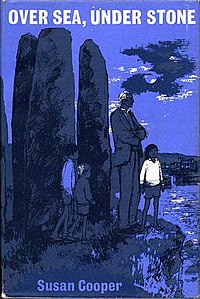
Over Sea, Under Stone

The title: Over Sea, Under Stone
The author: Susan Cooper
Publication: Aladdin paperback, 1965
Got it from: Amazon, c.1998

There are times in your life when you need to read a Harlequin Blaze. And then there are other times when you need to read an amazing, stupendous and completely wonderful childhood series. Oh Dark is Rising series, how I love thee in so many ways. I'm kind of sad that I read The Dark is Rising last Christmas, only because it means I probably shouldn't read it so soon and it's my favourite. But I did get to go back and re-read the first book in the series, which takes place in Cornwall and involves three children who find a treasure map and follow the clues to a very special treasure. It sounds simple, but it's not, because there's so many layers and so much going on here that eventually comes out in the rest of the series. I love that it was written in 1965 and is so much in its era in some ways and so timeless in others. It's summer holidays spent by the sea without TV or computers or cell phones, when kids could just run around by themselves and have fun.

Why are the best books written for kids? There's so much adventure, so much suspense, so much charm that the 243 pages of my edition can hardly contain it. I will never, ever get tired of these books. Reading them is like giving myself a secret present that gives me delight every day.

Tuesday, December 22, 2009

The Dark Is Rising


The title: The Dark Is RisingThe author: Susan Cooper
Publication: Atheneum, 1973Got it from: ??, 1998

I have recently been re-reading The Dark Is Rising, one of my favourite books from years ago, to put myself in a Christmas-y mood. I had forgotten how good this book is, and how crappy the movie "loosely" based on the book was. This book is actually the second in the series, but can be read as a stand-alone. It's Midwinter's Eve and 11-year-old Will Stanton's birthday. Strange things begin happening to him and he discovers he's the last of the Old Ones, ancient people who protect the world against the Dark.

It sounds like an ordinary fantasy, but it's not. It's chock full of British mythology, set in contemporary (or at least 1970's) rural England at Christmas, and it's fantastic. What I love about this book is the juxtaposition of the everyday and the supernatural. Will is an ordinary boy with an ordinary family, but he's also someone with great power and ancient knowledge. A snowstorm is no longer just a snowstorm, it's the work of dark forces.
Neighbours Will has known for years are not what they seem. It's a wonderful bridge to fantasy for people like me who don't necessarily want to read about completely different worlds and creatures. Will's world is entirely recognizable, but the forces at work within it are not. It's also classic Arthurian legend, bildungsroman and quest fable rolled into one.

I am looking forward to re-reading the other four books in the series in 2010.

Wednesday, April 22, 2009

It's just like Degrassi!; or Princess on the Brink

The title: Princess on the Brink
The author: Meg Cabot
Publication:HarperCollins, 2007
Got it from: The Book Depot

I don't want to upset anyone, but things in this book get serrrrious.

Why else would there be (gasp!) no lists?

Michael tells Mia he is moving to Japan, to work on a robotic arm that will help doctors perform closed-heart surgery. Mia is, of course, devastated. So she decides that in order to convince him to stay, she will give up her Precious Gift, aka her virginity, to him.

Sound the alarms! A teenager is thinking about having sex with her boyfriend! Yes, that's why people tried to ban this book.

I don't wanna tell you how it ends, but it's NOT GOOD. Michael, as I have said all along, is still a jerk. I'm beginning to think J.P. is too, but I still like him better than Michael.

Here's hoping things get better in the next one. But I know they won't, because I've already started reading it.

Sunday, April 5, 2009

Party Princess, Sweet Sixteen Princess


The title(s): Party Princess, Sweet Sixteen Princess
The author: Meg Cabot
Publication: Harper Collins, 2006
Got it from: Book Depot

Party Princess, aka Volume 7 is my favourite book so far in the series. Mostly because of J.P. but also because it's the most fun.

In this book, Grandmere is gloriously basking in being the manipulative monster she loves to be. She wants to buy the faux island of Genovia in Dubai but has to outbid John-Paul Reynolds Abernathy III for it. Meanwhile, Mia discovers her student government has spent all their money on recycling bins and can't afford the place they need for the senior's commencement ceremony.

So Grandmere steps in with a play she's written: Braid! The Musical. Of course it's all a ploy to give John Paul Reynolds Abernathy III's son the lead role. And the son turns out to be the Guy-Who-Hates-It-When-They-Put-Corn-in-the-Chili. Mia is mortified because she's written a story about him called "No More Corn!" in which he commits suicide at the end. She also discovers that besides being kind of cute, J.P. is actually really nice to her. Wink wink nudge nudge.

Meg Cabot is really in her glory here and Mia's chaotic existence is never funnier. Braid! The Musical is (loosely) based upon the life of Rosagunde, Mia's royal ancestress who strangled her enemy with her braid the night he forced her to marry him. Rosagunde is my heroine. J.P. plays Gustav, Rosagunde's peasant lover and a fictional creation of Grandmere.

Can we just get rid of Michael now and have J.P. instead? Please?

Sweet Sixteen Princess, which took me about 35 minutes to read, takes place on Mia's sixteenth birthday. Grandmere has some big idea of taking all of Mia's friends to Genovia and airing her party on MTV. Mia, of course, freaks. This mini-novel is interesting because it actually furthers the plot rather than being purely stand-alone. Lily is now dating J.P., whom she's crazy about, but it's clear that J.P. prefers a certain princess. Oh, what a tangled web. On to Book Eight, the book that right-wing zealots tried to get banned. Stay tuned to find out why...