Showing posts with label Biography. Show all posts

Saturday, April 30, 2016

A Girl from Yamhill and My Own Two Feet


The titles: A Girl From Yamhill and My Own Two Feet
The author: Beverly Cleary
Publication: Yamhill: Dell, 1988; Feet: Morrow Junior Books, 1995
Got it from: Yamhill: The Barrow Bookstore, Concord, Massachusetts, 2013; Feet: Interlibrary loan

In honour of Beverly Cleary's 100th birthday this month, I thought it was finally time to crack open my copy of  A Girl from Yamhill, Cleary's autobiography, and its follow-up, My Own Two Feet.  (And I do mean crack open - my copy basically disintegrated while I was reading and pages started to fall out.  Oh well.)  I love autobiographies from the early 20th century, and this one was special to me for two reasons.  One is that she is a beloved author from my childhood, two is that she is a librarian and I was really interested in what library school and being a librarian was like in the 30s and 40s.  

Yamhill starts with Cleary's earliest memories of living on her family's Yamhill farm.  She remembers the bells ringing to mark the end of the First World War, at the tender age of two.  Life is difficult on the farm, and Beverly is constantly reminded (and irritated) by stories of her hardy pioneer ancestors.  Her family's story is really a mirror of the larger American story: the move from agricultural life to urban living.  When the farm becomes too much for too little money, the family moves to Portland, which would later serve as the setting of Cleary's books.  Many of the scenes from school and around her neighbourhood will be familiar to fans of Cleary's work.  Her childhood in the 1920s will seem both familiar and strange to children of today.  Material possessions were fewer, but fun and imagination remained the same.

(As a warning, it's not all innocent fun.  In one awful section, she describes being sexually harassed by a creepy uncle and being unable to tell anyone for a long time.)  

And then the Depression.  Unfortunately for Cleary, it struck just as she entered adolescence, already a difficult time for anyone. Her father lost his job, and her mother became a bitter, controlling, manipulative presence in Beverly's young life.  Those high school scenes of deprivation, hunger and unhappiness at home were particularly difficult to read.  On top of it all, Beverly was dogged by a wet blanket of a "boyfriend," a young man her mother encouraged she she couldn't shake for years, despite not being able to stand.  Yamhill ends with Beverly finally being able to escape by going to college in California.  

My Own Two Feet picks right up where Yamhill ends, with Beverly on the bus to her new life in California.  It's the middle of the Depression, but California is better off economically, and Beverly is finally out from under her mother's thumb.  In many ways this volume is easier to read than the first, consisting of a whirlwind of friends, dates and studies.  She describes living in San Francisco while the Golden Gate and Bay bridges were being built, being courted by Clarence Cleary and how her English teachers gave her writing advice that stayed with her and later helped guide her stories.  

Her library school experience was interesting to read about, especially as I couldn't help comparing it to my own almost 70 years later.  Some of it was familiar, some not so much - a teacher actually gave her a C even though she'd earned A's, because she didn't like the look on Beverly's face!  It's clear she loved her time working in children's departments, where the requests for books about "kids like us" would eventually lead her to write Henry Huggins.  Through the war, she served as a librarian on an army base and later a military hospital, where she had a front-row seat of the action taking place on the Pacific front.  In 1949, she finally settled down to write and the story ends with the successful publication of Henry Huggins.

Because it's a biography, the narrative doesn't flow quite like it would in fiction, and her breaking out from under her mother's thumb is a long, drawn-out process with a lot of frustrating setbacks.  Still, these books are fascinating glimpses into a fascinating few decades of American history, from the perspective of an (extra)ordinary woman's life. 

Monday, March 7, 2016

Notorious RBG


The title: Notorious RBG: The Life and Times of Ruth Bader Ginsburg
The authors: Irin Carmon and Shana Knizhik
Publication: Dey Street Books, 2015
Got it from: The library

I had this book checked out and waiting for me on my coffee table when Antonin Scalia died - perfect timing, I thought, to read the biography of his ideological opposite.  Ruth Bader Ginsburg has become extremely popular in recent years for her spot-on dissents and no-nonsense takedowns of conservative views.  Although she's only recently become a rock star, RBG has been fighting the social justice fight for decades.  As this slight but entertaining biography chronicles, she pushed herself through law school at a time when there were almost no women lawyers, all while raising a family and helping her husband through law school himself. 

Although at the time she was not as famous as fellow feminists like Gloria Steinem and Betty Friedan*, RBG chose to fight for women's rights in the courts during the second-wave feminism era.  She brought several discriminatory cases to the Supreme Court and refused to be intimidated by the all-male justices.  Appointed to the SC by Bill Clinton in the 1990s, she has helped judged some of the most important cases in U.S. history, and famously dissented on decisions like Bush v. Gore, Lilly Ledbetter and Hobby Lobby.  Despite some seriously scathing (and awesome) dissents, the book continually points out that she has never come in with guns blazing.  Instead, Ginsburg has worked to chip away at discrimination one law at a time, in cases she knows have a chance of winning. 

Her approach may dismay the young social justice warriors (among who I consider myself, partially) but her dismantle-from-the-inside technique is remarkably effective, if exhausting.  I have a ton of admiration for women like her, who've been putting up with BS for years but still manage to maintain their sass and class well into old age.  Oh, and did I mention she had a swoon-worthy romance with her husband for over fifty years, and that her daily workouts put my own to shame?  RBG is an inspiration to women everyone everywhere. 

*Review of The Feminine Mystique coming soon

Monday, July 21, 2014

Louisa May Alcott: An Intimate Anthology

The title: Louisa May Alcott: An Intimate Anthology
The author:
Publication: New York Public Library Collection, 1997
Got it from: Annapolis Valley, 2013

I bought this book in anticipation of a trip I would be making last year and began it while I was visiting Concord, which you can read about here.  Louisa May Alcott is an author I admire almost as much as Lucy Maud Montgomery, and that's really saying something.  This collection is an excellent find for someone who, like me, knows Little Women back to front but wants to find out more about the author behind it.  There's a little bit of everything here: biographical sketches by those who knew her and selections of her diaries, poetry, letters and short stories.  The more I read, the more I was impressed by how ahead of her time Alcott was (as is the case in all the historical women I admire).  She understood the need for women to exercise, to learn and to be independent.  She had a sensitive and humorous understanding of society (G.K. Chesterton compares her to Austen) and advocated for women's rights and abolition long before it was fashionable to do so.  It is very difficult for me to separate the March family from the Alcott, and in fact when I visited Orchard House I had the disorienting experience of seeing both at the same time.

There are three very personal autobiographical sketches in this anthology.  In "Transcendental Wild Oats," Alcott paints a very vivid picture of her family's somewhat horrifying experiment with living in a commune at Fruitlands.  A hundred years before hippies made it popular, Bronson Alcott was advocating for peace, vegetarianism and brotherly love.  Unfortunately his lofty ideals couldn't support his family for long.  Particularly interesting to the history buff in me are the letters that comprise "Hospital Sketches," detailing Louisa's ill-fated experience as a nurse during the Civil War when she was thirty.  How exciting to read about the war firsthand from a woman my own age!  Unfortunately the experience doesn't last long, as Louisa developed typhoid fever and never fully recovered.  Perhaps the most amusing story is "How I Went Out to Service," chronicling a time during Louisa's youth that she went to work as a companion and ended up being taken advantage of by the family.  She ends up leaving in disgust but the family's vulgarity provides much fodder for amusement.

In addition to the lively glimpses of her life are some of Alcott's delightful stories.  "Debby's Debut" is a classic love-triangle story, with the "right man" obvious from the beginning.  "Pauline's Passion and Punishment," an early story of Alcott's, is a drawn-out melodrama that could easily have been one of the thrillers Jo March pens to amuse her sisters.  "Perilous Play" is actually about the dangerous effects of (shocker!) drugs.  Didn't I tell you she was ahead of her time?

Thursday, January 31, 2008

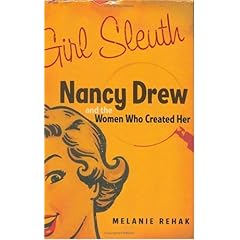
5. Girl Sleuth: Nancy Drew and the Women Who Created Her


The title: Girl Sleuth: Nancy Drew and the Women Who Created Her
The author: Melanie Rehak
Publication: Harcourt, 2005
Got it from: La Library

It was a cold September morning, 1992. I was ten years old. My dad had picked up my grandmother from the airport where she had just returned from an overseas visit to my uncle. Everyone else was asleep and I stumbled bleary-eyed into the kitchen to discover two presents waiting for me, fresh from Japan: books one and two of the Nancy Drew series. Thus began my foray into the world that enthralled generations of girls (my grandmother included). I never read the whole series, as did some of my friends, who owned all 50+ of the originals and reread them half a dozen times. Truthfully, I never found Nancy Drew sexy enough to keep up my interest - I mean, Judy Blume talked about periods. But I have a certain fondness for the titian-haired detective and certainly more so now that I've read this book.

Girl Sleuth is more about the two women who essentially created the Nancy we know and love than Nancy herself. It's also about the 20th century history that surrounds Nancy, including the women's rights movements of the early century and later the 1960's, which I find fascinating. (I did my undergraduate thesis on a comparison of the suffrage movements in Canada, the US and Britain so this was right up my alley). Not everyone may be interested in early twentieth century women's history, though, so I could see how this book might bog people down in parts. What I found most interesting was how Nancy - independent and uninterested in domesticity and marriage - was adopted by feminists as their icon.

Which of the two women (Harriet Stratemeyer Adams and Mildred Wirt Benson) was the "real" Carolyn Keene? As the book clearly notes, it's complicated. Both could lay equal claim. Harriet's father, a pioneer in children's publishing, actually first came up with the idea for Nancy, the Hardy Boys and Bobbsey Twins in the early 20th century. He hired Mildred, a talented young writer of about 25 to pen the first few Nancy Drews based on a few brief outlines. He died soon after, leaving his company in the hands of his young daughter Harriet, who took on the job of CEO at a time when women simply didn't work outside the home. I do love me a good story about women who triumph in business. (Go read Butterfly by Kathryn Harvey. Seriously. Now). To make a long story short, Mildred wrote the first few dozen books in the series under Harriet's strict and watchful eye, until Harriet decided to take complete control of the series and write them herself. Harriet died in 1982 at the age of 90. Mildred only died in 2002, when she was still working as a journalist at the incredible age of 96.

I could go on a lot more, but to sum up: history of early 20th century children's publishing industry + 2 incredibly take-charge women + women's suffrage movement + one feminist girl detective who don't take crap from no one = one awesome read. A-