A fascinating article from the New York Times' Caitlyn Flanagan on teen girls and romance:
One of the manifold ways our culture fails girls is in its refusal to honor or even acknowledge their deep interest in romance. A girl’s world is drenched in romance, and the process by which she negotiates that deep emotional need with the countervailing force of sexuality — with all its power, pleasure and danger — is the great work of female adolescence. But our present moment is terrible for anyone who is thoughtful or private or introspective, and thus terrible for girls. The impossible music, the normalization of hard-core pornography, the explicitly sexual nature of even supposedly “family friendly” entertainment — everything about modern life mocks the romantic impulse.
One of the last places where girls can encounter the romantic stories they crave is in novels, an art form perfect for anyone who wants to spend time alone with her dreams and her imaginings.
[Emphasis added by me]
Sunday, September 4, 2011

Sunday, August 28, 2011
102 Minutes

The title: 102 Minutes: The Untold Story of the Fight to Survive Inside the Twin Towers
The authors: Jim Dwyer and Kevin Flynn
Publication: Times Books, 2005
Got it from: The library
Everybody has their story.
Mine goes like this. I was 19 years old. It was the first week of classes, my second year of university. Ten a.m. As the course outline was passed around, a boy I'd known since high school slid into the seat beside me. "Hey," he said. "Did you hear that somebody flew a plane into the World Trade Center?"
This was confusing to me. I had only a vague idea of what the World Trade Center was, and no idea that it was actually two buildings. "Do you think there were people inside?"
"Oh yeah, thousands."
It wasn't until I arrived home after lunch that the magnitude of the situation hit me. My first instinct was to think, okay, it was before 9 am, probably nobody was inside the building. But as the news footage showed the events of that morning, it dawned on me. Hundreds of people were actually killed. Maybe thousands. I was unable to turn off the TV until after supper, trying to make sense of what was going on. It felt like the bottom had fallen off the world.
That fall, I would remember the sense of fear following everything and eveybody. I couldn't watch or think about that day in the weeks and months that followed. It felt too raw, too immediate. That day was seared into everybody's consciousness, but nobody wanted to talk about it.
Six and a half years later. It was a quiet Sunday morning, not unlike the Sunday that will mark the 10th anniversary two weeks from today. My husband and I were in lower Manhattan and ended up on Liberty Street. We were looking at the open space where just a few years before, the world had changed forever. I can't describe that moment. There were only a handful of us, plus a security guard watching the site, and we were completely silent. On the ground, a homeless man played "Amazing Grace" on his flute. Next to me, a woman who couldn't speak English pointed to a picture she had of the twin towers. She pointed to one, and then pointed to the spot just in front of us. The south tower. She put her finger on the picture of the other tower, and pointed slightly northwest. The north tower.
We were standing at the graveyard of a scene of mass murder. It was horrible. I had been to the Colosseum before, but the people there had died thousands of years ago, and not all at once. I felt sick to my stomach, and we had to leave and walk down Wall Street and across the Brooklyn Bridge, but I still felt shaken until much later in the day. But I was also full of questions. I was finally ready to discover what happened that day.
Since then I have read countless books and seen many documentaries about what took place that day. I feel driven by a strange impulse to know every detail of what happened. Jim Dwyer and Kevin Flynn's 102 Minutes: The Untold Story of the Fight to Survive Inside the Twin Towers is exactly the kind of book that tells the full story. We all know what we saw as we were watching outside, but for those inside, most of whom were unaware of what was really going on, it was a wholly different experience. The stories of those who survived, and most especially, those who didn't, deserve to be told.
Life and death that day was a matter of chance. Some people, like Brian Clark in the south tower, survived despite all odds, making it from above the impact zones while managing to rescue another man who was trapped. In the 79th floor sky lobby, directly where the plane struck, some survived while others were killed instantly. In the north tower, everybody above the 92nd floor was doomed by impassable stairwells, their horrific last few minutes unimaginable. But there were also stories of hope. Frank Di Martini and Pablo Oritz, the subjects of an upcoming TLC documentary, despite being neither police officers nor firefighters, managed to rescue over seventy people who would have otherwise been trapped in the upper floors. Another group of people trapped in an elevator shaft were able to break the drywall outside the doors and emerge into a bathroom where they descended to safety.
The real protagonists, though, are the towers themselves. Like the Titanic, any number of safety precautions could have been put in place during their construction that would have saved countless more lives on September 11. If, for instance, they had followed the building code used in the construction of the Empire State Building and had more fire-resistant stairwells placed further apart on each floor, it is likely that those on the upper floors would have had an escape route. If the elevators had not had safety locks that prevented the doors from opening when the cars were between floors, hundreds of people trapped in elevators across the towers would not have needlessly perished. And there is also the failure of the emergency crews - that for all their bravery and self-sacrifice, they had serious communication problems that compromised their ability to talk to their commanders, their fellow teams and the other emergency departments. Had it not been for their communication breakdowns, many in the police and firefighting departments would have evacuated in time to save their own lives.
So many myths and conspiracy theories have arisen over that day, and it's so important that books like this exist to get the facts straight now, while the events are still within living memory. I have a feeling that historians will mark September 11 as a turning point in world history, and certainly as a defining moment that forever changed the course of the 21st century. In all the chaos and monumental sadness that permeates those events, it's more important than ever to study it at the individual level, to see how it affected each person who was in those towers that day. But for the hand of fate, it could have been us. Their stories are our own.
 Photo taken by me of the World Trade Center, April 2008. The South Tower would have stood directly in front of us. The North Tower was in the northwest behind it.
Monday, August 1, 2011
Things I haven't been reviewing, 2011 edition
I just realized it's been exactly one year since I did my summer roundup of interesting things I'd recently read/seen. So I thought, why not make it an annual event? Thus, here is my list of things I have enjoyed in the past few months, in no particular order:
 The Guernsey Literary and Potato Peel Pie Society by Mary Ann Shaffer - I had to read this one for book club, and it's one of the few book club books that I've really enjoyed. (I'm working on overcoming the trauma of Still Alice and trying not to freak out when I can't remember something). I can totally see this book as a movie. I love the character of Juliet, and stories written in letters. I wish I belonged to the Guernsey Literary and Potato Peel Pie Society!
 The Adams Chronicles (PBS, 1976) - I haven't seen the new John Adams movie, and I didn't know anything about John Adams, but it was on sale for $10 at a store last Christmas so I picked it up. I'm not done yet, but I love this series! Such a bargain for ten bucks! Abigail Adams is my hero. I'm so mad I never learned about her before this. She was a feminist AND she was opposed to slavery AND she has her own mystery series! Which makes her 200% awesome. I love her and John as a couple, and how they were so smart and affectionate and loyal to each other. Plus, I really just enjoy the late 18th century as a time period. As much as I love the 19th century, there's something about the 1700's that I think is also great, especially in North American history. I'm not as big a fan of the ostentatious Marie Antoinette-style dresses, but I love the simple ones worn by women of the period - here's an example I found online.

Also, tricorn hats = win!

Snow Flower and the Secret Fan by Lisa See - A really interesting look into 19th century Chinese women's lives. I had no idea footbinding was so brutal. After reading this book, you'll realize how little women were valued in that society and how restricted they were. Although I enjoyed this, I found the ending to be a real downer because everybody dies.

Victorian London by Liza Picard - My love of Victorian London never ceases. I'm fascinated by all the little details, reading this book with a giant map of London by my side so I can locate the places the author talks about. Victorian London is like a vacation spot to me, a place I never get to go to but know so well just from the descriptions. I'd visit in a second if I had the chance, but the smog and cholera would probably kill me after three days.
 Manor House (PBS, 2001) - Yes, I'm ten years behind on this one, but I'm enjoying it as much as 1900 House last year. I was glued to YouTube for the few days I watched this show (what would I do without YouTube movies?) This one is set in the Edwardian period and shows just how miserable the lives of servants were. The people playing the rich people, though, loved being waited on hand and foot and didn't want to leave at the end of the three months. Hmm, I wonder why?

The Once and Future Giants by Sharon Levy - I don't talk a lot about my love of science and all my science reading on this blog, but as this is an "anything goes" list and I loved this book, I thought I'd throw it in here. It's an account of what our world looked like at the end of the last Ice Age and how our ecosystems have gone haywire without the megafauna that are supposed to be roaming our landscapes. Some people have even proposed inserting African elephants and other large animals back in North America as replacements for their extinct cousins. All I know is, I want to be the first to sign up to have a wooly mammoth as a pet. They're like elephants, only fuzzier!

Extreme Makeover: Weight Loss Edition. My guilty pleasure reality TV this summer. There's just something about weight loss shows that draws me in. It's three parts inspiration, one part horror at seeing how other people eat. This show is great, because it doesn't just chronicle people losing ten pounds (big deal), but actually hundreds of pounds in one year. Every time I watch this show, I want to immediately go to the gym afterward.
That's it for another year - unless I go wild 'n' crazy and do another one at Christmas or something. In the meantime, lots more good book reviews ahead, as always!
 The Guernsey Literary and Potato Peel Pie Society by Mary Ann Shaffer - I had to read this one for book club, and it's one of the few book club books that I've really enjoyed. (I'm working on overcoming the trauma of Still Alice and trying not to freak out when I can't remember something). I can totally see this book as a movie. I love the character of Juliet, and stories written in letters. I wish I belonged to the Guernsey Literary and Potato Peel Pie Society!
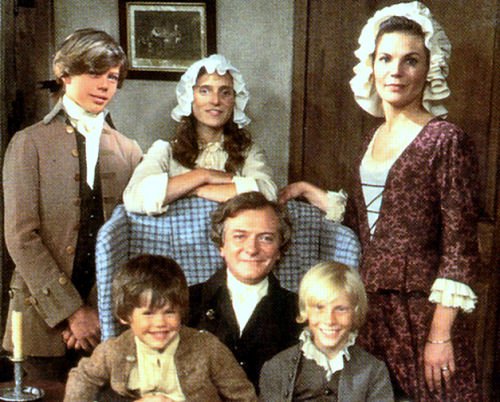 The Adams Chronicles (PBS, 1976) - I haven't seen the new John Adams movie, and I didn't know anything about John Adams, but it was on sale for $10 at a store last Christmas so I picked it up. I'm not done yet, but I love this series! Such a bargain for ten bucks! Abigail Adams is my hero. I'm so mad I never learned about her before this. She was a feminist AND she was opposed to slavery AND she has her own mystery series! Which makes her 200% awesome. I love her and John as a couple, and how they were so smart and affectionate and loyal to each other. Plus, I really just enjoy the late 18th century as a time period. As much as I love the 19th century, there's something about the 1700's that I think is also great, especially in North American history. I'm not as big a fan of the ostentatious Marie Antoinette-style dresses, but I love the simple ones worn by women of the period - here's an example I found online.

Also, tricorn hats = win!

Snow Flower and the Secret Fan by Lisa See - A really interesting look into 19th century Chinese women's lives. I had no idea footbinding was so brutal. After reading this book, you'll realize how little women were valued in that society and how restricted they were. Although I enjoyed this, I found the ending to be a real downer because everybody dies.

Victorian London by Liza Picard - My love of Victorian London never ceases. I'm fascinated by all the little details, reading this book with a giant map of London by my side so I can locate the places the author talks about. Victorian London is like a vacation spot to me, a place I never get to go to but know so well just from the descriptions. I'd visit in a second if I had the chance, but the smog and cholera would probably kill me after three days.
 Manor House (PBS, 2001) - Yes, I'm ten years behind on this one, but I'm enjoying it as much as 1900 House last year. I was glued to YouTube for the few days I watched this show (what would I do without YouTube movies?) This one is set in the Edwardian period and shows just how miserable the lives of servants were. The people playing the rich people, though, loved being waited on hand and foot and didn't want to leave at the end of the three months. Hmm, I wonder why?

The Once and Future Giants by Sharon Levy - I don't talk a lot about my love of science and all my science reading on this blog, but as this is an "anything goes" list and I loved this book, I thought I'd throw it in here. It's an account of what our world looked like at the end of the last Ice Age and how our ecosystems have gone haywire without the megafauna that are supposed to be roaming our landscapes. Some people have even proposed inserting African elephants and other large animals back in North America as replacements for their extinct cousins. All I know is, I want to be the first to sign up to have a wooly mammoth as a pet. They're like elephants, only fuzzier!

Extreme Makeover: Weight Loss Edition. My guilty pleasure reality TV this summer. There's just something about weight loss shows that draws me in. It's three parts inspiration, one part horror at seeing how other people eat. This show is great, because it doesn't just chronicle people losing ten pounds (big deal), but actually hundreds of pounds in one year. Every time I watch this show, I want to immediately go to the gym afterward.
That's it for another year - unless I go wild 'n' crazy and do another one at Christmas or something. In the meantime, lots more good book reviews ahead, as always!
Monday, July 18, 2011
Black Sheep
 The title: Black Sheep
The author: Georgette Heyer
Publication: Sourcebooks, 2008 (originally 1966)
Got it from: JL, August 2009
Abigail Wendover is the youngest sister of a formidable clan, "on-the-shelf" and headed to spinsterhood at the ripe old age of 28. She and her much older sister Selina are in charge of raising their headstrong niece Fanny. Abigail has just returned to Bath from a visit to London and discovers that Fanny has taken up with ne'er-do-well rogue Stacy Calverleigh (who is after her fortune), although Fanny is in the throes of love and can't see Stacy's faults. Chance happens to bring Stacy's uncle Miles Calverleigh to Bath, after having been exiled to India for 20 years. Miles's blunt manner should shock Abby, but instead she finds herself laughing at his disregard for society and family duty. At first he is unwilling to have anything to do with his wayward nephew and refuses to intervene for Abby's sake, but his regard for her soon has him rethinking his stance.
This is a delightful book, my favourite so far of all the Heyer books I've read. (Yes, I liked it better even than The Grand Sophy, whose heroine is a little bit too unconventional for my taste). Heyer is a genius at creating three-dimensional characters, so that even the hysterical older sister is shown to be sympathetic when she sides with Abby against their tyrannical older brother. Abby is one of the most delightful heroines I've ever encountered, right up there with Elizabeth Bennet. She is fashionable and pretty but not overly gorgeous, she has a wicked sense of humour and she doesn't take herself seriously. The real conflict of the novel here is internal, with Abby warring against a sense of duty to her family and desire to do something for herself and marry the man she loves. This is one of the few novels where I think I actually liked the heroine better than the hero.
Although several reviews I read complain about the ending, I thought it was perfect, and a perfect way for Miles to force Abby to overcome her scruples. As always, the dialogue is excellent, making me grin throughout my reading of the novel. I love how the repartee represented the way both the hero and heroine have had to develop their personalities, given that neither are the best-looking people in town. I found myself eagerly looking forward to when I would be able to fit in a few more chapters, a sure sign of an excellent book. A real summer treat.
Monday, July 4, 2011
Countess of Scandal
 The title: Countess of Scandal
The author: Laurel McKee
Publication: Hachette, 2010
Got it from: Chapters, 2011
This is the first in the "Daughters of Erin" trilogy by Laurel McKee, aka Amanda McCabe. Eliza Blacknall and William Denton grew up together in Ireland, best friends who found themselves falling in love. They are both from English families, although Eliza embraces her Irish home more fervently, loving the Irish people in her community and enjoying their legends and folklore. They are torn apart by Eliza's having to marry a count and Will's joining the British army.
Seven years later, and Eliza is a widowed countess living in Dublin, involved in the Irish movement that eventually culminates in the 1798 uprising. Will returns as a commanding officer, and they find themselves once again falling for each other despite being on opposite sides of the Irish rebellion.
I love the time period just before the Regency, and it is refreshing to read a story set in Ireland rather than England. The whole story had an Irish Scarlet Pimpernel feel, and there's even a daring escape with disguises as the aristocracy flee the countryside for the safety of Dublin. I really liked the historical aspects of this book - it's very much a political book, which may weigh it down for those not enthused about history. The romance I felt was a bit on the warm, rather than hot, side. I usually enjoy the "childhood friends become lovers" trope, but I felt like it was such a foregone conclusion that they loved each other deeply. I usually prefer a bit more tension before they hop into bed and declare their love. Overall, I found this to be a pleasant (rather than page-turning) read.
Sunday, June 26, 2011
Proof by Seduction
 The title: Proof by Seduction
The author: Courtney Milan
Publication: Harlequin, 2010
Got it from: A library
Courtney Milan has been getting a lot of buzz since this book debuted last year, so when I read the premise I just had to try it out. It's 1836, and Jenny Keeble, aka Madame Esmerelda, pretends to predict the future for the rich and titled of London. It's the only way she knows how to make an honest living, with no prospects for a respectable job. One day a young man named Ned comes to her. He's suicidal, depressed, and in desperate need of guidance. Jenny convinces him that it's written in the stars he will thrive and grow into a man.
Flash-forward two years later, and Ned is completely under the spell of Madame Esmerela, believing everything she says without question. This enrages his uncle, Gareth, the Marquess of Blakely, who is a scientist and demands evidence for everything. One night he goes along with Ned to confront the so-called gypsy Esmerelda. Jenny is desperate to retain Ned's trust and bring the haughty Lord Blakely down a peg or two. So she makes a bet with him that she really can predict the future, and he must complete three tasks to win his future wife.
The first two-thirds of this novel were a delight. The time period comfortably straddles the conventions of the Regency and Victorian worlds, giving it a timeless 19th-century feeling. Gareth is an archetypal Mr. Darcy, putting on a cold demeanor while struggling with an overwhelming physical attraction to Jenny. Jenny is no typical historical debutante - she's in her 30's - and she matches Gareth intellectually to produce some fun (and funny) verbal sparring. But this is also an extremely emotional book. Gareth fights the whole way through to break free of his fear of being ridiculed and it takes him a long time to come around to seeing the value in human companionship. Jenny also must face her own demons, and see the consequences of her lies.
The book only loses points because the last third of the book meandered too much, being relentlessly uncheerful and going around in circles of sadness without anything really developing. I felt like both Gareth and Jenny could have come to their senses much sooner. Still, I loved the first part of the book and couldn't put it down. It's now on my list of all-time favourite romances.
Monday, June 20, 2011
O Come Ye Back to Ireland
 The title: O Come Ye Back to Ireland: Our First Year in County Clare
The author: Niall Williams and Christine Breen
Publication: Soho Press, 1987
Got it from: London, Ontario used book store 2004
I've only just returned from Ireland, and I re-read this book in anticipation of our trip. It's funny re-reading a book you first read at 16, and it's certainly different looking back now after the trip. It's the story of a Manhattan couple who, in the 1980's, decided to give up urban life and live on a rural farm on the west coast of Ireland. It is far from the idyllic paradise it sounds. The weather is awful, the farm difficult and material comforts are few and far between. The authors documented a world that is ancient but rapidly fading away, something that is still very much in evidence in Ireland today. Although they describe the kindness of neighbours and the beauty of the land, it's not a life I think I could live. It's basically a chronicle of the hardships that nature keeps throwing at them, relentlessly. They really have to eke out a living on the land, no extra money to fall back on for them. Yet I felt it rang true for what Ireland is really like - many of the scenes and people they describe are familiar. It's an interesting book, one of the best "travel" stories I've read and a true portrait of Ireland.
Subscribe to:
Comments (Atom)