Showing posts with label Fantasy. Show all posts

Sunday, February 21, 2016

Jonathan Strange & Mr. Norrell

The title: Jonathan Strange & Mr. Norrell
The author: Susanna Clarke
Publication: Bloomsbury, 2004
Got it from: NB, 2007

I had originally read JS&MN almost ten years ago, back in 2007.  But last year the TV mini-series came out, my husband wanted to read it, and I thought it was time to dust off my paperback and re-read.

My impressions are going to be mostly about my experience reading it for a second time, and inevitably it will be compared to the first time.  In order to understand why I loved this book back then, you have to also understand that I was deep into my Regency-loving phase, as well as my magic realism phase.  I also read it swiftly and deeply.  This time the demands of work and other responsibilities meant I read this in a five-month stretch, divided in chunks.

Unfortunately the book didn't hold up as well the second time around.  Maybe I was just feeling impatient, but the whole thing just felt too darn long.  The first time I think I was projecting emotions on the characters that weren't there.  With a few minor exceptions, I didn't connect emotionally with any of the characters.  At all.   Having read the Mrs. Quent series in the last five years, which was probably 2/3 longer than JS&MN's hefty 1000 pages (although divided over three volumes), I feel the former series did it so much better.  Fantasy world building and 19th century manners are fine, but if I can't relate to the characters, forget it.  The Mrs. Quent series had me turning the pages because I cared about the people and felt involved in their lives.  Clarke's writing feels remote and standoffish in comparison.  It's a deliberate choice on the author's part to make it feel more like writing from the era, but it doesn't sit well with my modern sensibilities.  Mrs. Quent had a formal Victorian feel, but the characters felt modern enough to make me feel I was experiencing everything with them.

The other thing that the Mrs. Quent books had was an actual female heroine.  JS&MN didn't, and it bothered me so much more this time around.  It shouldn't be surprising - I mean, the book has two dudes in the title, but I wish the women had been more than just passive, helpless victims.  I know The Ladies of Grace Adieu helps make up for this, but it's a separate book and by the end of JS&MN I was totally sick of reading about dude magicians, dude ministers, dude dandies, dude servants, dude soldiers and dude fairies. 

There's no doubt that Clarke did an enormous amount of research in terms of historical detail - events, people and places are all accurate, with the addition of magic.  The book is actually at its best when it diverts from the main plot for witty, amusing footnotes of magical history grounded in England's real past.  (And an anecdote about Napoleon being outwitted by a charlatan and his honking goose is comedy gold.)  But something about it just felt off, like a stuffy piece of furniture that no longer appeals to me.  I realize the book hasn't changed.  I have.  Maybe in another ten years it will be the right time in my life to appreciate it again.  Or maybe it belongs in my past forever.

Monday, December 15, 2014

The Master of Heathcrest Hall

The title: The Master of Heathcrest Hall
The authors: Galen Beckett
Publication: Spectra, 2012
Got it from: Amazon 2012

I finally got around to reading the 700+ page conclusion to the Magicians and Mrs. Quent trilogy.  I like to read books by the season.  The first one I read in the dead of winter, the second in the middle of summer, and I planned to save the third for the long fall evenings.  I started it in October, a perfect time for reading about eerie primeval sentient forests.  But then work compilations, back-to-back illness and a busy holiday season threw my reading schedule way off track.  This book proved the perfect antidote to all the stresses in my life.

The story opens with an extended flashback to a Neolithic Britain and the origins of many of the series' central elements: the arrival of the planet Cerephus and the Ashen, the first magicians, the true nature of the Wyrdwood and the first women who spoke to the trees.  Naturally, the significance of the events don't become clear until the end, but it still made for gripping Stone Age action.  

Thus far in the series, I've been of the opinion that the story and characters are great but nothing actually happens.  Well, The Master of Heathcrest Hall totally did a 180 on the action front.  Tons of things went down in a dramatic fashion, and in some parts I couldn't turn the pages fast enough.  There were mornings when I had to (reluctantly) wrench the book away so I could finish getting ready for work.  

It's difficult for me to say what actually happens without potentially spoiling the plot.  Suffice to say that some of my predictions came true and some didn't.  There were a lot of plot threads going on that had to be wrapped up, and most of them satisfactorily did.  Much to my pleasure, the one I deemed most important to the overall series was saved for the very last few pages.  Yes, that's right.  I spent the book swooning over Mr. Rafferdy.  He had big-time character growth over the series but in The Master of Heathcrest Hall he pulls a Mr. Darcy and becomes wiser and more selfless, while still being awesomely snarky.  Jane Austen fans will note that the primary romance bears a striking resemblance to Pride and Prejudice, albeit with feminism and gay rights and evil ancient aliens.  Really, what more could you ask for?  This is a trilogy well worth the huge time investment - a pleasure from start to finish.

Saturday, April 12, 2014

The Serial Garden

The title: The Serial Garden: The Complete Armitage Family Stories
The author: Joan Aiken
Publication: Big Mouth House*, 2008
Got it from: MC

Before there was Harry Potter, there was his smarter predecessor, Joan Aiken's delightful Armitage family.  Back when Mr. and Mrs. Armitage were first married, Mrs. Armitage made a wish on a wishing-stone that their lives would never be boring.  Years later, young Harriet and Mark Armitage experience a life full of strange occurrences (usually on a Monday), which they take in stride with good humour.  A unicorn that shows up in the garden?  A governess ghost who is still trying to teach?  A doll sized family in the attic?  No big deal.  

Each of these short stories can be read as a self-contained treasure, but they are loosely linked and best read in chronological order.  (Joan Aiken wrote them starting in 1944 and continuing until, incredibly, her death in 2004.)  Each story is really a mystery to solve.  The formula runs like this: bizarre events happen, children uncover the reason why, unexpected resolution, things return to normal, Mr. Armitage makes a hilariously sarcastic comment, The End.  Toward the end of the book, the stories start taking on darker, deeper layers that I won't spoil.  Suffice to say that intelligent adults and children will be satisfied.

*Looking at the back of the book, I see the publisher has the following statement: "A new imprint devoted to fiction for readers of all ages.  We will publish one or two weird and great titles (short story collections and novels) per year. We expect to publish books for readers ages 10 and up."  How awesome is that???

Monday, January 27, 2014

Goddess of Legend

The title: Goddess of Legend
The author: P.C. Cast
Publication: Berkley, 2010
Got it from: SC, 2010

Middle Age(s) Romance

There was a time, when I was in my late teens/early 20's when I was all about the Arthurian legends.  I read The Mists of Avalon when I was 17 and it blew my mind.  In university I took a whole class about the women of Arthurian legend.  As a result I have read virtually every version of this story.  So back in 2010 when I saw P.C. Cast was going to set her latest Goddess story in Camelot, I was curious what she was going to do.

Here is my quick review:  I enjoyed it.  But leave your brain at home.

Here is my long review: Isabel is a 42-year-old photojournalist who's seen it all.  Back home in Oklahoma after a traumatic experience in Afghanistan, she comes close to death when her car plunges into a lake.  Back in Camelot, Vivienne, the Water Goddess, is in need of help.  Her beloved Merlin remains in eternal sleep unless things are righted in Camelot.  And Camelot is in a mess because Guinevere and Lancelot are having an affair.  So Vivienne needs a lady to seduce Lancelot so Gwen can return to Arthur.  Isabel is given a second chance at life to complete Vivienne's mission.  Only it's Arthur she falls hard for, not Lancelot.

I had mixed feelings about this book.  I was happy to read about an older heroine and I liked that Isabel and Arthur were able to handle things like grown-ups.  It's nice to read about middle aged romance that's actually sweet and sexy, unlike so many other "literary" books that portray it as warped and dysfunctional.  Arthur was such a sweetie, so kind and good-hearted, it would be impossible to dislike him.  

But oh my word, this book is so silly.  I mean really, really, unbelievably silly.  All of the residents of Camelot pick up on Isabel's 21st century slang and begin talking like her, quoting lines from Jeopardy and wanting pedicures.  Let me put it in this analogy:

If Mallory's Le Morte D'Arthur = Camelot

then

Goddess of Legend = Medieval Times dinner banquet

or how about:

If Mists of Avalon = Game of Thrones

then

Goddess of Legend =  Monty Python and the Holy Grail

In other words, don't expect much actual serious Camelot stuff.  Almost nothing happens in this book that isn't  relationship-based.  Even the "big battle" that you expect at the end doesn't really go anywhere.  At times the book felt repetitive and there was a feeling that it had been rushed to press.  With a little tweaking, it could have been a better story.  

Rating: Three Spamalots out of Five


Sunday, August 25, 2013

The House on Durrow Street


The title: The House on Durrow Street
The authors: Galen Beckett
Publication: Spectra, 2010
Got it from: Amazon b-day money 2012 (thanks sis!)

The House on Durrow Street is the sequel to The Magicians and Mrs. Quent (my review can be found here.)  There are some minor spoilers for the first book in my review below.

The narrative splits the three main characters and separates them for most of the 700-page novel.  Having married Mr. Quent in the last book, Ivy, her sisters and new husband take up residence at the Lockwells' old house on Durrow Street.  It is currently under renovations to restore it to its former glory, and the workmen uncover several secrets about the house, chief among them a set of doors which had formerly been walled up.  Some of the most interesting scenes in the book involve Ivy's investigations into the life of the house's original owner, Dratham, and his work as a magician.  Another key in the form of her father's journal is uncovered, which provides Ivy with more clues to the house's secrets as well as her father's younger years.  Meanwhile, Mr. Quent's work for the government sees the family rising in rank.  Ivy suddenly finds herself moving in more exalted circles and making friends with nobility.

While this is going on, Rafferdy is still in love with Ivy and trying (unsuccessfully) to get over losing her to Mr. Quent.  He finds some distraction in taking his father's place in parliament, which provides the reader with an insight into the political machinations of Altania.  Rafferdy also joins a secret magician's cult that is not as it seems.

And then we have Garritt, who has taken up a relationship with the illusionist Dercy and is supporting himself and his sister through his work as a church clerk.  Garritt slowly uncovers his talent for illusions while nursing a dream of entering the priesthood.  His ambitions are stymied by the fact that both illusionists and gay men are banned from the priesthood.

Once again I was drawn into the author's well-crafted world.  This is not by any means a page-turner.  It is meant to be read slowly and savoured like a twelve-course banquet.  The messages are subtle and the action is all character-driven.  Beckett is the master at dropping intriguing little hints at things but not quite following up with definite answers.  For instance, in a book Ivy reads, it's suggested that their world once had regular days like ours instead of days of varying length - will we discover that this novel actually takes place in the future?   There's also some suggestion that Altania was once a more matriarchal society, with women/witches having strong ties with the Wyrdwood.  In fact, I loved how focused this book was on the Wyrdwood, the ancient forests of Altania (and clearly a reference to the old forests of England).  I love the idea of the Wyrdwood having almost human-like sentience and the power to defeat enemies.  Basically I love trees and wish I could communicate with them like Ivy.  It seems way cooler than just being a regular old (male) magician.

There's so many little things in this book that I could talk about that I almost could have done chapter-by-chapter blogging.  However, I will leave it at this and say that if you enjoyed the first book, you will undoubtedly love this one.  Can't wait for number threee.

And speaking of which:

My predictions for The Master of Heathcrest Hall

Rafferdy will continue to wear awesome outfits and carry his vanity cane.

Sashie will jump off a cliff.  (Just kidding.  Although I wish that were true).

Mr. Quent is going to die.  This is unfortunate because I quite like him.  But I'm sorry, the man is toast.

Garritt will finally catch a break.

The man in the Black Mask will turn out to be Dratham.

The people of Altania will stop fighting, band together, and defeat the Ashen with the help of the Wyrdwood.

Ivy and Rafferdy will finally resolve their unresolved sexual tension.


Monday, July 15, 2013

Queen Victoria's Book of Spells

The title: Queen Victoria's Book of Spells: An Anthology of Gaslamp Fantasy
The author: Ellen Datlow and Terri Windling (editors)
Publication:  Tor Books, 2013 
Got it from: The library

"Gaslamp fantasy," as the introduction to this book explains, is a work of fantasy set at any time during the era of gaslamps (primarily the nineteenth century).  The idea immediately conjures up steampunk, although that is just one subgenre of gaslamp.  (Incidentally, only one of the short stories in this anthology is what I would call steampunk: "Their Monstrous Minds," a Frankenstein retelling by Tanith Lee.)  The stories in this collection are all over the place: some deal with Queen Victoria, others with subjects like the Great Exhibition, the Pre-Raphaelite Brotherhood, Dickens, the cholera epidemic and spiritualism.  All the stories have some aspect of the fantastic.

As with any collection of short stories, I enjoyed some more than others.  The most lighthearted is the title story by Delia Sherman, in which a modern-day scholar discovers that Queen Victoria may have used magic for her own selfish ends.  "The Unwanted Women of Surrey" by Kaaron Warren highlights the vulnerability of women who were considered mentally ill in the Victorian era, set amidst the Broad Street cholera outbreak of 1854 (an event I've been interested in since reading Steven Johnson's fascinating book The Ghost Map.)  "Estella Saves the Village" by Theodora Goss is a fun story of Victorian literature lovers as it imagines a village inhabited by characters from Great Expectations, Middlemarch, Jane Eyre and Sherlock Holmes, etc and in which Estella must solve a mystery a la Flavia de Luce.  The real reason I picked up this book was for Ellen Kushner and Caroline Stevermer's "The Vital Importance of the Superficial."  Fans of Sorcery & Cecelia will not be disappointed by this laugh-out-loud story told in letters. 

But if I remember one story above all others, it will be James P. Blaylock's fascinating and eerie"Smithfield."  In it, Arthur Conan Doyle is photographing a street on London on the last night before it gets electricity.  It's a brilliant meditation on what we lose with progress.  With perpetual daylight, have we lost the ghosts of the past?  It perfectly encapsulates what I find fascinating about the nineteenth century, which I consider the key turning point in history, where the old world meets the modern one.  At the end of the story Blaylock states, "I'm not at all fond of the idea that the world as I've come to know it is passing away."  Any thoughtful person would agree.

Sunday, January 6, 2013

The Grand Tour


The title: The Grand Tour; or, The Purloined Coronation Regalia
The author: Patricia Wrede & Caroline Stevermer
Publication: Harcourt, 2004  
Got it from: DC, 2006

I re-read Sorcery & Cecelia for the third time in 2011, so I thought it was high time I re-read the sequel as well.  One of the nice things about the Internet is the opportunity to engage with authors about their works.  I was about halfway through this book when I had a chance to participate in a Live Chat with the authors, which was pretty neat.  My question for them was about how it felt to go back and write the sequel almost twenty years after the first.  Caroline's response?  "It was like tuning into a radio station you really, really love."

When I first read this book almost seven years ago, I adored it.  I couldn't put it down. I was winding up my master's degree and it was the perfect distraction to all the work I was trying to get through.  This time it was - well, I enjoyed it, but maybe not quite as much as the first time.  I guess this was partly due to the fact that I knew what was going to happen.  That kind of takes away some of the suspense. 

In this sequel, Kate and Cecy are happily married to Thomas and James and they are about to embark on a honeymoon tour of Europe.  One of the delights of the book is the real-life details of what it would have been like to actually travel around Europe in the Regency period.  Any romantic notions I may have had quickly dissipated - seasickness, bed bugs, bumpy carriages and freezing temperatures were all part of the deal.  Real historical figures also pop into the book.  Beau Brummell is involved in a rather amusing dinner fiasco and the Duke of Wellington is also involved in their adventures.  Of course their honeymoon doesn't go smoothly, and the Scooby Gang couples soon find themselves in the centre of a scheme to steal ancient coronation regalia.  There's plenty of chases, highwaymen, spying and magical doings afoot.

This is definitely a sequel where you need to read the first book, but anyone who has will undoubtedly enjoy this one.  I think it's a tad overlong, but anyone who revels in the minutiae of  Regency life will howl with protest, so it's not a serious complaint.  Stevermer has a short story coming out in the upcoming Queen Victoria's Book of Spells, and I am keeping my fingers crossed that Kate and Cecy can solve mysteries again.


Sunday, September 16, 2012

Entwined


The title: Entwined
The author: Heather Dixon
Publication:  Greenwillow Books, 2011
Got it from:  The library

This YA story is based on one of my favourite childhood fairy tales, The Twelve Dancing Princesses.  It takes the theme of the story about twelve princesses who disappear into a magic realm under the castle each night to dance, and adds new twists.  

I have been putting off writing a review of this book, I think because I had mixed feelings about it.  Some parts were clever, like the part about the enchanted sugar teeth and the young men who attempt to solve the riddle (thankfully in this version they are not executed by the king if they fail).  But the book took me such a long, long time to get into.  And I'm not sure if they payoff was worth it.  I felt like there was a lot of unnecessary exposition (Princess A did this, Princess B said that, etc.) that the book could have been cut in half and still retained its essence.  I never really got a feel for the characters of the princesses, especially the eldest daughter Azalea, who is the heroine of the story.  Ultimately I finished this book feeling unsatisfied.

Saturday, March 31, 2012

The Grey King

The title: The Grey King
The authors: Susan Cooper
Publication: Simon & Shuster, 1975
Got it from: ?, 1998


I suppose it's rather fitting that I re-read The Grey King over a weekend while I was sick with a cold, as the book (the fourth in The Dark is Rising series) opens with Will Stanton recovering from a bout of hepatitis.  This is by no means my favourite in the series - the first three will always be the dearest to me - but it's still delightful.  This time Will travels to Wales in the autumn to recover from his sickness at an aunt and uncle's, but his real reason for going is to find the magic harp that will wake "the Sleepers" and aid the Light on their quest against the rising forced of the Dark.  Will ends up befriending an albino boy named Bran, who plays a significant part in the quest.  What I love about these novels is that even though they're fantasy, what they really feel like are a love letter to the parts of Britain Susan Cooper is describing: the farmlands of Buckinghamshire, the seacoasts of Cornwall, the mountains of Wales.  Her language is beautiful; it's haunting, and even without the fantasy elements you would have five lovely, evocative novels.  Not only did I feel I was in Northern Wales, I actually felt like I was part of the landscape.  It's a slim novel, almost a novella, but it adds to the building tension of the previous novels.  I look forward to reading the next and last.

Sunday, February 12, 2012

The Magicians and Mrs. Quent

The title: The Magicians and Mrs. Quent
The authors: Galen Beckett
Publication: Spectra, 2008
Got it from: Chapters

At a seminar I attended last weekend, given by the infamous Nancy Pearl, one of the rules of thumb she gave was that if a book has the character's name in the title, you better believe it's about character.  Considering this book's title has most of the characters in it, I think it's safe to say that this is absolutely, positively a story in which the main hook is the characters.

I have read this kind of story before - this homage to Jane Austen and the Brontes with magic mixed in, and it's to the author's credit that I enjoyed this novel as much as I did.  I feel that so much could have gone wrong, like using characters from the aforementioned authors' works as a sort of lazy shorthand to our understanding them, but that's not what happens here.  It is also written by a man, and men in general seem to have a poor understanding of Austen's works (see Pride and Prejudice and Zombies, and the numerous classic mashups, for reference).  In fact most male writers don't get female characters at all, but Galen Beckett (aka Mark Anthony - no, not that one) actually does.

But let me back up for a moment.  The Magicians and Mrs. Quent is the first volume in a trilogy (the third is due to be published this year).  And it's big.  Five hundred ginormous pages with teeny-tiny type big.  The story hinges on three main characters with the focus being more or less equal between them, with the exception of the middle part of the book.  Primary of the three protagonists is Ivy Lockwell, the eldest daughter of a magician who has gone mad, for reasons which will be revealed as the book progresses.  Ivy is a bookworm and the level-headed peacemaker who holds her family together, taking care of her father, mother and two younger sisters.  The second character is Dashton Rafferdy, who as his name might suggest is a gadabout.  He comes from an aristocratic family and when the story opens he spends his days in idleness and dissipation.  But there's more to Rafferdy than just the rake, and of the three characters he makes the biggest personal journey, particularly where it concerns his feelings for Ivy and the growing evidence that he is a magician.  The third character is Eldyn Garritt, Rafferdy's friend, who also came from a good family but whose fortunes have fallen low thanks to his abusive, drunken and now dead father.  Eldyn's plot mainly involves his desperate need for money to support both himself and his beloved sister, but there is also darkness and secrecy involved where he is concerned.

I ought to mention that the setting is essentially another world, albeit one that is virtually identical to late Regency/early Victorian Britain.  Readers who are not into sci fi or fantasy will have no trouble keeping up with and enjoying the story.  The main differences are 1) there is magic, although it is not used much in this first volume), 2) the days and nights are of varying length and there's different nearby planets and 3) the place names are different, although it is not hard for the reader to figure out that Invarel = London, Torland = Scotland, etc. 

The first third of the book takes place in Invarel, and it seems like we're in a Jane Austen novel with Mrs. Lockwell trying to marry off her daughters.  However, there is a bleaker undercurrent with rumors of rebellion against the king in the air.  The second part of the book switches to first person point of view in the form of Ivy's letters to her father.  After losing all hope of marrying Rafferdy, Ivy becomes a governess in an eerie manor house on the windswept moors, and the master of the house, the elusive and mysterious Mr. Quent, bears more than a striking resemblance to Mr. Rochester.  In the third and final section, the characters come together again in Invarel and after much buildup events are finally set in motion that will have significance for the country and the characters themselves.

I love how the characters are seemingly caricatures but turn out to be so much more.  Ivy could have been the beautiful, smart Mary Sue who everybody falls in love with, but she doesn't become that at all.  There's one important piece I've forgotten to mention, and that is in this world only men can inherit and use magic.  Part of Ivy's character growth comes from her trying to reconcile herself to this injustice while discovering that there is another way women can wield power, and this involves a discovery about her past that I hope gets fleshed out more in the next two novels.  Likewise, Rafferdy starts out as a bored, spoiled aristocrat but eventually learns to think outside himself and balance his sarcasm with kindness.  There's a particularly wonderful illustrative scene of Rafferdy trying to learn magic despite his initial disdain for it, and he can't help interjecting during a serious moment:

Mr. Bennick gave a sharp smile.  "...to protect their secrets and to make sure they did not fall into the hands of those who might misuse them, ancient magicians often wrote in a kind of code, referring to symbols that only another who had spent long years studying the arcane would understand.  Unfortunately, the meaning of many of the references Horestes and others used is lost to us now.  It is one of the greatest tasks of a magician, to spend long hours poring through old books, searching for clues to the meaning of these symbols and codes."

"Sounds delightful," Rafferdy said.

Be ye warned: although there is much to treasure about the characters, there is little to no action in this novel, not even in the climax.  The middle section does start to get draggy in parts, but thankfully moves along before it becomes unbearable.  The buildup is very slow, and the whole novel feels like it's just setting the scene for the next two books.  The writing is very similar to Jonathan Strange & Mr. Norrell, without the tongue-in-cheek humour of the latter.  It's a serious novel that doesn't take itself too seriously, and I can't get it out of my head even though I finished it days ago.  I'm well and truly torn over my desire to read the whole trilogy and the knowledge that it will be a huge investment of my time when I have literally hundreds of books that need my attention.  However, I have a sneaking suspicion the characters will draw me back sooner or later.

Saturday, November 26, 2011

Black Heart, Ivory Bones


The title: Black Heart, Ivory Bones
The author: Ellen Datlow & Terri Windling (eds.)
Publication: HarperCollins, 2000
Got it from: Vancouver, Chapters, 2001


I bought this book in Vancouver over ten years ago and for some reason, it's taken me this long to get around to it.  This year I resolved to finally tackle it and put it to my all-important reading list.  It's a collection of re-told fairy tales, some by very famous fantasy writers (Charles de Lint, Tanith Lee), some by authors who weren't nearly as famous then as they are now (Neil Gaiman, Susannah Clarke) and others who remain obscure.  

Like many short story collections, the quality of these stories varied widely.  Some of them, like "Rapunzel" were obviously linked to specific fairy tales, others were vaguely fairy tale in theme.  Some were gritty and modern ("Big Hair" was about teenage beauty pageants, "Goldilocks Tells All" was like a Jerry Springer show involving psychiatry, "The Red Boots" made me think of a strange lesbian country-and-western song).  I didn't like the ones that were gross or violent, like "Rosie's Dance" and "My Life as a Bird."  "The Cats of San Martino" by Ellen Steiber was a fun story on its own, while, "You, Little Match Girl" was a haunting tale that accomplished a great deal of emotion in just a few short pages.  Interestingly, "Mr. Simonelli, or The Fairy Widower" from Susannah Clarke's other short story collection The Ladies of Grace Adieu, first appeared here, long before Jonathan Strange & Mr. Norrell was first published, and it is an excellent story, well worth re-reading.  Was this collection worth waiting ten years for?  Probably not, but it wasn't entirely a waste of time.

Monday, October 10, 2011

Sorcery & Cecelia


The title: Sorcery & Cecilia, or, The Enchanted Chocolate Pot
The authors: Patricia C. Wrede & Caroline Stevermer
Publication: Harcourt, 1988 
Got it from: DC, 2006


I added a few re-reads to my "must read in 2011" list, and I'm so glad I did because reading this book again reminded me why it's one of my favourites.  The authors originally wrote it as part of a letter game, with each author taking a character and writing letters in that character's voice.  Wrede is Cecelia, a young woman in Regency England with an aptitude for magic.  Stevermer is Kate, Cecelia's cousin, who is embarking on her coming-out in London.  Along the way they uncover all kinds of craziness: Cecelia's brother turns into a tree, there's a wizard planning dastardly deeds, a chocolate pot is draining magic from another wizard, magic gardens appear out of nowhere, and somebody's mother takes finding a husband for her daughter to a whole 'nother level of crazy.  

This book is delightful.  I adore books written in letters, and it helped move the pace along quickly - almost too quickly, as I was enjoying things so much.  Kate and Cecelia are wonderfully sarcastic (Cecelia, on the prospect of listening to Reverend Fitzwilliam's lectures, declares, "I am determined to have the headache Thursday, if I have to hit myself with a rock to do it.")  Naturally, each finds a love interest who is mixed up with the plot, but neither lets the boys get away with anything. (Cecelia to James: "I must tell you that you are very bad at sneaking about. You should not have worn that black coat and crossing the lawn to the pavilion was a completely chuckle-headed thing to do.")  If the Regency were always this fun, I'd never want to leave.

Sunday, September 11, 2011

Warrior Rising

The title: Warrior Rising
The authors: P.C. Cast
Publication: Berkley, 2008
Got it from: DC, Aug 2009

P.C. Cast returns for another installment of the goddess summoning series. Like Goddess of Spring,* Cast is trying to reinvent the Greek myths. It's hard not to compare the two books, because both are cases of, "they're really not such bad fellows, just misunderstood." In Warrior Rising, the hero is Achilles. The goddesses Hera, Athena and Venus are getting tired after ten years of the Trojan war and feel that by distracting Achilles with a woman, the Trojans can win and the war will be over. Venus chooses a modern-day woman to do the job, but when she and her best friend are killed in a car accident, Venus places their souls into the bodies of a Trojan princess and her handmaiden. Kat (now Princess Polyxena) must help Achilles break the curse that has been inflicted on him since he was a teenager and stop the monster that literally lurks within him.

I confess to being no fan of Achilles. If I'm going to go for anyone in the Trojan War, it's Hector all the way for me. Achilles always seemed like a spoiled brat, but Cast does her best here to redeem him. A secondary love story between Kat's friend Jacky and Patroklas rounds the story out. This is a pretty frothy read and fun if you're familiar with the classics. Expect silliness and warm fuzzies by the end.

* Someday soon I am going to update the graphics on my blog. Some of my old pictures have disappeared.

Sunday, February 20, 2011

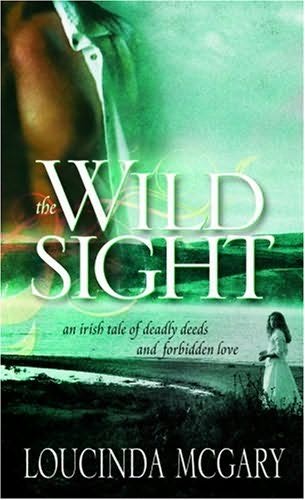
The Wild Sight

The title: The Wild Sight
The author: Loucinda McGary
Publication: Sourcebooks, 2008
Got it from: Amazon, 2009


I love books set in Ireland, especially Irish romances, so I was eager to read this one. It's about an Irish man who has spent most of his life in America escaping his past, only to return to Ireland and find the past catching up to him. Donovan has "the sight" which allows him to travel back in time and also to witness events of the past just by being near certain objects. When visiting his father, who's had a stroke, he meets a woman named Riley who claims to be his half-sister. Of course we, the readers, know that can't be true because Riley is his love interest.

I enjoyed this book for the most part. I liked that it was set in Northern Ireland, where most Irish books I read tend to be set in the south. In particular I liked the descriptions of the countryside, their visits to Belfast and the Giant's Causeway. It was also fast-paced with lots of twists and turns thrown in.

However, there were a few things that really annoyed me. I couldn't stand the main character, Riley. She is basically described as a blonde California princess, and every male character instantly falls in love with her. Barf. This would have been more acceptable if she wasn't such a wimp, but she's constantly "squeaking" and "wimpering," which really grated on me. And she was described as a "wee golden thing" so many times I wanted to plant her in the garden like a carrot, upside-down. Also, I found it really annoying that in the middle of something exciting or some dire situation, the main characters would always be dropping or fumbling for something. It really broke up the action in a frustrating way. (I can't stand when they do this in movies, either).

Overall, though, this wasn't bad. I'd probably read another book by this author and hope it had a better heroine.

Sunday, November 7, 2010

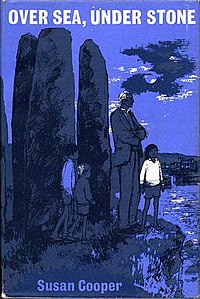
Over Sea, Under Stone

The title: Over Sea, Under Stone
The author: Susan Cooper
Publication: Aladdin paperback, 1965
Got it from: Amazon, c.1998

There are times in your life when you need to read a Harlequin Blaze. And then there are other times when you need to read an amazing, stupendous and completely wonderful childhood series. Oh Dark is Rising series, how I love thee in so many ways. I'm kind of sad that I read The Dark is Rising last Christmas, only because it means I probably shouldn't read it so soon and it's my favourite. But I did get to go back and re-read the first book in the series, which takes place in Cornwall and involves three children who find a treasure map and follow the clues to a very special treasure. It sounds simple, but it's not, because there's so many layers and so much going on here that eventually comes out in the rest of the series. I love that it was written in 1965 and is so much in its era in some ways and so timeless in others. It's summer holidays spent by the sea without TV or computers or cell phones, when kids could just run around by themselves and have fun.

Why are the best books written for kids? There's so much adventure, so much suspense, so much charm that the 243 pages of my edition can hardly contain it. I will never, ever get tired of these books. Reading them is like giving myself a secret present that gives me delight every day.

Tuesday, December 22, 2009

The Dark Is Rising


The title: The Dark Is RisingThe author: Susan Cooper
Publication: Atheneum, 1973Got it from: ??, 1998

I have recently been re-reading The Dark Is Rising, one of my favourite books from years ago, to put myself in a Christmas-y mood. I had forgotten how good this book is, and how crappy the movie "loosely" based on the book was. This book is actually the second in the series, but can be read as a stand-alone. It's Midwinter's Eve and 11-year-old Will Stanton's birthday. Strange things begin happening to him and he discovers he's the last of the Old Ones, ancient people who protect the world against the Dark.

It sounds like an ordinary fantasy, but it's not. It's chock full of British mythology, set in contemporary (or at least 1970's) rural England at Christmas, and it's fantastic. What I love about this book is the juxtaposition of the everyday and the supernatural. Will is an ordinary boy with an ordinary family, but he's also someone with great power and ancient knowledge. A snowstorm is no longer just a snowstorm, it's the work of dark forces.
Neighbours Will has known for years are not what they seem. It's a wonderful bridge to fantasy for people like me who don't necessarily want to read about completely different worlds and creatures. Will's world is entirely recognizable, but the forces at work within it are not. It's also classic Arthurian legend, bildungsroman and quest fable rolled into one.

I am looking forward to re-reading the other four books in the series in 2010.

Thursday, March 12, 2009

If only someone could tame him, or; Goddess of Spring


The title: Goddess of Spring
The author: P.C. Cast
Publication: Berkley Sensation
Got it from: Freemount Books

Dang. I feel like I've been tearing through books like a woman on fire, and I can barely come up with three snarky things to say between them all. I hate to say it, but I keep coming up with winners here. Goddess of Spring was just too good.

Basic premise: Lina is a 43-year-old baker who needs money for her business, badly. So she summons the Goddess Demeter (half jokingly) and asks her help. Presto, Demeter appears and tells Lina she'll exchange Lina's body with her daughter Persephone's so Persephone can save Lina's business. All she'll have to do is spend six months as the Goddess of Spring. Easy! Oh wait, wasn't there something about Hades and a rape?...crap, too late!

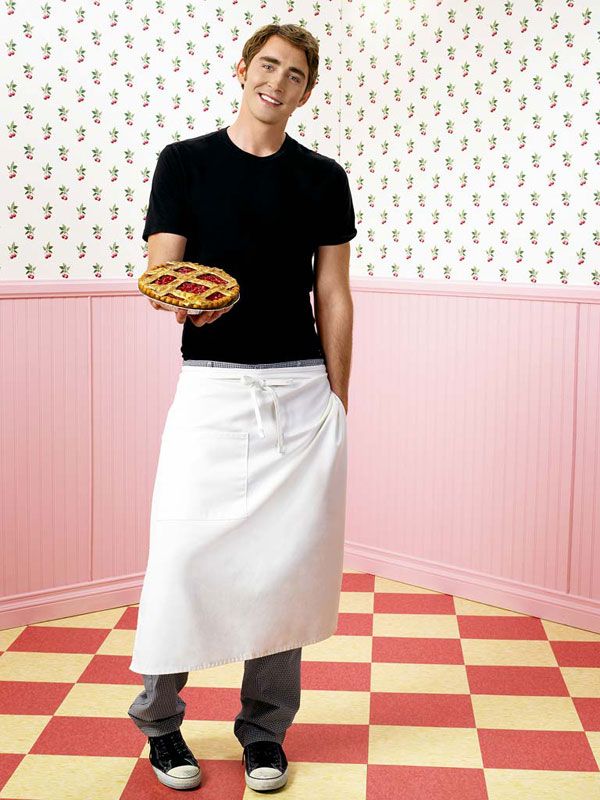
I didn't think I was going to like this book for the first 100 pages or so. I have to admit, it was a bit slow going. Not bad, mind you. It was like wading through gummi bears while the rest of the book was swimming in chocolate silk. I like gummi bears, though. Just like I liked the description of Lina's bakery. I happen to have a strong interest in the pastry business, since my two favourite men work there. (One is my husband and the other is this guy). So I felt like I could really picture Lina's shop. The way the author described everything made me hungry.

Once Lina descends into the underworld to pay a visit to Hades (the rape doesn't happen here) things really pick up. Lina continually describes Hades as her "Batman" and I think the comparison is apt. There's definitely a case for describing Hades as the original model for all the brooding, misunderstood Batman/Mr. Rochester types out there. How could any woman read this book and not love Hades? Apollo seems like a whiny sissy boy next to this guy. Hades is passionate, he's devoted, he's romantic. Even the Underworld seems like a pretty great place to be when he's around. And it's full of DEAD people.

You don't have to be familiar with Greek mythology to understand or enjoy this book, but it helps. For instance, if you know the story of Orpheus and Eurydice already, you'll know where their characters are coming from (although Orpheus only makes a brief appearance). Also, knowing the various gods and semi-gods make their appearances funnier (Lina refers to the Limoniades as the "Lemonades").

Greek mythology is already fully of hilarity and sexiness and it's nice to see the stories updated so skillfully for a modern audience. I'll definitely read the other books in the series if I have the chance.

One teeny, tiny, complaint:
I am so, so sick of every single woman in the romances I've read recently having a cat. I don't have anything against cats, but why does every romance heroine have to have one? Not every single woman, or every woman in general for that matter, likes cats. Also, if you're going to give your character's cat the stupidest name ever (Patchy Poo the Pud), please don't tell me in your author bio that your OWN cat has the same stupid name. It isn't cute, it's vomit-inducing. It almost made me want to stop reading the book, and that would have been a terrible shame since I ended up loving it so much. Thank Hades that Lina left her cat back in the mortal realm.

Sorry, P.C. Cast, if you ever read this. I think you're an incredible writer, but that cat name - don't. Just don't.

Tuesday, January 13, 2009

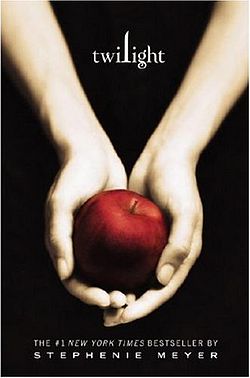
Twilight and New Moon


The titles: Twilight and New Moon
The author: Stephanie Meyer
Publication: Little, Brown and Company, 2005 and 2006
Got it from: LC

It was inevitable that as soon as I swore I would never read this series, somebody would loan it to me with the exclamation that I would just love it. So over the past ten days I have been busy working my way through the 1,061 pages that compromise Twilight and New Moon. I plead uncle.

By now you've probably heard the basic plot of these novels, so I won't go into too much detail. Basically it's your typical sexy vampire dude falls for beautiful mortal woman, albeit they're both teenagers (technically Edward is over 100 years old, but we won't argue the finer points). As I was reading these books, a number of things kept popping up in my mind, and this being my here blog, you can bet I'll share them with you.

First of all, my general opinion. No, these books weren't awful. I'll give them that. They weren't terrible, wretched or badly written. Nor were they the stuff dreams are made of, either. I'll be the first to admit that vampires don't really do it for me. Given the right material, I'd be happy to be proven wrong. I'm sure somewhere out there is a vampire romance that has my name on it. Twilight, however, did not exactly make me want to run out into the woods, desperately searching for my own vampire studmuffin of love.

Yet I can see the appeal. My friend swore that they made her feel like a teenager again, bringing back all the emotions of first love. I get that. One of the reasons I love a good YA book is because it does bring me back to that stage. You know the one - where you can't eat or sleep or do anything but think about him 24/7. When everything is new and you swear eternal devotion after a week of dating. I read Meg Cabot books like they're my own personal crack stash because they evoke that feeling of first love so well. My inner 16-year-old sighed with happiness when Edward declared his feelings ever so poignantly to Bella.

Problem is, my inner 16-year-old has been subsumed by my inner 26-year-old. The person I am now, who is happily married, who understands that love is about a lot more than looking passionately into someone's eyes and spending every waking moment with them. And that person couldn't help rolling her eyes at the ridiculous love story of Bella and Edward. If I ever had a stage where I was drawn to the rebellious loner, it's long gone and replaced with my love for sensible men who are emotionally stable and mature enough to give me my space.

It's been mentioned on other reviews, and I have to agree that despite the all-consuming nature of typical teenage love, there's something particularly squicky about Bella's relationship with Edward. Neither one of them seems mature enough to handle anything. Take Edward. The guy is 100+ years old with superhuman strength and abilities, and how does he choose to spend his life? In high school. I feel it's only fair to mention his life outside of high school is exceptionally boring as well. Besides vampire stuff, his world consists of a bitchin' music collection (unlike, say, every teenage boy who's ever lived) and the occasional playing of piano. I'm sorry - what? If I had all that time and strength and ability, I wouldn't be within 1000 miles of a high school, except maybe accidentally burning one down while I was fighting my evil vampire nemesis. If I were a good vampire, I'd be some sort of bounty hunter or Nobel Peace prize winner or saving baby seals from global warming. If I were a bad vampire I'd be cooking up elaborate schemes in my ridiculously huge lair and plotting to take over the world.

Our Edward isn't interested in that. All he's interested in is charting cell mitosis and watching Bella while she sleeps and zzzz....

Excuse me, I just fell asleep thinking about how boring his life is. No wonder Bella consumes his every thought. I'd be stalkerish and possessive too if I had nothing else going on in my life.

Then there's Bella. You know, "beautiful" in Italian? That's right, she's the ultimate Mary Sue. She's me, she's you, she's every one of us, girls! She doesn't think she's beautiful, but every single boy in school wants to ask her out! I nearly choked with laughter when she got asked by three different boys to the dance on the same day. Careful now, you don't want to overdo the she's-so-desirable th...oh wait, too late. She's way too cool to call her parents "mom" and "dad" and refers to them by their first names. She barely has any parental supervision at all, in fact. She's such a saint, she babies her mom and practically spoon-feeds her dad, too. She's so special, she has all these abilities that no human has ever had before and confounds all the vampires. Even her "faults" are carefully constructed to make her appear like a beautiful damsel in distress. She's klutzy, and it's so cute. Now all the boys can save her. She was swooped into so many manly arms in these two books, I lost count. Oh look! Now Edward's saving her again, and he's constantly trying to protect her from danger. Ditto Jacob.

To be frank (next time I'll be Joe), neither character is very appealing. Edward is possessive and controlling to the point where it borders on physical and emotional abuse. He appeals to the sort of girl who will go bananas over Heathcliff once they reach college. They're the girls who, I'm sorry, don't have the ovaries to stand up for themselves and develop the self-esteem to appreciate someone who's actually stable. Bella, besides being a laughably bad Mary Sue, is incredibly boring. She has absolutely no life, no interests, no passions outside of Edward. She's rude to everyone who wants to be nice to her. I wouldn't know what to say to someone like that, because I would never be friends with her.

As for the stories themselves, they would have been far better served by being cut in half. New Moon, in particular, dragged like a carcass being hauled across the desert. Once Edward leaves, Bella spends approximately 50,000 pages living like a zombie, gasping for air because she can't live without him, crying, moping and having nightmares. I know love can be all-consuming at that age, but give me a break! You see what happens when you don't develop a personality before you plunge headlong into a bad relationship? By the end of page 1,061 I couldn't decide which was worse: Bella's moaning when Edward wasn't around or their gag-inducing vows of eternal love when he was.

By far the worst thing about these books was their complete and utter lack of humour. There was nothing fun, nothing tongue-in-cheek, nothing to even remotely lighten the deathly atmosphere once in these pages. I never even cracked so much as a hint of a smile. I can think of approximately 1,061 things that are potentially hilarious about teenage vampire romance and Stephanie Meyer didn't put any of those in. Want to know what a fate worse than death would be to me? No, I'm not talking about being turned into a vampire. I'm talking about being in a relationship where I can't just laugh and have some fun.

So go ahead, read these books on your Wuthering Heights, angsty, emo days. You'll relate. But I don't know why you wouldn't choose something more edifying with, er, more bite. Call me a cynical wench who's read too many novels in her life, but I just don't get the appeal. Twilight reads like a run-of-the mill romance for someone like me who's been around the romance novel block so many times they named a beverage after me in their cafe. At the risk of being trite, I have to say it: Twilight sucks.

Monday, October 27, 2008

50. The New Policeman


Yay! We've hit fifty books!
The title: The New Policeman
The author: Kate Thompson
Publication: Greenwillow Books, 2005
Got it from: The library

This is a deceptively big book that reads very easily and is a lot of fun. J.J. Liddy, the hero of the book, is a 15-year-old who lives in an Ireland where there never seems to be enough time. When his mother wishes for more of it for her birthday, J.J. sets out to find her some. There's a lot of Irish mythology woven in here. Yes, it involves the "F" word. (Hint: it's almost impossible to write about Irish mythology without them). Each chapter ends with a piece of music related to the plot. I wish I could read music so I would know what it sounded like. At least now I know where all my missing socks are. B+

Tuesday, September 23, 2008

46. The Blue Roan Child

The title: The Blue Roan Child
The author: Jamieson Findlay
Publication: Doubleday, 2002
Got it from: Book Club

"The unforgettable story about the magical bond between a young girl and a wild mare." That's what the back cover says. If you like horses and similes, you'll probably love this book. As for myself, I'm hesitant to say anything harsh about it because I don't think it was all that badly written. But oh my sweet nectarines, was it ever boring. I had to force, force, force myself to read it until the end. If the interest-o-meter was like those hospital vital signs, I don't think mine would register far over "dead." I can't even even write this review without getting a little heavy-lidded, so...C.