The title: Atlas of Lost Cities
The author: Aude de Toqueville
Publication: Hachette, 2016
Got it from: The library
I love reading travel books, but not the normal kind, more like the kind about really weird places almost no one goes to or wants to go to. It gives me a strange thrill, like when I'm alone in a deserted part of a museum looking at some forgotten display that suddenly transports me to another time and place. In some ways this book reminds me of Unruly Places, a book I still like to think about from time to time. The title of Atlas is misleading, because this book is not really an atlas, nor is it solely about cities, and they're not lost, except in the sense that they aren't what they once were (which, really, what place isn't?)
I read this book cover to cover, which is kind of a weird way to read it, since it's not very organized. The sections are roughly based around continents, but they jump around in time and place depending on the author's whim. There's no rhyme or reason to the author's choices, and they're really just little snippets of the history of these places, not encyclopedia entries. There's not even any real pictures, just drawings, which might disappoint some people but kind of reminded me of a charming Victorian travel guide. If you're okay with the randomness of it all, you'll probably enjoy this book. I learned quite a bit about places I knew nothing about, like the town in Pennsylvania that's been on fire since some fireworks were foolishly set off in the 1960s. There's a lot of weird ghost towns in this book, like places that were built and expected to prosper but were never lived in and just abandoned. There's also some underwater towns, although sadly no mention of the towns lost to the St. Lawrence seaway. The author seemed to stick more to lesser-known places that spark the imagination rather than famous lost places, although Pompeii is in here (the only one of the "lost cities" I've actually been to.)
Showing posts with label Travel. Show all posts
Monday, August 1, 2016
Sunday, April 5, 2015
Cool Japan Guide
The title: Cool Japan Guide: Fun in the Land of Manga, Lucky Cats and Ramen
The author: Abby Denson
Publication: Tuttle, 2014
Got it from: The library
Abby Denson is a graphic novel writer and huge manga fan who has spent over a decade travelling back and forth to Japan. In Cool Japan Guide, she presents a super fun and cute comic guide to the country based on her own experiences. This is definitely not the kind of book I normally read. I tend not to like comics. But I loved this one. For one thing, given how bright and colourful a country Japan is, it actually lends itself well to the comic format. Abby herself is like the experienced friend you would love to have guide you through confusing cultural differences and take you straight to Japan's best spots.
Reading this reminded me of all the things I love about Japanese culture. The politeness and introversion. The cleanliness and efficiency. The tranquil gardens and exciting cities. The elaborate tea ceremonies (I got to see a traditional Japanese tea ceremony at a tea festival this year, and it was fascinating). And the food - oh my god, the food. There is a whole chapter devoted to Japanese cuisine worth the price of the book alone. I am already obsessed with sushi and ramen and bento boxes and tempura, but I learned about so many more delicious things. Do not read this book hungry. I almost drooled on the pages.
Even if you don't know much about Japan I would recommend this book. I was definitely ready to pack my bags and go by the end of it. Here's hoping that the comic book travel guide becomes a big thing soon.
Friday, August 15, 2014
Unruly Places
The title: Unruly Places: Lost Spaces, Secret Cities, and Other Inscrutable Geographies
The author: Alastair Bonnett
Publication: Houghton Mifflin Harcourt, 2014
Got it from: The library
In this unusual book, author Alastair Bonnett dives into the psychology of those places considered to be "unruly." What makes a place unruly? It is the spaces we overlook, the borders that aren't quite there, those islands we can't quite get a hold of. The author uncovers both the micro (a local fox hole, gutterspaces) and the macro (the vanishing Aral Sea, Leningrad.) In a world increasingly overtaken by Blandscapes, unruly places draw us to the unknown.
There's a lot of entries in this book, so I'll touch on a few that spoke to me. There's a small garden in New York City that began as an art project in the 1970's which grows plants that would have been native to the city before it was a city. There's a town just outside of Chernobyl that has been left exactly as it was abandoned in 1986, complete with a half-finished amusement park. And if you're super-rich, you can buy an apartment aboard a luxury liner that travels the world.
Beyond the descriptions of these varied places, what I enjoyed most was the author's psychology of space. Places have meaning for us, one that we should embrace because it makes us human. The yearning for a space of our own, familiar and reassuring, is in our nature. But place is also unique: it changes based on time, from person to person, from mood to mood. All spaces are shifting and ephemeral. Appropriately, he saves what is perhaps the most ephemeral space of all for last: the places of childhood play. Reading about his childhood experiences playing make-believe in an alley, I suddenly felt click of connection. No one transforms a space like a child: a clump of trees becomes a fortress, a palace, a home. This is where we learn to shape our world. Unfortunately, like everything else in this book, it is being lost to a digital touch-screen childhood. If we lose it completely, we will lose an important part of ourselves.
Monday, May 6, 2013
Eighty Days: Nellie Bly and Elizabeth Bisland's History-Making Race Around the World
The title: Eighty Days: Nellie Bly and Elizabeth Bisland's History-Making Race Around the World
The author: Matthew Goodman
Publication: Ballantine Books, 2013
Got it from: The library
I was MIA in April because I was buried deep in five books I was book-talking for a library program (and all of you librarians know how nerve-wracking book talks are). One of the books was Matthew Goodman's Eighty Days: Nellie Bly and Elizabeth Bisland's History-Making Race Around the World.
Now, I did read Jules Verne's book a few years ago, and I think Nellie Bly is pretty boss, so how did I not know that she once raced around the world? If you don't know Nellie Bly, look her up - she was a scrappy female reporter in Gilded Age New York who did some pretty awesome things. (She also has her own mystery series, which will show up here in future reviews). In 1889, she set out to beat the record set by the fictional Phileas Fogg in Around the World in 80 Days and circumnavigate the globe in 75 days. Meanwhile, another reporter, Elizabeth Bisland (a literary critic who was none too pleased to be told she had to travel in a moment's notice) also set out to race against her, albeit in the opposite direction.
It was the perfect age to travel in. Both of the ladies had rich newspaper companies paying their first-class fares the whole way around, and Britain was at the height of its empire. They barely had to step foot off British soil, even though they stopped at ports around the world to change transportation. Nellie Bly headed east, suffered horrible seasickness on the Atlantic, met Jules Verne in France, bought a monkey in Ceylon, and fended off would-be suitors who thought she was rich. Elizabeth Bisland went west, encountered a hair-raising train trip through the Rockies, charmed everyone on board her Pacific steamer and fell in love with Japan. Both women got a bit cranky (as you do when you're traveling at breakneck speed for over seventy days) but only one ultimately emerged triumphant, breaking the world record and becoming a national heroine.
This book isn't a quick read. There's a lot of dense text and tons and tons of historical detail that interrupts the narrative of the race itself. If you don't mind that sort of thing and are curious about what the world looked like in the late 19th century (at least through the eyes of two kinda racist but good-hearted women), you'll love Eighty Days.
Monday, June 11, 2012
Non-fiction bites
Tutankhamen by Joyce Fyldesley
Obviously I am crazy about all things Egypt and this book is an excellent introduction to the rock-star like pharaoh who was a minor king in his own time but has achieved huge cultural significance today. The author touches on both what is known about Tutankhamen's actual life (no, he wasn't murdered) and his discovery by Howard Carter in the 1920's. Wisely, she urges readers to avoid any book about the pharaoh that uses the words: "the truth" or "the real story."
The Siesta and the Midnight Sun: How Our Bodies Experience Time by Jessica Gamble
An interesting long at our circadian rhythms, both in terms of the shorter daily cycles and longer seasonal ones. The author looks at a number of studies about what happens when usual daylight clues are removed and how in such cases human beings resort to a much longer sleep/wake cycle. She also looks at how cultures adapt when there is an absence of light, such as the Arctic in winter.
If Walls Could Talk by Lucy Worsley
Similar to At Home by Bill Bryson, but somehow not as compelling. Based on a miniseries in Britain, Lucy Worsley charts the history of our lives as seen through our home. Covers much of the same ground as Bryson's book but is still full of interesting facts: for instance closets were once considered retreat spaces for reflection and prayer. Definitely of interest to history junkies, particularly of the Tudor and Victorian age.
The World of Downtown Abbey by Julian Fellowes
A no-brainer for Downton Abbey fans, lots of great facts from the daughter of Julian Fellowes. Gorgeous pictures of life on set, too.
50 Popular Beliefs That People Think Are True by Guy P. Harrison
I adored this book. I devoured (almost) every single one of the 50 entries in just a couple of days. I would put this on the list of books that everybody MUST read at some point in their lives. Basically, the author cuts through all the nonsense and superstition in the world to explain in plain, non-condescending language, why things just aren't true. Beliefs such as ghosts, UFO's, homeopathy, bad medicine, and religion all get exposed. Although you may laugh at some of the beliefs (such as that witches are real), the author is quick to point out how harmful these beliefs can be, as in parts of Africa where the murder of innocent children on charges of witchcraft are ongoing. Quite simply, this is an outstanding book on the necessity of thinking critically. There is no ranting and raving here, the author is almost gentle in his approach, and his arguments are all the better for it.
Europe on 5 Wrong Turns a Day
Fans of funny travel writing a la Bill Bryson will probably enjoy this tale of a man who tours Europe using a 1963 guidebook (Europe on $5 a day) that he found at a flea market. The advice the book gives is of course hilariously out-of-date and Europe has changed considerably since then. Or has it? This book explores Europe then and now, as well as providing a guide to what you can get nowadays for $5. (Not much, as it turns out).
The Statues that Walked by Terry Hunt and Carl Lipo
I've saved the most mysterious for last. The name of Easter Island represents a secretly thrilling world of wonder for me, a far-flung island so remote its closest inhabited neighbour island is over 2,000 km away. Nevertheless, I was surprised to learn that it actually has a good tourist industry, thanks to daily flights from Chile. It seems that not even this remote island is safe from the ravages of the modern world - sigh. Still, the history of the island is full of enough surprises and puzzles to keep even the most jaded explorer happy. Here's a fact I learned: the islanders were obsessed with hats, and when the Europeans came wearing theirs, the native women would sexy-dance to distract them and then grab the hats and run. For some reason I feel this is the thing I'm going to remember the most about this book.
Saturday, March 3, 2012
The Brendan Voyage
The title: The Brendan Voyage
The authors: Tim Severin
Publication: Arrow Books, 1978
Got it from: Attic Books, London, 2004
I was first came across the story of the Brendan Voyage in O.R. Melling's marvelous The Book of Dreams, in which Tim Severin and his crew appear as fictional characters. Some years ago I stumbled across The Brendan Voyage in a used book store and thought it would be entertaining, although it has taken me years to get around to reading it.
In some ways it is a great follow-up to Simon Winchester's Atlantic. This story is part history, part sea tale, part adventure and part mystery. St. Brendan was a 6th century Irish monk who features in Navigatio sancti Brendani abbatis (the voyage of St. Brendan the abbot). For many years people thought his fantastical voyages to "promised lands" was the stuff of legend, but recent studies have shown that Brendan may in fact have visited real places, and maybe even North America, by island-hopping in the North Atlantic. In the 1970's scholar Tim Severin set out to prove that the traditional Irish curraghs could have withstood the arduous journey.
I never would have thought I'd find boat-building fascinating, but I did. Severin had to use his medieval detective skills and assemble a crack team of experts in traditional boat-building skills in order to make it happen. Even in the 1970's, this proved difficult, as many of the traditional crafts were dying out. The boat itself was constructed out of all-medieval materials, using wood for the frame with a leather covering. The most astonishing thing about the boat was not the material, but the size. It was barely 36' long, but had to comfortably stow five men and all their supplies.
Amazingly, Tim and his crew discovered that not only did their medieval boat hold up, in a lot of cases the medieval material fared better than its modern counterpart. Of course there were a lot of nail-biting moments, including several storms and a rather harrowing encounter with icebergs, but the little boat that could seemed to roll with the waves better than the bigger, modern boats. Intriguingly, they discovered that many parts of Brendan's tale that people dismissed as myth could have been true - for example, the "island of fire" might be the volcanoes of Iceland and the monstrous beasts could have been whales (who, incidentally, showed little fear of the boat and swam beside it for much of the journey). Even though Tim answered the question of whether Brendan could have reached North America, scholars are skeptical regarding whether he did. The question remains an intriguing mystery.
Monday, June 20, 2011
O Come Ye Back to Ireland
The title: O Come Ye Back to Ireland: Our First Year in County ClareThe author: Niall Williams and Christine Breen
Publication: Soho Press, 1987
Got it from: London, Ontario used book store 2004
I've only just returned from Ireland, and I re-read this book in anticipation of our trip. It's funny re-reading a book you first read at 16, and it's certainly different looking back now after the trip. It's the story of a Manhattan couple who, in the 1980's, decided to give up urban life and live on a rural farm on the west coast of Ireland. It is far from the idyllic paradise it sounds. The weather is awful, the farm difficult and material comforts are few and far between. The authors documented a world that is ancient but rapidly fading away, something that is still very much in evidence in Ireland today. Although they describe the kindness of neighbours and the beauty of the land, it's not a life I think I could live. It's basically a chronicle of the hardships that nature keeps throwing at them, relentlessly. They really have to eke out a living on the land, no extra money to fall back on for them. Yet I felt it rang true for what Ireland is really like - many of the scenes and people they describe are familiar. It's an interesting book, one of the best "travel" stories I've read and a true portrait of Ireland.
Sunday, November 22, 2009
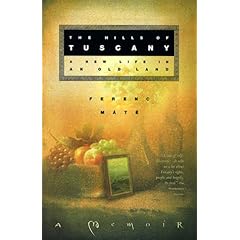
The Hills of Tuscany
The author: Ferenc Mate
Publication: Delta, 1998
Got it from: RC, Xmas 2003
I got this book as a Christmas present the year I studied in Rome and, uh, here it is, uh, six years later. R, if you're reading this...I'm sorry. I took this book with me everywhere, including Halifax and Perth, and I have been meaning to read it sooner than this. What can I say? Just a warning to those of you who have given me books as gifts that you may have to wait another five years for my review, but rest assured I will get to it eventually.
This book chronicles the experience of the author and his wife spontaneously moving to to Tuscany in the 1980's. The first half of the book concerns them looking for a house to live (no easy feat when everything is word-of-mouth) and the second half trying to accustom themselves to a completely foreign world. I read this book almost entirely on my breaks at work and the descriptions of the food made me terribly hungry. Also, if you didn't know this already, this book pretty much proves that Italians are lovable but certifiably insane. Now I'm off to find some crostini and pasta. With some gelato for dessert.
Subscribe to:
Posts (Atom)