The title: Absolutely Truly: A Pumpkin Falls Mystery
The author: Heather Vogel Frederick
Publication: Simon & Schuster, 2014
Got it from: Hoopla Audiobooks
Exciting news for fans of the Mother-Daughter Book Club series: after writing what was supposed to be the final book in the series back in 2012, author Heather Vogel Frederick has announced another installment due next spring. In the meantime, I've been listening to the audiobook of her new chapter book for younger readers.
Truly Lovejoy is 13 and her family has just moved to Pumpkin Falls, New Hampshire from Texas after her father sustained an injury fighting overseas. Truly's family is concerned about the change in their father, who has become more stern and withdrawn. Taking over the family bookstore might be what he needs to get back on his feet. Meanwhile, Truly has to deal with the awkwardness of moving to a new town and adolescence in general.
At first I was skeptical. These weren't my beloved Mother-Daughter Book Club characters, and Truly seemed like a bit of a whiny brat. But as with the MDBC series, I began to warm to the story and the charming small-town characters. The book doesn't really start getting good until Truly starts solving the mystery. As with the girls of the MDBC, Truly leads a busy life that involves dancing lessons, swimming, birding and algebra lessons that she has to squeeze the mystery around. The mystery involves a series of clues found in a first edition of Charlotte's Web. (I totally figured out who the letters were for early on.) As an added bonus, a familiar character from the Mother-Daughter Book Club universe makes a hilarious cameo.
Hooray for Pumpkin Falls and what will hopefully be the first of many in a new mystery series.
Showing posts with label Mystery. Show all posts
Monday, October 26, 2015
Sunday, January 18, 2015
Tea for Three
The title: Tea for Three (includes Death by Darjeeling, Gunpowder Green and Shades of Earl Grey)
The author: Laura Childs
Publication: Berkley, 2001, 2002, 2003
Got it from: Indigo Saint John, 2014
One of the things I have discovered about mystery series is that there are mysteries with themes and then there are themes with mysteries. The Tea Shop books definitely fall into the latter category. The main character/sleuth in these stories is Theodosia Browning, an outgoing 36-year-old entrepreneur who runs the Indigo Tea Shop in historic Charleston, South Carolina. Besides being a crack shopkeeper, Theodosia is also deeply involved in the lives of her friends and neighbours, who have a habit of killing each other for some fairly flimsy reasons. Like many cozy detective stories, the mystery often takes a backseat to the setting.
And what a setting! Let me first start with the Indigo Tea Shop itself. It is the kind of tea shop that dreams are made of. Theodosia's employees include a gentle, grandfatherly tea expert named Drayton and an adorable pastry chef named Haley. While Theodosia often forgets about work to run around solving mysteries, her two employees run the shop without a hitch. There is always a kettle on the boil and batches of delicious scones being pulled out of the oven. Regulars are always dropping in to gossip and rave about the shop and drink tea by the fire. No one is ever angry, demanding or asking for a refund. Everyone is always neighborly and helpful. Let's face it, by the time I finished reading, I was ready to move in.
Then there is Charleston itself, a place that before I read these books, I wouldn't want to go anywhere near on account of the heat and humidity. But Laura Childs paints such a cozy picture of the city, with quaint shops and friendly shopkeepers and historic charm, that I now I want to go.
The mystery aspects of the books are, I'm afraid to say, not that great. The mysteries are fairly easy to solve and not super exciting. (In the third book I actually figured out who the perpetrator was in the first chapter, before they were even introduced or the crime was committed). I feel kind of bad saying this, because I did enjoy the books. If you're as into tea shops and as steeped (heh) in tea culture as I am, you will probably also love them. Bonus - you will get to learn about new teas to try and there are recipes for all the food described in the book. Yum!
Monday, April 7, 2014
The Ivy Tree
The title: The Ivy Tree
The author: Mary Stewart
Publication: HarperCollins, 1961
Got it from: Amazon
A few years ago I reviewed Mary Stewart's marvelous Touch Not the Cat, and hearing that The Ivy Tree was a similar story, I was eager to read this one. Mary Grey is a young woman on vacation to the north of England, where she is mistaken for Annabel Winslow, another young woman who ran away from home eight years ago and was presumed dead. Annabel's distant cousin Connor hatches a plan with Mary: she will impersonate Annabel in exchange for a share of the inheritance given by the dying Winslow grandfather.
Like Touch Not the Cat, this is a classic Gothic mystery, steeped in atmosphere and description. But compared to that story, this one was a big meh for me. There's a Big Secret at the heart of the plot which is fairly easy to guess if you know anything about this kind of novel. Unlike in Cat, the revelation of the true hero at the end of the novel wasn't a happy surprise. One of the reasons Cat worked for me was that the romantic revelation was a huge payoff for all the slow pacing beforehand. In Ivy Tree, there's the slow pacing but no payoff. I didn't dislike the book but I also wasn't rushing to read it. I think it would much better suit someone looking for an old-fashioned Gothic story.
Monday, November 11, 2013
The Ape Who Guards the Balance
The title: The Ape Who Guards the Balance
The author: Elizabeth Peters
Publication: Avon, 1998
Got it from: Maine, 2009
I've been having a hard time getting around to writing this review, for a number of reasons. If you've been following this blog for awhile, you know that I've been reading the Amelia Peabody series at the rate of approximately one book per year. This year I was finally going to catch up to myself, in a "this is where we came in" way. The Ape Who Guards the Balance was my very first Amelia Peabody mystery, which I read when I was seventeen, and it was my first introduction to the amazing Elizabeth Peters.
And then on August 8 of this year, Elizabeth Peters died. I was - or should say, am - heartbroken. Nobody wrote quite like her. No other author, with the exception maybe of L.M. Montgomery, has written more novels that I've enjoyed. She left behind an endlessly delightful body of work. To pick up an Elizabeth Peters (or her pseudonym Barbara Michaels) novel is to read an intelligent, funny, romantic book with a strong heroine. (Even the ones written in the 60's and 70's, a rare thing in itself). Any of her books is going to be a treat, but it's the Amelia Peabody series that she will be (deservedly) remembered for.
Reading this book, I felt like I was catching up with old friends. I remembered almost nothing from my original reading of it, so I was pleasantly surprised by the ending. The events of The Ape Who Guards the Balance take place in 1907. Owing to Emerson's feuds with various authorities, the clan are forced to excavate in a less-than-stellar site in the Valley of the Kings. The Victorian era is still very much present and the game of the day is to make the splashiest find with the most treasure. Somewhat humiliated but not deterred, the Emersons embark on their dig and it's not long before murder turns up.
Amelia Peabody is ever the proto-feminist and Peters cleverly weaves the early history of the women's suffrage movement into the story. "Pray do not detain me, Emerson," Amelia says calmly in what may be the most hilarious first page ever. "I am on my way to chain myself to the railings at Number Ten Downing Street, and I am already late." The Emersons' adopted daughter Nephret is also breaking barriers by becoming a medical student and she becomes a crusader for the grassroots women's education movement that is taking place in Egypt.
More and more the series is becoming focused on the children and large chunks of it are told as their diaries and memoirs. It's rather a shame, because nobody holds a candle to Amelia as a narrator, and the sexual tension between her son Ramses and Nephret isn't half as hot as that between Amelia and Emerson (and more shirts get ruined, obviously). And speaking of hot, the Master Criminal himself, Sethos shows up toward the end, which instantly sends the rating through the roof for me. (I don't want to spoil anything but that train scene at the end - *dies.*) My only complaint is that the book is just too long. I do like to know the details of their everyday life but there was just too much we ate this-and then I wrote this letter-and then we sat on the porch, etc. With about a hundred pages trimmed, this book would be almost perfect.
Saturday, June 22, 2013
A Marked Man
The title: A Marked Man
The author: Barbara Hamilton
Publication: Berkeley, 2010
Got it from: Amazon b-day money 2012 (thanks sis!)
Boston, 1774: Just ten weeks after the Boston Tea Party, the city is holding its breath awaiting retribution from the king. Amidst days of endless sleet, Abigail Adams is approached by a young friend, Lucy Fluckner: her lover is accused of murdering a royal representative to the colonies. Abigail knows that the accused, Harry Knox, is involved with her cousin Sam and the other members of the Sons of Liberty. There is a danger that if convicted, Harry might be coerced into revealing the names of the other rebels. While John travels afield to do his duty as a lawyer, Abigail must unravel the clues that point to the real murderer, while facing considerable danger herself.
There's so much I like about this novel and so much I could say. Barbara Hamilton (a pseudonym for prolific writer Barbara Hambly) does an excellent job in this second Abigail Adams mystery, and her knowledge of the people and customs of the era is mind-boggling. It is a time and place in history that holds so much fascination for me, because it is so unique: a group of intellectuals who foment rebellion against an oppressive regime and rouse the support of the common people in the process. They're a circle of neighbours and acquaintances who use their knowledge of history and politics to dare to imagine a different, better way of life. I love all the characters in this world: irascible John, forever turning to the classics for inspiration and guidance; cunning and daring Sam Adams; brave and reliable silversmith Paul Revere; young and idealistic printer Harry Knox; and most of all Abigail herself, resourceful, intelligent and playful all at the same time.
It's Abigail who forms the heart and mind and soul of the stories - she's not just a sleuth in the background, her life with all its trials and routines is at the forefront. She is first and foremost a women in 18th century America with strong Puritan values, and therefore has strong ties to church, family and home life. It's hard not to sympathize with her when she feels the exasperating contradiction between knowing she should be doing the household chores and hating them "like the mouth of hell." And it's easy to see why a woman with her intellect would feel a strong urge to solve a mystery rather than try to separate squabbling children or do endless rounds of thankless washing. Reading this, one has the sense that proud as she is of her home, she also wants something more than what is allotted to women of her time.
Here, too, we get tantalizing hints that she's unconsciously nursing a crush on her ally throughout the series, the British Lieutenant Coldstone, a man whose principles and intellect match her own. Naturally she's appalled that people would think there is anything untoward in their relationship and she of course would never dream of betraying her beloved John. But early on in the story, when she knows she needs to visit the officer again on Castle Island, she has a fleeting "twinge of regret" when she thinks of him. This is all we get until later on in the story, where she describes him to herself as "extremely comely." It's one of those clever little teases the author throws in, like name Coldstone: at first we assume it's because he's a stiff-backed and standoffish, but I rather like my own theory, that it's because he's a stone cold fox.
The pleasure here is in the place more than the mystery (alas, I guessed the murderer straight away) and in that Hamilton succeeds wonderfully. Now if only I could stop worrying that the latest book in the series, #3 (published in 2011) won't be the last. The author has given hints about Abigail solving crimes with Martha Washington and Thomas Jefferson, and I'll be sorely disappointed if she doesn't.
Saturday, November 10, 2012
A Study in Scarlet
The title: A Study in Scarlet
The author: Sir Arthur Conan Doyle
Publication: 1887
Got it from: MC
I am deeply in love with the BBC series of Sherlock, and while I read The Hound of the Baskervilles last year, until now I have not read any of the other Sherlock Holmes stories. I decided to start at the beginning and work my way through the Sherlock canon.
I tend to be wary of Victorian literature as it can be quite wordy, so I was surprised at how utterly readable this novella was. I don't think anybody reading it today would find it difficult or foreign. Much has been said elsewhere about how modern and ahead-of-his-time Conan Doyle's creation was, so I'll skip that and just say it was a cracking good story.
The first part of the novella deals with Watson and Holmes' meeting and is hilarious in the way it portrayes Watson's bafflement over his new roommate. (A list Watson makes of Sherlock's knowledge of various subjects is a highlight). The majority of the middle portion of the book involves the back story of the murder case Holmes and Watson are trying to solve, and involves a nail-biting tale of fanatic Mormons, a love affair, a daring escape and a plot for revenge. I can see why the Victorians went crazy over this. Whether or not you actually believe Holmes could possibly know what he knows from the clues he's given, he certainly makes you want to pay more attention to the world around you.
Sunday, July 8, 2012
Seeing a Large Cat
The title: Seeing a Large Cat
The authors: Elizabeth Peters
Publication: Warner, 1997
Got it from: Chapters Vancouver, 2001
Reading this book, I couldn't help thinking, "this is where I came in" When I was a teenager and started reading these books, I jumped into the later books in the series, then went and re-read the back titles year by year. This book, which is actually the ninth in the series, is the one just before where I jumped in (The Ape That Guards the Balance). So now I feel that I'm (somewhat) caught up.
Being an Elizabeth Peters book, it is of course funny, well-written and exciting, but I couldn't help feeling that it was a little unmemorable. The plot of this one involves the Emersons exploring a so-called "lost" tomb in the Valley of the Kings. The three kids - Ramses, Nefret and David - are teenagers and starting to have adventures of their own, and we even get some narrative from Ramses' perspective. There were many elements of the plot that feel familiar from other books - seemingly unrelated people and events turning out to be related, the Emersons having to prove to gullible people that there is nothing supernatural going on, people trying to get romantically involved with Ramses and/or Nefret. And of course a gun-wielding villain in a tomb at the end. Which is to say that I loved it, of course, but as an Amelia Peabody book it wasn't one of my favourites.
Tuesday, June 26, 2012
Midnight in Austenland
The title: Midnight in Austenland
The authors: Shannon Hale
Publication: Bloomsbury, 2012
Got it from: The library
So I did something I almost never do - diverged from my reading list to read the sequel to a book I've just read. Midnight in Austenland follows a different character in the same place. Charlotte Kinder is a divorced thirtysomething woman with two kids and a cheating ex-husband. A successful Internet entrepreneur, she treats herself to a holiday in Austenland to indulge her love of Jane Austen. But because she states on her questionnaire that she also loves Agatha Christie novels, she and the other actors in Austenland get involved trying to solve a murder mystery. The problem is that Charlotte thinks the mystery may spill from make-believe into the real world...
I really enjoyed this sequel and read it in just a few days. I liked Charlotte as a heroine more than Jane from the original novel, since she has a more can-do attitude and spends less time feeling sorry for herself, even when she had more to deal with in her home life. I also liked that we're mislead as to who the hero of the novel really is - let's just say it will probably be less of a surprise to those of you familiar with Northanger Abbey, the Austen novel this book is based on. We also get to meet with some of the characters from the first novel - Mrs. Wattlesbrook, Col. Andrews and Miss Charming, and learn more of their back stories. Overall I have to say I liked this novel more because there was more action involved in solving the mystery. If I have to be nitpicky, I did smack my forehead a number of times when the characters did some very silly things (without giving too much away, if you suspect there's a murderer in a cottage, you wait for the police, not go rushing in yourself!) I certainly hope we'll get to have more adventures in Austenland.
Friday, January 13, 2012
The Ninth Daughter
The title: The Ninth Daughter
The authors: Barbara Hamilton
Publication: Berkley, 2009
Got it from: SC, Xmas 2011
Kicking off 2012 is a mystery that wasn't quite what I'd hoped, but was still an enjoyable read.
The Ninth Daughter features Abigail Adams as a sleuth, investigating the murder of a well-to-do woman in the home of her friend Rebecca, a former housemaid. Complicating matters is the fact that Rebecca is a secret member of the Sons of Liberty, the revolutionary group who are against the imposition of the English King. Even worse, her husband John is accused of the murder.
Hamilton wisely sets the action in the middle of pre-revolutionary Boston with a young Abigail rather than the later First Lady Abigail. The turbulent times makes for an excellent setting for a murder mystery, with divided loyalties and suspicion everywhere. Real historical characters like Samuel Adams and Paul Revere come to life on the pages, while some of the British soldiers are created as fully realized, nuanced characters who have noble sides despite being the "enemy." In fact, the realism really stands out in this book. You can almost smell 18th century Boston and feel like you are walking through its cramped streets and standing in its tiny kitchens. And it's gritty too - not just the murder(s), which are pretty brutal, but everything from the stench of the poor district to the bitter hardships of women's married lives.
I found the book difficult to get into, with so many characters and so much thrown at you in the beginning, but it is satisfying to see it come together in the end and know the author is making you think. I was hoping for more evidence of the witty and playful between John and Abigail, which was hinted at in almost the first page:
John - her beloved, self-important, irascible John, the hero of her heart, husband of her bosom, and occasional bane of her existence
What woman doesn't feel this way sometimes about her husband?
I would recommend this book, especially for learning about pre-Revolutionary Boston, but with the caveat that it's not a cozy mystery by any means, nor is it a light read that's easy to pick up and put down.
Sunday, May 22, 2011
Touch Not the Cat
The title: Touch Not the CatThe author: Mary StewartPublication: Hodder & Stoughton, 1977Got it from: Hannelore's, 2010
How is it that I have gone all my life without ever having read a Mary Stewart book? How is it that I have waited so long, after so many online recommendations by people who love the same books I do, to read this book? And how is it that Mary Stewart has managed to take a premise that could be so silly and instead write something that is so wonderful?
Bryony Ashley is the only daughter of the esteemed Ashley clan. Her ancestors were noblemen, but it is now the 1970's and their money has run out. The only thing they have remaining is their enormous, beautiful estate. But Ashley Court has become neglected over the years and is starting to deteriorate. Bryony is in her early twenties and her mother is no longer alive. She grew up on the estate with her father and spent her childhood playing with her three boy cousins and the son of a local farmer who lives on the estate. Bryony also has another companion - the friend she has communicated psychically with since childhood. The Ashleys, you see, had a witch in their history, and ever since then, various family members have been able to communicate with each other via their thoughts. Because of this, Bryony thinks her secret friend (who becomes her secret lover) must be one of her cousins.
The story begins when Bryony is in Spain, and she receives a message from her secret lover that her father has been killed. She arrives back in Ashley Court, grieving, and discovers one of her cousins there. Being female, she is not allowed to inherit the estate, so it is going to her cousins' family instead. As time goes on and Bryony sees past her grief, she realizes that her cousins may be behind the disappearance of several valuable objects from the court. Worse, her father's death may not be an accident. As he lay dying, her father's last words were a riddle that she must solve, along with the true meaning of the Ashley motto, "Touch not the cat."
At first I wasn't sure if I was going to like this book. I thought Bryony was going to be too young and immature, but I ended up really liking her character, as she behaves with dignity well beyond her years. (In fact, I don't think I would have taken the destruction of my childhood home as calmly as she did). And of course, the Big Secret - the identity of her lover - is a perfect reveal toward the end. At first you are worried, because of the cousins' duplicity, that Bryony is going to be burned - but you needn't fear, this is a Jane Austen romance, not a Bronte one. The big reveal is a romantic moment that moved me in a way that most romance novels fail to do, being so sweet, so wonderful and so right. Of course you know who it is when you look back and see all the signs laid out for you.
But it was the writing - oh, the writing! - that literally blew me away. This book was meant to be savoured, slowly. It simply cannot be read quickly. To do so is not merely to miss the many subtleties and hidden meanings, but to miss the point of the book entirely. Read it a few pages at a time, and be amazed at the way it creeps over you, gothic novel that it is, and gets under your skin. There is so much going on, so much complexity, but at the same time it's the simple evocation of the place that gets to you. You are there on a summer's evening at this sprawling, crumbling estate, and you can almost smell the grass and see the shadows. Trust me, you will never look at a hedge maze the same way again.
What I love most about the writing is the way so much is told by what is left unsaid. A lot of authors love to beat you over the head with a stupid stick but Mary Stewart assumes her readers are a lot smarter than that, without being in the least bit pretentious, of course. It's a summer novel with weight to it, and I look forward to many happy hours with her other books in years to come.
Monday, March 14, 2011
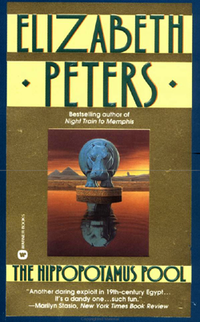
The Hippopotamus Pool
The title: The Hippopotamus Pool
The author: Elizabeth Peters
Publication: Warner, 1996
Got it from: Vancouver, 2001
"Another year, another dead body" is a favorite expression of the Emersons, but for me it's another year, another Amelia Peabody mystery. After last year's thrilling plotline, Amelia's husband Emerson has regained his memory and their archnemesis Sethos is dead - or is he? (Emerson: "I wouldn't put it past him to survive solely in order to annoy ME.") It's a new digging season, and a mysterious messenger seeks out the Emersons to tell them of the discovered tomb of Queen Tetisheri. This time, their children Ramses and Nefret are along for the ride and bickering only the way two non-related siblings who are destined to love each other can. Also along is their laughably inept new governess, Miss Marmaduke, and David, the grandson of their foreman Abdullah, who has a talent for forgeries. As the Emersons work on uncovering Tetisheri's tomb, it becomes clear that there are at least two sets of robbers also out for the tomb's treasures.
After The Snake, the Crocodile and the Dog, which focused so much more on the adventure and the relationships, I felt that The Hippopotamus Pool fared poorly in comparison. This is not to say it wasn't enjoyable, but I felt like it was an ordinary Amelia Peabody episode that followed similar plotlines to previous works in the series. A mysterious man shows up and is soon murdered - check. Unknown adversaries threatening their digs - check. Somebody in the family is kidnapped - check. Emerson tries to protect Amelia, she wants to go, they fight and then have sex a lot, she goes into danger anyway - check. It's predictable, but it's good, and I learned some more about archaeology in this one than I have in the other ones. A visit with old friends is still pleasant, even if the cake isn't as delicious this time around.
Sunday, August 29, 2010
The Sweetness at the Bottom of the Pie
The author: Alan Bradley
Publication: Doubleday, 2009
Got it from: The library
This book has been getting a lot of buzz in the past year and I'm probably the last person I know who's read it. 11-year-old Flavia de Luce is a precocious - and I do mean precocious - girl living in rural 1950's England. Living in a big old ramshackle family estate, she loves to indulge in her passion for chemistry in a lab abandoned by a long-dead ancestor. Her mother is dead and her father is a reclusive stamp collector who seldom talks to his daughters. Sister Ophelia (Feely) is obsessed with boys and makeup and Daphne (Daffy) likes to read big books with difficult words. Both enjoy tormenting Flavia.
The story begins when a dead jack snipe turns up on the kitchen porch with a stamp impaled on its bill. If that isn't strange enough, Flavia finds a dying man in the cucumber patch who breathes his last words to her before promptly expiring. Flavia sets out to solve the case with pigtails swinging, cycling around the town of Bishop's Lacey on her trusted bike Gladys and gathering evidence.
This is a mystery as comforting as tea on Sunday. One can't help wondering if Flavia is still out there somewhere in an English village, 7o years old and solving crime Miss Marple-style. It's light and enjoyable, easy to read and a lot of fun.
Saturday, April 17, 2010
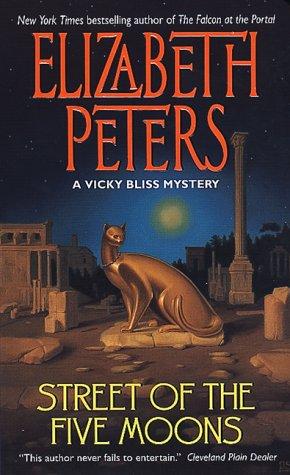
Street of the Five Moons (Vicky Bliss #2)
The author: Elizabeth Peters
Publication: HarperCollins, 1978
Got it from: DC, Aug 2009
I've been on such an EP kick lately. I've been gobbling up her books and have to force myself to slow down or I'll burn through them too quickly. Right now I'm alternating between Amelia Peabody and Vicky Bliss. Street of the Five Moons falls second in the Vicky Bliss series, after Borrower of the Night. It's an important one in the series because it introduces gentleman thief Sir John Smythe, who will become Vicky's main love interest.
Beautiful and blonde Dr. Victoria Bliss takes a holiday from her museum in Munich and goes hunting for art forgers in Rome (a favourite locale of EP's, also seen in the Amelia Peabody and Jacqueline Kirby books). Of course, she meets up with a cast of extremely quirky characters and there is non-stop action, starting with when Vicky is drugged and kidnapped from the Forum and is rescued by an unknown member of the smuggling ring (Sir John), who employs one or two or several shut up kisses in the process. (She does talk a lot, but to be fair Vicky also points out that John himself is a "long-winded devil.") Of course Vicky manages to stumble right into the thick of things, as Elizabeth Peters heroines always do, and everybody goes off to the palazzo of the very rich Count Caravaggio. It's the kind of house party setup - where everybody has lots of motivation and nothing is as it seems - that would make Agatha Christie weep with joy. The plot moves along nicely with more turns than a carousel until it's discovered Vicky is out to expose them all. I can't say too much, but she and Sir John do undertake what may be the longest escape scene in the history of literature. I counted about 40 pages. It's all good fun, tongue-in-cheek stuff, of course. I won't remember the details six months from now but it was all very entertaining, I assure you.
Sunday, December 27, 2009
The Snake, The Crocodile and the Dog
The author: Elizabeth Peters
Publication: Warner, 1992
Got it from: Vancouver, 2001
My project of reading one Amelia Peabody a year continues with the seventh in the series, which picks up where The Last Camel Died at Noon left off. Having rescued the daughter of missionaries from the Lost Oasis in Nubia, the Emersons leave young Nefret and their son Ramses (who is obviously infatuated with their new ward) in England. Once in Egypt, they find word of their adventure has spread and unscrupulous archaeologists are willing to do anything to learn the location of the Lost Oasis. While selecting this year's dig site, the usual excitement occurs and Amelia, then Emerson, get kidnapped. When Amelia eventually rescues him, she discovers her husband has forgotten her and must attempt to win his love all over again. Meanwhile, their friend Cyrus Vandergelt has arrived on the scene to help Amelia and may be developing feelings for her as well.
As usual, it's becoming impossible for me to not love an Elizabeth Peters book. I kept laughing on my lunch break at work, much to the annoyance of my co-workers, I'm sure. I enjoyed watching Amelia and Emerson stumble into love all over again and seeing Emerson fight his bad temper to grudgingly admit Amelia is not such a bad archaeologist. I also loved the appearance of one of my favourite characters (can't say who, it would spoil everything) who, as usual, is present throughout the story but not revealed until the end. There's not as much archaeology going on in this installment, but who cares? This book was just too exciting to put down. My only regret was that it had to end.
10 royal tombs out of 10
Monday, September 14, 2009
A Poisoned Season
The author: Tasha Alexander
Publication: HarperCollins, 2007
Got it from: TWBB, Toronto, April
This is the second book in the Lady Emily Ashton series, the first being And Only To Deceive, which I read and loved last summer. A Poisoned Season takes place the summer following the last novel's close. Emily has since returned from a holiday from her estate in Greece, undecided whether to accept the proposal of Colin Hargreaves, her late husband's best friend and spy for the royal crown. Meanwhile, a pompous gentleman has been making the rounds in London claiming to be a descendant of Marie Antoinette, and Emily has picked up a secret admirer who may be the thief stealing Marie Antoinette's property. Like every good British mystery, a murder occurs early on in the book and the victim's widow entrusts Emily with the task of solving it.
As usual, the charm of this series lies with the details of Victorian life. If you, like me, daydream about elegant balls, fancy dresses, tea parties, leisurely promenades and traveling the continent one art gallery at a time, you will not be disappointed. If you crave excitement, there's plenty of that too. The heroine is forever getting involved in dangerous situations that involve drugged wine, thieves in the night and attempted carriage overturnings.
Be warned, though: even if you've read the first book, the cast of characters in huge and difficult to keep track of. Thankfully there is a listing of them in the front of the book to help sort them out. Emily continues to be an enjoyable heroine. She only slightly borders on Mary Sue territory (another man in love with me? ho hum), but her intelligence and curiosity help redeem her.
Sadly, I will probably not be continuing on with this series. The except from book three at the back of this one did not seem like my cup of tea, and from the descriptions and reviews of the rest of the series I've read online, I don't think I would enjoy them all that much to put in the huge amount of concentration it takes to appreciate them. Still, I enjoyed these first two books and have already recommended them to others with very positive feedback.
Monday, August 10, 2009
Borrower of the Night (Vicky Bliss #1)
The title: Borrower of the Night
The author: Elizabeth Peters
Publication: HarperCollins, 1973
Got it from: Chapters
There have been few authors as consistently enjoyable for me as Elizabeth Peters. I am still working my way through the brilliant Amelia Peabody series, but a crazy notion (must be the August heat) had me reaching for Vicky Bliss instead. I'm sorry I haven't tried reading the Vicky Bliss series earlier. Vicky's no Amelia Peabody, but she's a pretty bad-ass modern counterpart.
Peters is the master of the romantic comedy mystery, no matter which era. As usual, the mystery is enjoyable but takes second place to the (sarcastic, wonderful, lovable) main characters. This book was written in 1973, but remains fresh 36 years later. Vicky is an American professor - tall, blonde, buxom and determined not to marry. Like Jacqueline Kirby, Peters' other droll heroine, Vicky flirts and spars with her male counterparts but rejects them all in favour of her independence at the end (though not without a bit of self pity. As she runs for help at the end of the novel, she muses in what may be one of the best paragraphs I've ever read: "I was sick. I was thirsty. I was all covered with dirt, and nobody loved me.") Supposedly she takes on a lover later in the series, someone more worthy of her. I can't wait.
The mystery feels a bit Agatha Christie-ish, with some Indiana Jones thrown in. Vicky and some of her university colleagues go to Germany in pursuit of long-lost shrine. A crumbling medieval castle plays a large role, as does the ubiquitous knife-wielding suit of armor. Of course it's all very silly, with moonlit chases in graveyards and fainting damsels, but I ain't complainin'. There's something comforting about a good mystery on a thunderstorming summer night (and we've had one every night for about a week). I am very much looking forward to reading more Vicky Bliss.
Saturday, November 22, 2008
56. Three Bags Full
The title: Three Bags Full: A Sheep Detective Story
The author: Leonie Swann
Publication: Random House, 2005
Got it from: The library
This review is late. I've been so busy watching the Dance Your PhD contest on YouTube that I can't do anything else. I'm still trying to think up a good dance for my husband's "the effects of Hegel on 19th century American writers" PhD. Nope. Nothing.
First, can I say: this book has a FLIP BOOK SHEEP in the bottom right hand corner! When you flip the pages the sheep hops! For that alone, the book deserves an extra letter. Maybe a letter and a half.
I was drawn to this book by the wacky premise: a flock of sheep solve their shepherd's murder. I really, really love this book. I have decided that I adore sheep now. I just wanted to squeeze every last one of those adorable sheep. I loved this book so much, I am adding a new category to my genre tags: crime-solving sheep.
George Glenn's sheep aren't ordinary sheep. George has read them detective novels, you see, and that makes them smarter than the average sheep, maybe the smartest sheep in the world. George has also given them names like Miss Maple (the smartest in the flock), Othello (the bad-boy black sheep), Mopple the Whale (he eats a lot), Cloud (very fluffy), etc. George turns up dead at the beginning of the book and the sheep, their heads full of detective novels, take it upon themselves to solve this most heinous crime.
The mystery itself isn't the least bit compelling. What makes this book so great is the sheep themselves. Everything is seen through their eyes and by their standards humans are very silly and incomprehensible. The sheep take to finding clues and spying on humans next to open windows. I find it hard to believe that everyone in the village talks next to an open window, but I suppose when one reads about sheep detectives one can't quibble with the plausible. What we see through the sheep is distorted and the mystery is as opaque as black paint. I wish things had been a little more clear at the end, but as the sheep didn't seem to mind I suppose the reader isn't supposed to either. I have to appreciate that the author didn't hit me over the head with the obvious, but let it unravel slowly like...wool. Funny, clever and adorable. Why hasn't there been a sequel? I want a sequel! A-
George Glenn's Sheep's List of Things That Make a Good Shepherd:
1. Clothes himself entirely in the products of his own flock.
2. The quantity and quality of the fodder he provides. Bread and sugar and green stuff, but also concentrated feed and mangel-wurzels.
3. Never docks his lambs' tails.
4. Doesn't keep a sheepdog.
Monday, September 8, 2008
42. The Last Camel Died at Noon
Amelia Peabody...eases the pain
The title: The Last Camel Died at Noon
The author: Elizabeth Peters
Publication: Warner Books, 1991
Got it from: Vancouver, 2001
Oops, I've painted myself into a corner. Ever since 2001, I vowed I'd read an Amelia Peabody mystery every year until I was finished all eighteen in the series. I'm a bit behind, because I keep missing years. Here's the problem: I'm hungry for more but I know I must wait another year. As Amelia's husband Emerson would say, "Curse it!"
For those of you who don't know, Amelia Peabody Emerson is the star of a series of Egyptology mysteries set around the turn of the 20th century. Those readers who don't share my enthusiasm for Egyptology are still urged to read them for the wonderful characters. The narrator of the story is Amelia herself, heiress to her late professor father's fortune and intrepid adventuress. Amelia is one of the most well-conceived female characters in literary history. Her witty observations, particularly about her husband, are a riot. She takes a no-nonsense attitude with everything, but she's secretly an incurable romantic. She's unstopable, particularly with her most trusty accomplice, her parasol, which she uses to frequently beat the snot out of anyone or anything who gets in her way. Then there's her temperamental husband, Emerson, who hates the world and everyone in it, except for his own family. He has a reputation as one of the most feared men in Egypt, and he's constantly tearing open his shirts, either in rage or in passion. (This prompts Amelia's most frequently-used phrase, "Another shirt ruined?" Her other phrase is "Another year, another dead body.") Then there's the Emersons' lovable, precocious brat of a son, Ramses, who will eventually grow up into a swoonbeast but for now is still a monkey who speaks several dead languages and disguises himself among natives to glean information. Naturally, the Emersons attract attention wherever they go and frequently stumble upon mysteries that they have to solve every digging season like clockwork.
This year's episode has the tireless threesome out in the desert, searching for a lost oasis that may or may not contain some friends who disappeared over a decade earlier. After nearly dying in the desert of thirst after their camels have all died (a reference to the book's title) they are whisked away to said mysterious oasis, restored to health and kept prisoners for some (as yet unknown) purpose. It's all very silly, of course, but the Emersons always make it enjoyable. The story is lifted straight out of H. Rider Haggard (whom Amelia is addicted to reading) and probably merits a B-grade romp, especially considering how the last third dragged a bit. What bumps it to the A-level is the hilarious one-liners. If I'd mark each spot that made me laugh out loud, the whole book would be marked up. Now if only I didn't have to wait until next year to continue the saga. It's like crack, I tells ya... A-
Saturday, August 2, 2008
38. And Only to Deceive
The title: And Only to Deceive
The author: Tasha Alexander
Publication: HarperCollins, 2005
Got it from: The highly scientific process of "it was in a box of books someone donated to the library": Part II
I actually finished this book awhile ago, and it's a shame I didn't get to write about it sooner, because I haven't enjoyed a book like this in a long time. (Our Interweb has been down, in case you're wondering).
In this Victorian-era mystery, young widow Lasy Ashton has been in mourning for her husband, the Viscount Ashton, for over a year. She didn't know him all that well, and thus feels no loss for him, while enjoying the privilege and freedom that comes with being a widow in the 19th century. That is until she stumbles across her husband's journals and discovers he was very much in love with her. Much to her dismay, she finds herself falling in love with her dead husband. With her new discovery, she takes up her husband's passion for classical literature and art, and soon stumbles upon a forgery ring centred around the British Museum. Did you say British Museum? Yes, I know, I have a weakness for the British Museum and books about it. There will actually be two more reviews coming up featuring the British M. but I shall leave that for later.
And Only to Deceive is full of wonderful secondary characters, like Cecile, the irreverent French dowager with a mania for miniatures, who takes Emily under her wing; and Margaret, her port-swilling, cigar smoking bluestocking friend. Emily is herself is a wonderfully drawn heroine, and her growth from rebellious daughter to intelligent woman is a delight to watch unfold. And of course I couldn't go without mentioning Colin (I have dubbed him Mr. Sexy Pants), her husband's best friend, whose "concern" for Emily goes beyond friendship. If you know what I mean. And I think you do.
And the settings! Late Victorian London, Paris during the height of the Impressionists and, briefly, Greece. What more could you ask for? This book was simply a treat to read, through and through. I can't wait to get my hands on the other two in the series. A-
Saturday, July 5, 2008
34. Her Royal Spyness
The title: Her Royal Spyness
The author: Rhys Bowen
Publication: Prime Crime, 2007
Got it from: Library
Lady Georgiana ("Georgie"), 34th in line to the British throne, has just had her allowance cut off and now the poor little rich girl has to make her own way in London. Think chick lit set in the 1930's. Okay, to be fair, Georgie isn't as annoying as your average chick lit heroine, and the plot isn't as fluffy. But it's still ridiculously light. There's a murder involved, of course, and a roguish love interest (natch) but I kept waiting for that extra bit of sparkle to come in, something that would make Georgie more than the expected plucky heroine. Sadly, it never came. I'll say two things in favour of the book, though. It did keep me interesteed, and it gave me the fabulous phrase "rumpy-pumpy" which is a euphemism for...well...I'll let you use your imagination. B.
Subscribe to:
Posts (Atom)