The title: America's Women
The author: Gail Collins
Publication: HarperCollins, 2003
Got it from: Christmas 2014
Last fall when I bought Gail Collins' When Everything Changed at the Seneca Falls Women's Rights Musuem I enjoyed it so much I asked for her other women's history book for Christmas. Where Changed focused on the 1960s to present, this one covers over 400 years of history. And let me tell you, it did not disappoint. One reviewer called it "as readable as any Harry Potter adventure," and they aren't kidding.
I am in absolute awe of the way Collins writes. The depth of her research and knowledge is astonishing, but it's the way she can pinpoint the remarkable women of history and make their lives exciting that's really impressive. Each chapter covers a different era in American history from the Pilgrims to the Women's Lib movement and honestly, each one could have been a whole book. I'd find myself caught up in a mini-biography of some fascinating, forgotten woman of history and be disappointed when her section ended, only to find myself riveted in the next part by details of how ordinary women lived their day-to-day lives. Of course she touches on the greats (Anthony, Tubman, Roosevelt, etc.) in a way that makes them accessible, but it's the way that she manages to make you feel as if you were a woman living that era that's truly remarkable.
It's hard to say which era I enjoyed reading about the most. The section on the Salem Witch trials was interesting, given the mythic proportions to which the event has been inflated - though the truth, as usual, is far more interesting. Reading about the Underground Railroad and first person testimony from former women slaves was probably the most enlightening of the whole book. And after reading about the hardships endured by the women pioneers in the West, I have to say thanks but no thanks. If I had to pick an era to live in as a woman (other than today), I'd have to go with 1920s New York, which was a pretty exciting time for us gals, what with the dispensing of corsets and getting to drink and party and wear your hair short for the first time.
Overall, this book does an outstanding job of filling the women-shaped hole in American history. I thought I knew these stories already, but I was wrong.
Showing posts with label History. Show all posts
Saturday, August 8, 2015
Monday, June 8, 2015
The Thrilling Adventures of Lovelace and Babbage
The title: The Thrilling Adventures of Lovelace and Babbage
The author: Sydney Padua
Publication: Pantheon, 2015
Got it from: The library
Ah, Ada Lovelace. Daughter of Lord Byron, the original Queen of Steampunk, arguably the world's first computer programmer. Is there anything she can't do? Sydney Padua doesn't think so, as she sets out to prove in this graphic novel/alternate history/adventure/science and math lesson. Yes, it's all over the place, as hard to pin down as Charles Babbage's never-finished Analytical Engine. This graphic novel is really a series of vignettes of "what might have been" if the computer had actually been built and was used to solve crime and various economical woes. Interspersed are a whole lot of background notes (seriously, at one point I was in the footnote of a footnote of a footnote). Various Victorian personages drop in and out, including Queen Victoria (apparently the world's first fan of LOLCats), George Eliot and of course the Romantics.
It's all a lot of silliness, of course, but oh my goodness is there a lot of math and science. I encountered terms I haven't heard since school and didn't know I even remembered. After reading detail after detail of how the Analytical Engine was designed, I think I may actually have a slight grasp of how computers work. Don't worry, it's not all dry mathematics, there's actually some pretty great historical humour in here that Victorianists will appreciate. I particularly love a scene where actual computers (people who did computations) try to wreck the machine Luddite-style and Babbage sits them down to tea to reason with them. Both Babbage and Lovelace were fascinating characters who make excellent heroes this quirky and fun book.
The author: Sydney Padua
Publication: Pantheon, 2015
Got it from: The library
Ah, Ada Lovelace. Daughter of Lord Byron, the original Queen of Steampunk, arguably the world's first computer programmer. Is there anything she can't do? Sydney Padua doesn't think so, as she sets out to prove in this graphic novel/alternate history/adventure/science and math lesson. Yes, it's all over the place, as hard to pin down as Charles Babbage's never-finished Analytical Engine. This graphic novel is really a series of vignettes of "what might have been" if the computer had actually been built and was used to solve crime and various economical woes. Interspersed are a whole lot of background notes (seriously, at one point I was in the footnote of a footnote of a footnote). Various Victorian personages drop in and out, including Queen Victoria (apparently the world's first fan of LOLCats), George Eliot and of course the Romantics.
It's all a lot of silliness, of course, but oh my goodness is there a lot of math and science. I encountered terms I haven't heard since school and didn't know I even remembered. After reading detail after detail of how the Analytical Engine was designed, I think I may actually have a slight grasp of how computers work. Don't worry, it's not all dry mathematics, there's actually some pretty great historical humour in here that Victorianists will appreciate. I particularly love a scene where actual computers (people who did computations) try to wreck the machine Luddite-style and Babbage sits them down to tea to reason with them. Both Babbage and Lovelace were fascinating characters who make excellent heroes this quirky and fun book.
Friday, January 2, 2015
Revolutionary Mothers
The title: Revolutionary Mothers: Women in the Struggle for America's Independence
The author: Carol Berkin
Publication: Vintage Books, 2005
Got it from: Visitor Center, Quincy, Massachusetts
I've been learning a lot about the American Revolution ever since I became interested in Abigail Adams, and I bought this book when I was on a tour of their home in Massachusetts. I have to confess it's taken me forever to read, even though it's not a long book at all. I started it on my holiday last June and finally when the new year rolled around, I told myself to just get it done.
Because this book is slight and doesn't spend too much time on any one woman, it feels like more of a jumping-off point for further research into this fascinating subject. It covers the everyday life of women on both sides of the war, from the well-to-do ladies of Boston to the camp followers to the plight of women who were slaves. The author is a professor of American history and this book suffered somewhat from sounding at times like a PhD thesis (x happened because of y, and here are the footnotes to back it up). I did enjoy some of the fun stories, especially of the Loyalist women who were exiled to my old hometown of Saint John. A poem of the day summed up the Loyalists' feelings: "Of all the vile countries that ever were known/In the frigid or torrid or temperate zone/From accounts I had there is not such another/It neither belongs to this world nor the other." Yeah, that's Saint John alright!
Predictably women went back to their confined lives after the war, despite having done some incredible and exciting things during the conflict. Maybe that's what makes the Revolution so much more fun to read about than the times of peace surrounding it.
The author: Carol Berkin
Publication: Vintage Books, 2005
Got it from: Visitor Center, Quincy, Massachusetts
I've been learning a lot about the American Revolution ever since I became interested in Abigail Adams, and I bought this book when I was on a tour of their home in Massachusetts. I have to confess it's taken me forever to read, even though it's not a long book at all. I started it on my holiday last June and finally when the new year rolled around, I told myself to just get it done.
Because this book is slight and doesn't spend too much time on any one woman, it feels like more of a jumping-off point for further research into this fascinating subject. It covers the everyday life of women on both sides of the war, from the well-to-do ladies of Boston to the camp followers to the plight of women who were slaves. The author is a professor of American history and this book suffered somewhat from sounding at times like a PhD thesis (x happened because of y, and here are the footnotes to back it up). I did enjoy some of the fun stories, especially of the Loyalist women who were exiled to my old hometown of Saint John. A poem of the day summed up the Loyalists' feelings: "Of all the vile countries that ever were known/In the frigid or torrid or temperate zone/From accounts I had there is not such another/It neither belongs to this world nor the other." Yeah, that's Saint John alright!
Predictably women went back to their confined lives after the war, despite having done some incredible and exciting things during the conflict. Maybe that's what makes the Revolution so much more fun to read about than the times of peace surrounding it.
Thursday, January 1, 2015
When Everything Changed
The title: When Everything Changed: The Amazing Journey of American Women from 1960 to the Present
The author: Gail Collins
Publication: Little, Brown and Company, 2009
Got it from: Seneca Falls Women's Rights Museum, 2014
Happy 2015! What a great book to be starting the new year with. I bought When Everything Changed last fall on a trip to Seneca Falls and could hardly put it down.
There's so much women of my generation and younger take for granted. Yet when this story opens in 1960, women weren't much further along than they had been in the nineteenth century. (Once upon a time, I used to think that 1960 was ancient history but - paradoxically - the older I get the closer in time it seems.) Which is why I think every girl and woman from 8 to 80 should read this book: to learn about a time when women weren't allowed in certain bars, on certain planes and in a lot of workplaces. There was once a time when women couldn't get their own credit cards without their husband's signature, or buy a house for themselves, or (gasp!) wear pants in public. And then Women's Liberation happened, and everything changed. As the author herself says, "Even people who were there don't actually remember what it was like."
What makes this book so engrossing is that Collins is able to seamlessly move from from describing the really big stories about landmark legal victories and big-name feminists like Betty Friedan to stories about ordinary women and their day-to-day lives, in their own words. There is honestly never a dry or superfluous passage. It all feels important and fascinating. Nor do white women hog all the limelight. A sizeable portion of the book is devoted to the Civil Rights movement and how it helped pave the way for the Women's Liberation movement. The profiles of the courageous African-American women who fought for both movements are some of the best parts of the book. Out of all the women in the book, Ella Baker is by far my biggest hero.
Most of the book is devoted to what happened between 1964-1973. As the author later admitted in an interview, everything after that has been an attempt to come to grips with the seismic shift of that short decade. Some of the ways that things haven't changed are infuriating (as is the section on Phyllis Schlafly, who has arguably done more to destroy feminism than any woman in history). Still, the story ends on a positive note: the U.S. has recently come close to having a female candidate run for president, and may very well soon have a woman in the White House. Now that would be amazing.
The author: Gail Collins
Publication: Little, Brown and Company, 2009
Got it from: Seneca Falls Women's Rights Museum, 2014
Happy 2015! What a great book to be starting the new year with. I bought When Everything Changed last fall on a trip to Seneca Falls and could hardly put it down.
There's so much women of my generation and younger take for granted. Yet when this story opens in 1960, women weren't much further along than they had been in the nineteenth century. (Once upon a time, I used to think that 1960 was ancient history but - paradoxically - the older I get the closer in time it seems.) Which is why I think every girl and woman from 8 to 80 should read this book: to learn about a time when women weren't allowed in certain bars, on certain planes and in a lot of workplaces. There was once a time when women couldn't get their own credit cards without their husband's signature, or buy a house for themselves, or (gasp!) wear pants in public. And then Women's Liberation happened, and everything changed. As the author herself says, "Even people who were there don't actually remember what it was like."
What makes this book so engrossing is that Collins is able to seamlessly move from from describing the really big stories about landmark legal victories and big-name feminists like Betty Friedan to stories about ordinary women and their day-to-day lives, in their own words. There is honestly never a dry or superfluous passage. It all feels important and fascinating. Nor do white women hog all the limelight. A sizeable portion of the book is devoted to the Civil Rights movement and how it helped pave the way for the Women's Liberation movement. The profiles of the courageous African-American women who fought for both movements are some of the best parts of the book. Out of all the women in the book, Ella Baker is by far my biggest hero.
Most of the book is devoted to what happened between 1964-1973. As the author later admitted in an interview, everything after that has been an attempt to come to grips with the seismic shift of that short decade. Some of the ways that things haven't changed are infuriating (as is the section on Phyllis Schlafly, who has arguably done more to destroy feminism than any woman in history). Still, the story ends on a positive note: the U.S. has recently come close to having a female candidate run for president, and may very well soon have a woman in the White House. Now that would be amazing.
Monday, December 22, 2014
Lost Animals
The title: Lost Animals: Extinction and the Photographic Record
The authors: Errol Fuller
Publication: Bloomsbury, 2013
Got it from: The library
Lost Animals charts the story of a handful of recently extinct species through photos and eyewitness histories. Most of the species went extinct at the beginning of the 20th century, so photographs are inevitably black and white (with a few exceptions). Like a detective, the author had to go to great lengths to track down some of these rare pictures. The stories of the efforts made to obtain photos of these vanishing creatures are almost as fascinating as the animals themselves.
Some of the animals in this book may be familiar, such as the passenger pigeon and the quagga, but others are more obscure. Species range from New Zealand's laughing owl to the Yangtze River dolphin (whose last member was the adorably name Qi Qi). Their stories all end the same way: humans. More specifically, hunting and habitat destruction. It's enough to make you think that Voluntary Human Extinction group may have the right idea.
This isn't exactly cheerful Christmas fare, but this is one of those rare books that feels like essential reading for anyone who cares about animals. Which is not to say it was a chore to read - far from it. This book made me feel a variety of emotions: fascination, anger at the thoughtlessness and cruelty of humans, despair, and a new appreciation for the precious animals still remaining on this planet. Thankfully it's not all doom and gloom. For every group of destructive humans, there seems to be an euqally passionate group of conservationist who speak up for the animals. Still, with global overcrowding becoming inevitable, one wonders how we will be able to maintain future diversity.
The authors: Errol Fuller
Publication: Bloomsbury, 2013
Got it from: The library
Lost Animals charts the story of a handful of recently extinct species through photos and eyewitness histories. Most of the species went extinct at the beginning of the 20th century, so photographs are inevitably black and white (with a few exceptions). Like a detective, the author had to go to great lengths to track down some of these rare pictures. The stories of the efforts made to obtain photos of these vanishing creatures are almost as fascinating as the animals themselves.
Some of the animals in this book may be familiar, such as the passenger pigeon and the quagga, but others are more obscure. Species range from New Zealand's laughing owl to the Yangtze River dolphin (whose last member was the adorably name Qi Qi). Their stories all end the same way: humans. More specifically, hunting and habitat destruction. It's enough to make you think that Voluntary Human Extinction group may have the right idea.
This isn't exactly cheerful Christmas fare, but this is one of those rare books that feels like essential reading for anyone who cares about animals. Which is not to say it was a chore to read - far from it. This book made me feel a variety of emotions: fascination, anger at the thoughtlessness and cruelty of humans, despair, and a new appreciation for the precious animals still remaining on this planet. Thankfully it's not all doom and gloom. For every group of destructive humans, there seems to be an euqally passionate group of conservationist who speak up for the animals. Still, with global overcrowding becoming inevitable, one wonders how we will be able to maintain future diversity.
Sunday, November 3, 2013
Colonial times, writing spaces and other miscellany
In preparation for my visit to New England, I read large chunks of Alice Morse Earle's Home and Child Life in Colonial Times (abridged from two of her earlier books). What makes her history so fascinating was that she wrote at the end of the 19th century and could record many first-person accounts from the elderly people in her community about their lives and those of their parents and grandparents.
This book is full of all kinds of funny gossip and stories about life in America before 1850. The author is not afraid to interject with her own opinions, such as when she calls early children's books dry and tedious. I was frequently amused by her references to "life in olden days" as opposed to "now," which for her that meant the difference between things like buying ready-made ink versus making it yourself from bark(!) There are some excellent sections on what school was like, the reason the Colonials had such good handwriting, early toys, etc. As an aside, I was amused by her account of the primitive mail system that existed in the 18th century, and the story of one mailman who liked to skate down the Hudson River with letters on his back while he knitted socks and hats.
Reading about homes, and then coming back to my own, helps me see mine with new eyes. I am extremely fortunate to have my own "creative" room that is just mine (and the only room in the house where my husband can't leave a mess!) I think everyone who does anything artistic needs their own creative space.
I'm not a big fan of the popular minimalist trend. I like to have things neat and tidy, but I also think you should surround yourself with things you love, have meaning for you and inspire you. Here are some shots of my creative space:
This is my desk, where I write all my letters, blog, scrapbook, etc. I have it set up facing my window. During the daytime, I love to open the blinds and watch the trees, birds and squirrels outside.
The desk itself is a family heirloom. It used to be a lot messier, but a few months ago I was inspired by a secretary I saw at an antiques store. I bought a really cheap (under $10) desk organizer to hold all my notepads, maps, etc.
On the left is a mug from Stonehenge that my grandmother bought me on a trip to England back in the 1990's. I've used it as a pencil/pen holder ever since. The Canadian flag is from this year's Canada Day celebrations. Beside it is a notepad of CBC logos that I bought in Toronto earlier this year. Beside the mouse is a beautiful glass coaster with real pressed flowers. On the right you can see a stack of recently acquired paperbacks waiting to be read an reviewed!
I'm not really into Pinterest. I like to keep an actual bulletin board of things I enjoy, like postcards and a sprig of flowers from my garden.
Beside that, I have one book case just for romance novels. In the cupboards below I keep presents and my scrapbooking and mosaic supplies.
I bought this blue box a few years ago to hold all my letters in chronological order.
Just beside my letters I keep all my envelopes and note cards. The Christmas box is one of my favourite objects and holds several years' worth of Christmas cards.
Beside my book case, I like to hang all my cloth bags that I've collected over the years that I use mostly to carry library books. The "Little Women" bag on top came with me to Concord!
To the right of the door is my "messy bookcase." A while ago I attempted to roughly organize the books by genre. You may recognize some of the books I've reviewed on this blog over the years. This is just a sample of my collection, the rest are elsewhere in the house.
Whenever I travel, I like to collect a miniature of the local famous landmark. I bought all but the Eiffel Tower, which was given to me by a friend (left to right: CN Tower, Big Ben tower, Eiffel Tower, Empire State Building, Colosseum). Just behind it you can see a silver box that I got for my high school graduation and a painting done by a close friend.
Continuing our circle around the room is the futon where I like to relax with a good book. The Jane Austen pillow was a birthday gift from my sister from a few years ago. The blanket was another graduation present made by a family friend.
Right above that is a poster of 18th century objects. It used to have a frame but unfortunately one hot and humid summer day the hook fell down and the frame broke. It will be replaced, eventually. Beside that is my "world at night" poster that I bought in grad school.
And now we have made a full circle! The Sense and Sensibility iPod charger is another gift from my sister, and the Provence candle a gift from a friend. And the laptop of course is where all the magic happens...
Thank for coming with me on a tour of my creative space!
Monday, August 26, 2013
Flu: The Story of the Great Influenza Pandemic of 1918
The title: Flu: The Story of the Great Influenza Pandemic of 1918
The authors: Gina Kolata
Publication: Farrar, Straus and Giroux, 1999
Got it from: The library
I have been wanting to read a book about the influenza epidemic of 1918 and this one was recommended as one of the best. Unfortunately it doesn't actually go into as much detail as I'd like about the actual epidemic. It's almost entirely about what happened after, which is itself a fascinating story.
In recent years there has been more interest in studying this flu, but until the 1990's (ie, in living memory), it was almost as if it never happened. But the facts are shocking: more people died of the flu in just a few months than were killed in World War I. What made the disease so horrifying was that it most often struck and killed young adults (aged 20-40). Until recently, no one knew what it was and what caused it.
The author goes into great detail about the lives of the scientists who in the years after searched for the killer virus. This is a timely subject for those of us living today, having just gone through the 2009 swine flu epidemic and will probably be facing another one in a matter of years. The problem was that in 1918 doctors and scientists weren't equipped with the tools and knowledge to combat the virus, let alone to figure out what was causing it. Modern-day scientists had to do some serious detective work to track down the extinct virus. In a few cases, they used tissue samples taken from victims and stored in paraffin, in other instances they traveled to the Arctic and unearthed the bodies of victims from permafrost.
Reading this makes me want to know more about the social history of the effects of this disease. How could 40 million people (most of them in the prime of life) just disappear without it affecting the course of history? There is some hint at the ripple effects on people's psyches, such as the 1976 American vaccine debacle where scientists and politicians rushed to vaccinate people because they feared another 1918. Perhaps these are questions to be answered by another book.
The authors: Gina Kolata
Publication: Farrar, Straus and Giroux, 1999
Got it from: The library
I have been wanting to read a book about the influenza epidemic of 1918 and this one was recommended as one of the best. Unfortunately it doesn't actually go into as much detail as I'd like about the actual epidemic. It's almost entirely about what happened after, which is itself a fascinating story.
In recent years there has been more interest in studying this flu, but until the 1990's (ie, in living memory), it was almost as if it never happened. But the facts are shocking: more people died of the flu in just a few months than were killed in World War I. What made the disease so horrifying was that it most often struck and killed young adults (aged 20-40). Until recently, no one knew what it was and what caused it.
The author goes into great detail about the lives of the scientists who in the years after searched for the killer virus. This is a timely subject for those of us living today, having just gone through the 2009 swine flu epidemic and will probably be facing another one in a matter of years. The problem was that in 1918 doctors and scientists weren't equipped with the tools and knowledge to combat the virus, let alone to figure out what was causing it. Modern-day scientists had to do some serious detective work to track down the extinct virus. In a few cases, they used tissue samples taken from victims and stored in paraffin, in other instances they traveled to the Arctic and unearthed the bodies of victims from permafrost.
Reading this makes me want to know more about the social history of the effects of this disease. How could 40 million people (most of them in the prime of life) just disappear without it affecting the course of history? There is some hint at the ripple effects on people's psyches, such as the 1976 American vaccine debacle where scientists and politicians rushed to vaccinate people because they feared another 1918. Perhaps these are questions to be answered by another book.
Monday, May 6, 2013
Eighty Days: Nellie Bly and Elizabeth Bisland's History-Making Race Around the World
The title: Eighty Days: Nellie Bly and Elizabeth Bisland's History-Making Race Around the World
The author: Matthew Goodman
Publication: Ballantine Books, 2013
Got it from: The library
I was MIA in April because I was buried deep in five books I was book-talking for a library program (and all of you librarians know how nerve-wracking book talks are). One of the books was Matthew Goodman's Eighty Days: Nellie Bly and Elizabeth Bisland's History-Making Race Around the World.
Now, I did read Jules Verne's book a few years ago, and I think Nellie Bly is pretty boss, so how did I not know that she once raced around the world? If you don't know Nellie Bly, look her up - she was a scrappy female reporter in Gilded Age New York who did some pretty awesome things. (She also has her own mystery series, which will show up here in future reviews). In 1889, she set out to beat the record set by the fictional Phileas Fogg in Around the World in 80 Days and circumnavigate the globe in 75 days. Meanwhile, another reporter, Elizabeth Bisland (a literary critic who was none too pleased to be told she had to travel in a moment's notice) also set out to race against her, albeit in the opposite direction.
It was the perfect age to travel in. Both of the ladies had rich newspaper companies paying their first-class fares the whole way around, and Britain was at the height of its empire. They barely had to step foot off British soil, even though they stopped at ports around the world to change transportation. Nellie Bly headed east, suffered horrible seasickness on the Atlantic, met Jules Verne in France, bought a monkey in Ceylon, and fended off would-be suitors who thought she was rich. Elizabeth Bisland went west, encountered a hair-raising train trip through the Rockies, charmed everyone on board her Pacific steamer and fell in love with Japan. Both women got a bit cranky (as you do when you're traveling at breakneck speed for over seventy days) but only one ultimately emerged triumphant, breaking the world record and becoming a national heroine.
This book isn't a quick read. There's a lot of dense text and tons and tons of historical detail that interrupts the narrative of the race itself. If you don't mind that sort of thing and are curious about what the world looked like in the late 19th century (at least through the eyes of two kinda racist but good-hearted women), you'll love Eighty Days.
The author: Matthew Goodman
Publication: Ballantine Books, 2013
Got it from: The library
I was MIA in April because I was buried deep in five books I was book-talking for a library program (and all of you librarians know how nerve-wracking book talks are). One of the books was Matthew Goodman's Eighty Days: Nellie Bly and Elizabeth Bisland's History-Making Race Around the World.
Now, I did read Jules Verne's book a few years ago, and I think Nellie Bly is pretty boss, so how did I not know that she once raced around the world? If you don't know Nellie Bly, look her up - she was a scrappy female reporter in Gilded Age New York who did some pretty awesome things. (She also has her own mystery series, which will show up here in future reviews). In 1889, she set out to beat the record set by the fictional Phileas Fogg in Around the World in 80 Days and circumnavigate the globe in 75 days. Meanwhile, another reporter, Elizabeth Bisland (a literary critic who was none too pleased to be told she had to travel in a moment's notice) also set out to race against her, albeit in the opposite direction.
It was the perfect age to travel in. Both of the ladies had rich newspaper companies paying their first-class fares the whole way around, and Britain was at the height of its empire. They barely had to step foot off British soil, even though they stopped at ports around the world to change transportation. Nellie Bly headed east, suffered horrible seasickness on the Atlantic, met Jules Verne in France, bought a monkey in Ceylon, and fended off would-be suitors who thought she was rich. Elizabeth Bisland went west, encountered a hair-raising train trip through the Rockies, charmed everyone on board her Pacific steamer and fell in love with Japan. Both women got a bit cranky (as you do when you're traveling at breakneck speed for over seventy days) but only one ultimately emerged triumphant, breaking the world record and becoming a national heroine.
This book isn't a quick read. There's a lot of dense text and tons and tons of historical detail that interrupts the narrative of the race itself. If you don't mind that sort of thing and are curious about what the world looked like in the late 19th century (at least through the eyes of two kinda racist but good-hearted women), you'll love Eighty Days.
Monday, January 21, 2013
Lost London
The title: Lost London
The author: Richard Guard
Publication: Michael O'Mara Books, 2012
Got it from: DC, Xmas 2012
Wow, is it Monday already? I've been completely absorbed in so many things this weekend. I finished Betsy-Tacy and the complete Beatrix Potter. Watched Downton Abbey - oh my goodness, can this show get any more addictive? Finished first season of Slings & Arrows. Also watched all seven hours of the John Adams miniseries from HBO. They made Thomas Jefferson sexy, don't ask me how. Anyway, I almost forgot I finished this book.
I love to collect useless information about London like a magpie, so I enjoyed this book. It's all about buildings, people and things that used to be found in London but are now gone. Many of them I have heard of already (like the Frost Fairs), but some I haven't. London is particularly fascinating for its "lost history" because so much was destroyed by the fire of 1666 and the Blitz. Henry Mayhew (this guy is in pretty much any Victorian London history) and Samuel Pepys provided a lot of information for this book.
I only wish there had been more detail for the entries, as some of the original source information was rather vague. For instance, there's the "Chelsea Bun House," home of the original chelsea bun, which supposedly sold 240,000 buns on Good Friday 1839. How is that even possible? Let's say they were open for ten hours, that's still 400 buns a minute! Another list by Mayhew of the different crossing sweepers included the following: "The Bearded Crossing Sweeper at the Exchange. An Old Woman. The Crossing Sweeper who had been a Serving Maid. One-Legged Crossing Sweeper of Chancery Lane." And my personal favourite: "The Negro Crossing Sweeper who has lost both his legs." Wow. Kind of puts your own life in perspective, doesn't it? Interestingly, the author lays to rest the popular notion of "plague pits," citing almost no evidence for these mythical mass graves to date.
Some familiarity with the city is required for reading this book, and it's more of a jumping-off point for further investigation, but it was still very amusing.
The author: Richard Guard
Publication: Michael O'Mara Books, 2012
Got it from: DC, Xmas 2012
Wow, is it Monday already? I've been completely absorbed in so many things this weekend. I finished Betsy-Tacy and the complete Beatrix Potter. Watched Downton Abbey - oh my goodness, can this show get any more addictive? Finished first season of Slings & Arrows. Also watched all seven hours of the John Adams miniseries from HBO. They made Thomas Jefferson sexy, don't ask me how. Anyway, I almost forgot I finished this book.
I love to collect useless information about London like a magpie, so I enjoyed this book. It's all about buildings, people and things that used to be found in London but are now gone. Many of them I have heard of already (like the Frost Fairs), but some I haven't. London is particularly fascinating for its "lost history" because so much was destroyed by the fire of 1666 and the Blitz. Henry Mayhew (this guy is in pretty much any Victorian London history) and Samuel Pepys provided a lot of information for this book.
I only wish there had been more detail for the entries, as some of the original source information was rather vague. For instance, there's the "Chelsea Bun House," home of the original chelsea bun, which supposedly sold 240,000 buns on Good Friday 1839. How is that even possible? Let's say they were open for ten hours, that's still 400 buns a minute! Another list by Mayhew of the different crossing sweepers included the following: "The Bearded Crossing Sweeper at the Exchange. An Old Woman. The Crossing Sweeper who had been a Serving Maid. One-Legged Crossing Sweeper of Chancery Lane." And my personal favourite: "The Negro Crossing Sweeper who has lost both his legs." Wow. Kind of puts your own life in perspective, doesn't it? Interestingly, the author lays to rest the popular notion of "plague pits," citing almost no evidence for these mythical mass graves to date.
Some familiarity with the city is required for reading this book, and it's more of a jumping-off point for further investigation, but it was still very amusing.
Wednesday, August 8, 2012
The Ancient Guide to Modern Life
The title: The Ancient Guide to Modern Life
The author: Natalie Haynes
Publication: Profile Books, 2012
Got it from: DC, Xmas 2011
I loved this book from comedian Natalie Haynes about the correlations between ancient times and today. I've been interested in the classical world ever since my university classics courses, but haven't read much about it since. I usually read things about the 19th century, so this was a nice change of pace. The book is divided into chapters dealing with aspects of ancient Greek and Roman society (law, politics, entertainment, etc.) and shows the similarities and differences between then and now, with some observations on how we can learn from our predecessors. For instance, there is a bit about how much more involved the people of ancient Greece were in politics and maintaining their democracy, and how we as a society can learn from their example. I liked the comparison of ancient entertainment to ours - how we still love stories of dysfunctional families, for example, only instead of Medea we watch The Sopranos. I highly recommend this funny, thought-provoking title.
The author: Natalie Haynes
Publication: Profile Books, 2012
Got it from: DC, Xmas 2011
I loved this book from comedian Natalie Haynes about the correlations between ancient times and today. I've been interested in the classical world ever since my university classics courses, but haven't read much about it since. I usually read things about the 19th century, so this was a nice change of pace. The book is divided into chapters dealing with aspects of ancient Greek and Roman society (law, politics, entertainment, etc.) and shows the similarities and differences between then and now, with some observations on how we can learn from our predecessors. For instance, there is a bit about how much more involved the people of ancient Greece were in politics and maintaining their democracy, and how we as a society can learn from their example. I liked the comparison of ancient entertainment to ours - how we still love stories of dysfunctional families, for example, only instead of Medea we watch The Sopranos. I highly recommend this funny, thought-provoking title.
Monday, June 11, 2012
Non-fiction bites
Tutankhamen by Joyce Fyldesley
Obviously I am crazy about all things Egypt and this book is an excellent introduction to the rock-star like pharaoh who was a minor king in his own time but has achieved huge cultural significance today. The author touches on both what is known about Tutankhamen's actual life (no, he wasn't murdered) and his discovery by Howard Carter in the 1920's. Wisely, she urges readers to avoid any book about the pharaoh that uses the words: "the truth" or "the real story."
The Siesta and the Midnight Sun: How Our Bodies Experience Time by Jessica Gamble
An interesting long at our circadian rhythms, both in terms of the shorter daily cycles and longer seasonal ones. The author looks at a number of studies about what happens when usual daylight clues are removed and how in such cases human beings resort to a much longer sleep/wake cycle. She also looks at how cultures adapt when there is an absence of light, such as the Arctic in winter.
If Walls Could Talk by Lucy Worsley
Similar to At Home by Bill Bryson, but somehow not as compelling. Based on a miniseries in Britain, Lucy Worsley charts the history of our lives as seen through our home. Covers much of the same ground as Bryson's book but is still full of interesting facts: for instance closets were once considered retreat spaces for reflection and prayer. Definitely of interest to history junkies, particularly of the Tudor and Victorian age.
The World of Downtown Abbey by Julian Fellowes
A no-brainer for Downton Abbey fans, lots of great facts from the daughter of Julian Fellowes. Gorgeous pictures of life on set, too.
50 Popular Beliefs That People Think Are True by Guy P. Harrison
I adored this book. I devoured (almost) every single one of the 50 entries in just a couple of days. I would put this on the list of books that everybody MUST read at some point in their lives. Basically, the author cuts through all the nonsense and superstition in the world to explain in plain, non-condescending language, why things just aren't true. Beliefs such as ghosts, UFO's, homeopathy, bad medicine, and religion all get exposed. Although you may laugh at some of the beliefs (such as that witches are real), the author is quick to point out how harmful these beliefs can be, as in parts of Africa where the murder of innocent children on charges of witchcraft are ongoing. Quite simply, this is an outstanding book on the necessity of thinking critically. There is no ranting and raving here, the author is almost gentle in his approach, and his arguments are all the better for it.
Europe on 5 Wrong Turns a Day
Fans of funny travel writing a la Bill Bryson will probably enjoy this tale of a man who tours Europe using a 1963 guidebook (Europe on $5 a day) that he found at a flea market. The advice the book gives is of course hilariously out-of-date and Europe has changed considerably since then. Or has it? This book explores Europe then and now, as well as providing a guide to what you can get nowadays for $5. (Not much, as it turns out).
The Statues that Walked by Terry Hunt and Carl Lipo
I've saved the most mysterious for last. The name of Easter Island represents a secretly thrilling world of wonder for me, a far-flung island so remote its closest inhabited neighbour island is over 2,000 km away. Nevertheless, I was surprised to learn that it actually has a good tourist industry, thanks to daily flights from Chile. It seems that not even this remote island is safe from the ravages of the modern world - sigh. Still, the history of the island is full of enough surprises and puzzles to keep even the most jaded explorer happy. Here's a fact I learned: the islanders were obsessed with hats, and when the Europeans came wearing theirs, the native women would sexy-dance to distract them and then grab the hats and run. For some reason I feel this is the thing I'm going to remember the most about this book.
Saturday, April 14, 2012
Shadow of the Titanic
The title: Shadow of the Titanic: The Incredible Stories of Those Who Survived
The authors: Andrew Wilson
Publication: Atria, 2011
Got it from: The library
I'm in the middle of reading this book about the Titanic survivors, and it's all a bit surreal to know that tonight is the 100th anniversary of the sinking. 100 years! How crazy is that?
I have been fascinated by the Titanic since I was a little girl. My mom's family is from Halifax and she heard stories about it from her mom, and introduced me to books and movies about it at a young age (thanks mom!). I also lived in Halifax and got to see the sites related to the disaster, so for me it definitely feels more "real" than legend. I continued to read about it for many years but then "the" movie came out and I just couldn't stomach all the so-called interest as everybody jumped on the Titanic bandwagon. It suddenly didn't seem special to me anymore, like it was a celebrity I loved who'd sold out for fame. Thankfully the hype died down a few years later and I was back on the bandwagon again, reading up on it every chance I got.
Now the centennial anniversary is here and I find my interest piquing again. Isn't it amazing that Titanic is still within living memory, and that there were survivors in my lifetime? Isn't it incredible to think of all the change that has taken place since then, and yet it was not so long ago after all? I love all the little details about the ship, all the human stories and tragedies and tales of survivors. I find this book a bit disappointing - although I am learning about the big-name survivors, I was hoping to hear more about the lesser-known passengers for whom there is very little record. It's still a good read, and a testament to the fact that the first class passengers were in no way happier than those in the lower classes. Madeleine Astor was married to the richest man not just on the ship but probably in the world and her life story reads like a walk through crazytown junction. Trust me, you wouldn't want to be in her pregnant 18-year-old shoes. Compare her to the lesser-known 26-year-old Marion Wright, who traveled in second class, survived, married her sweetheart and settled down to a contented life on an Oregon farm. Not all the stories are of tragedy and suicide, although these are detailed here too. Overall I feel like I'm reading the Hello magazine gossip version of the passengers - most of these people are not people to whom I can relate, not being fabulously wealthy and weirdly eccentric myself.
Maybe someday someone will write a book about the small tales and lesser-known people on board (maybe they have?). Until then, I'll just keep mining for details and quietly walking the decks in my imagination.
Saturday, March 3, 2012
The Brendan Voyage
The title: The Brendan Voyage
The authors: Tim Severin
Publication: Arrow Books, 1978
Got it from: Attic Books, London, 2004
I was first came across the story of the Brendan Voyage in O.R. Melling's marvelous The Book of Dreams, in which Tim Severin and his crew appear as fictional characters. Some years ago I stumbled across The Brendan Voyage in a used book store and thought it would be entertaining, although it has taken me years to get around to reading it.
In some ways it is a great follow-up to Simon Winchester's Atlantic. This story is part history, part sea tale, part adventure and part mystery. St. Brendan was a 6th century Irish monk who features in Navigatio sancti Brendani abbatis (the voyage of St. Brendan the abbot). For many years people thought his fantastical voyages to "promised lands" was the stuff of legend, but recent studies have shown that Brendan may in fact have visited real places, and maybe even North America, by island-hopping in the North Atlantic. In the 1970's scholar Tim Severin set out to prove that the traditional Irish curraghs could have withstood the arduous journey.
I never would have thought I'd find boat-building fascinating, but I did. Severin had to use his medieval detective skills and assemble a crack team of experts in traditional boat-building skills in order to make it happen. Even in the 1970's, this proved difficult, as many of the traditional crafts were dying out. The boat itself was constructed out of all-medieval materials, using wood for the frame with a leather covering. The most astonishing thing about the boat was not the material, but the size. It was barely 36' long, but had to comfortably stow five men and all their supplies.
Amazingly, Tim and his crew discovered that not only did their medieval boat hold up, in a lot of cases the medieval material fared better than its modern counterpart. Of course there were a lot of nail-biting moments, including several storms and a rather harrowing encounter with icebergs, but the little boat that could seemed to roll with the waves better than the bigger, modern boats. Intriguingly, they discovered that many parts of Brendan's tale that people dismissed as myth could have been true - for example, the "island of fire" might be the volcanoes of Iceland and the monstrous beasts could have been whales (who, incidentally, showed little fear of the boat and swam beside it for much of the journey). Even though Tim answered the question of whether Brendan could have reached North America, scholars are skeptical regarding whether he did. The question remains an intriguing mystery.
The authors: Tim Severin
Publication: Arrow Books, 1978
Got it from: Attic Books, London, 2004
I was first came across the story of the Brendan Voyage in O.R. Melling's marvelous The Book of Dreams, in which Tim Severin and his crew appear as fictional characters. Some years ago I stumbled across The Brendan Voyage in a used book store and thought it would be entertaining, although it has taken me years to get around to reading it.
In some ways it is a great follow-up to Simon Winchester's Atlantic. This story is part history, part sea tale, part adventure and part mystery. St. Brendan was a 6th century Irish monk who features in Navigatio sancti Brendani abbatis (the voyage of St. Brendan the abbot). For many years people thought his fantastical voyages to "promised lands" was the stuff of legend, but recent studies have shown that Brendan may in fact have visited real places, and maybe even North America, by island-hopping in the North Atlantic. In the 1970's scholar Tim Severin set out to prove that the traditional Irish curraghs could have withstood the arduous journey.
I never would have thought I'd find boat-building fascinating, but I did. Severin had to use his medieval detective skills and assemble a crack team of experts in traditional boat-building skills in order to make it happen. Even in the 1970's, this proved difficult, as many of the traditional crafts were dying out. The boat itself was constructed out of all-medieval materials, using wood for the frame with a leather covering. The most astonishing thing about the boat was not the material, but the size. It was barely 36' long, but had to comfortably stow five men and all their supplies.
Amazingly, Tim and his crew discovered that not only did their medieval boat hold up, in a lot of cases the medieval material fared better than its modern counterpart. Of course there were a lot of nail-biting moments, including several storms and a rather harrowing encounter with icebergs, but the little boat that could seemed to roll with the waves better than the bigger, modern boats. Intriguingly, they discovered that many parts of Brendan's tale that people dismissed as myth could have been true - for example, the "island of fire" might be the volcanoes of Iceland and the monstrous beasts could have been whales (who, incidentally, showed little fear of the boat and swam beside it for much of the journey). Even though Tim answered the question of whether Brendan could have reached North America, scholars are skeptical regarding whether he did. The question remains an intriguing mystery.
Sunday, August 28, 2011
102 Minutes
The title: 102 Minutes: The Untold Story of the Fight to Survive Inside the Twin Towers
The authors: Jim Dwyer and Kevin Flynn
Publication: Times Books, 2005
Got it from: The library
Everybody has their story.
Mine goes like this. I was 19 years old. It was the first week of classes, my second year of university. Ten a.m. As the course outline was passed around, a boy I'd known since high school slid into the seat beside me. "Hey," he said. "Did you hear that somebody flew a plane into the World Trade Center?"
This was confusing to me. I had only a vague idea of what the World Trade Center was, and no idea that it was actually two buildings. "Do you think there were people inside?"
"Oh yeah, thousands."
It wasn't until I arrived home after lunch that the magnitude of the situation hit me. My first instinct was to think, okay, it was before 9 am, probably nobody was inside the building. But as the news footage showed the events of that morning, it dawned on me. Hundreds of people were actually killed. Maybe thousands. I was unable to turn off the TV until after supper, trying to make sense of what was going on. It felt like the bottom had fallen off the world.
That fall, I would remember the sense of fear following everything and eveybody. I couldn't watch or think about that day in the weeks and months that followed. It felt too raw, too immediate. That day was seared into everybody's consciousness, but nobody wanted to talk about it.
Six and a half years later. It was a quiet Sunday morning, not unlike the Sunday that will mark the 10th anniversary two weeks from today. My husband and I were in lower Manhattan and ended up on Liberty Street. We were looking at the open space where just a few years before, the world had changed forever. I can't describe that moment. There were only a handful of us, plus a security guard watching the site, and we were completely silent. On the ground, a homeless man played "Amazing Grace" on his flute. Next to me, a woman who couldn't speak English pointed to a picture she had of the twin towers. She pointed to one, and then pointed to the spot just in front of us. The south tower. She put her finger on the picture of the other tower, and pointed slightly northwest. The north tower.
We were standing at the graveyard of a scene of mass murder. It was horrible. I had been to the Colosseum before, but the people there had died thousands of years ago, and not all at once. I felt sick to my stomach, and we had to leave and walk down Wall Street and across the Brooklyn Bridge, but I still felt shaken until much later in the day. But I was also full of questions. I was finally ready to discover what happened that day.
Since then I have read countless books and seen many documentaries about what took place that day. I feel driven by a strange impulse to know every detail of what happened. Jim Dwyer and Kevin Flynn's 102 Minutes: The Untold Story of the Fight to Survive Inside the Twin Towers is exactly the kind of book that tells the full story. We all know what we saw as we were watching outside, but for those inside, most of whom were unaware of what was really going on, it was a wholly different experience. The stories of those who survived, and most especially, those who didn't, deserve to be told.
Life and death that day was a matter of chance. Some people, like Brian Clark in the south tower, survived despite all odds, making it from above the impact zones while managing to rescue another man who was trapped. In the 79th floor sky lobby, directly where the plane struck, some survived while others were killed instantly. In the north tower, everybody above the 92nd floor was doomed by impassable stairwells, their horrific last few minutes unimaginable. But there were also stories of hope. Frank Di Martini and Pablo Oritz, the subjects of an upcoming TLC documentary, despite being neither police officers nor firefighters, managed to rescue over seventy people who would have otherwise been trapped in the upper floors. Another group of people trapped in an elevator shaft were able to break the drywall outside the doors and emerge into a bathroom where they descended to safety.
The real protagonists, though, are the towers themselves. Like the Titanic, any number of safety precautions could have been put in place during their construction that would have saved countless more lives on September 11. If, for instance, they had followed the building code used in the construction of the Empire State Building and had more fire-resistant stairwells placed further apart on each floor, it is likely that those on the upper floors would have had an escape route. If the elevators had not had safety locks that prevented the doors from opening when the cars were between floors, hundreds of people trapped in elevators across the towers would not have needlessly perished. And there is also the failure of the emergency crews - that for all their bravery and self-sacrifice, they had serious communication problems that compromised their ability to talk to their commanders, their fellow teams and the other emergency departments. Had it not been for their communication breakdowns, many in the police and firefighting departments would have evacuated in time to save their own lives.
So many myths and conspiracy theories have arisen over that day, and it's so important that books like this exist to get the facts straight now, while the events are still within living memory. I have a feeling that historians will mark September 11 as a turning point in world history, and certainly as a defining moment that forever changed the course of the 21st century. In all the chaos and monumental sadness that permeates those events, it's more important than ever to study it at the individual level, to see how it affected each person who was in those towers that day. But for the hand of fate, it could have been us. Their stories are our own.
Tuesday, May 10, 2011
Atlantic
The title: AtlanticThe author: Simon Winchester
Publication: Harper, 2010Got it from: La library
April was a disappointing month for me, reading-wise, since most of my reading material was for work and I didn't really enjoy it. (Dragon Tattoo, I'm looking at you). But one of the good things was that Atlantic was one of the books I got to book-talk at my library, so that meant I finally got to finish it.
I love Simon Winchester. I first discovered him when I was in university and I won the British High Commissioner's award, and my prize was a signed copies of two of his books (The Professor and the Madman and The Map at the Edge of the World), which my professor had him sign for me when he visited my university. I quickly became enamored of his writing and had the chance to meet him three years later when I was doing my library degree in Halifax, when I was the last person remaining at the Lord Nelson after his talk and I excitedly had him sign his latest book, Krakatoa. I remain in constant awe of the breadth of his travels, his sweeping narrative storytelling and his ability to ferret out the most fascinating little-known facts about the world. So you can imagine my happiness when I discovered that his next book would be about the ocean I grew up next to and adored.
Of course it would be impossible to write the entire history of the Atlantic, so Winchester has done something ingenious: he gives life to the Atlantic by treating it as a human being and chronicling its birth, life, and eventual death. He does this by dividing the book into seven chapters, each corresponding to one of Shakespeare's seven ages of man (the infant, the schoolchild, the lover, etc.) Humankind has only recently - since the age of Columbus - discovered that the Atlantic was in fact a separate ocean, rather than a dark, treacherous, unthinkably huge body of water. Here are just some of the subject covered by this book, each one made fascinating: Pangaea, the Lusitania. pirates, the Middle Passage, the age of exploration, the evolution of shipbuilding, the collapse of the Newfoundland cod fisheries, early aviation, the Falkland Islands invasion, the Vikings, Hurricane Katrina.
Through the book one thing is clear, and that is Winchester's reverence for and love of this ocean. The sad end to this tale is that we have come to disrespect the Atlantic. We cross it in our airplanes, not realizing its immense size, its awesome power or its incredible history. It has always been a dream of mine to cross the Atlantic by boat; reading this book makes me want to do it even more, if only to see it as it really is. This is a wonderful book, one that will surely resonate with me for years to come.
Sunday, January 16, 2011
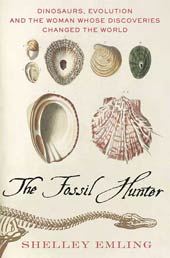
The Fossil Hunter
The author: Shelley Emling
Publication: Palgrave Macmillan, 2009
Got it from: DC, Xmas 2010
You've probably never heard of Mary Anning, but without her our knowledge of fossils and dinosaurs would be considerably poorer. In 1811, she discovered the first complete dinosaur skeleton at only twelve years of age. She spent a lifetime uncovering extraordinary fossils in her hometown of Lyme Regis, but never received proper recognition because she was a woman.
It's hard to comprehend the tremendous strides in science that occurred during the 19th century. In 1800, the world was thought to be a only a few thousand years old, and everything on it, including plants and animals, never changed. The concepts of Ice Ages, evolution and dinosaurs simply did not exist. We tend to think of our own era as one of rapid change, but imagine having your entire view of history swept out from under your feet and replaced with something completely astonishing. It must have been frightening, like suddenly viewing the world upside-down.
For Mary Anning, the poor daughter of a carpenter, it would have been even more incomprehensible. Yet Mary was at the very heart of the discovery of dinosaurs. Learned scientists of the day flocked to meet her and learn about her latest discoveries, men at the forefront of the fossil revolution, including Henry De la Beche, Charles Lyell and Louis Agassiz, the man who first proposed the idea of ice ages. At a time when "gentlemen scientists" stayed comfortably in labs and lecture halls, Mary was scrambling over cliffs in all kinds of weather and practically breaking her back working to extract fossils. It was her discoveries that led to scientists identifying dinosaurs and later influencing Charles Darwin in his theory of evolution. She even inspired the tongue twister "she sells seashells by the seashore."
But for all her effort, she received almost no recognition, was scorned by the people of her town, remained poor all her life and was barred from even attending lectures about her own discoveries. One can't help but feel indignation at Mary's plight. She remained forever at the periphery of the exciting times she lived in, hungering for more scientific knowledge and was by all accounts considered an extremely intelligent woman who impressed her scientific friends. Her life, however, was one of hardship and struggle right up until her death.
Shelley Emling brings Mary to life from the few remaining letters and journals that remain detailing her life. The Fossil Hunter is as much about her as about the history of the early 19th century in which she lived. It's a fascinating story that reads almost like a romance between Mary and fossil hunting, bogged down only in parts by the author's unfortunate tendency to repeat herself. It's a story that deserves to be told about the birth of paleontology and the woman who made it all possible. It's a refreshing change to read about the accomplishments of somebody in science who isn't a man, and I hope everybody interested in the history of fossil hunters reads this and understands what a remarkable contribution Mary Anning made to the field.
Wednesday, April 22, 2009
Sex with the Queen
The author: Eleanor Herman
Publication:HarperCollins, 2006
Got it from: Talking Leaves Buffalo
Things I have learned from reading Sex with the Queen:
1. It's better to be a queen in your own right than just a queen consort.
Examples: Look at poor Anne Boleyn. She got her head cut off for adultery and she wasn't even doing it. Catherine the Great, on the other hand, may have had more lovers than any woman in history and everyone thought that was just great.
2. If you're having an arranged marriage to a prince or a king, check him out first. If everyone refuses to let you see him before the wedding, nine times out of ten it's because he's insane, feeble, impotent, obese, gay or some combination of the above.
Examples: just about all of them.
3. If your husband-king is hated by his people for being ineffectual, it's totally cool to have an affair with a guy who's more effectual. Your people will love you for it.
Example: Maria Francesca of Savoy, Queen of Portugal, was married to the incompetent, impotent and obese King Alfonso. So she did what any normal woman would do: she had an affair with his sexy younger brother Pedro. They all lived happily ever after, with Maria and Pedro ruling the country and Alfonso growing so fat they had to roll him down the hallway.
4. If you're a Russian peasant family living in the eighteenth century, send your handsome young sons to the court of Catherine the Great. If they can perform, your family will never be poor again.
Examples: Sergei Saltikov, Stanislaus Poniatowski, Gregory Orlov, Alexander Vasilchikov, Gregory Potemkin, Peter Zavadovsky, Ivan Korsakov...and so on and so on.
Subscribe to:
Posts (Atom)