Showing posts with label Classics. Show all posts

Wednesday, May 11, 2016

The Feminine Mystique

The title: The Feminine Mystique
The author: Betty Friedan
Publication: Norton, 1963 (50th anniversary edition, 2013)
Got it from: Talking Leaves, Buffalo, 2015

I've finally gotten around to reading the big one, the grandmother of the modern feminist movement.  The one that "pulled the trigger on history," an awesome phrase that gives me goosebumps every time I hear it.  I've read the reviews and the criticism: it's too focused on white women's experiences, it's too middle-class.  The sections on Freud and Margaret Mead are a slog, and not as important to the average woman's experience.  

All valid, of course.  And yet, despite having jumped into the deep end of feminism a long time ago, this book was a revelation to me.  Far from feeling like an anachronism, an inconsequential relic from another era, this book should be required reading for everyone entering adulthood.  Yes, it's written for women, but the message about living up to your potential is a powerful message everyone should take to heart.

Here's the thing: and this is where I will deviate from my usual book review and into my own personal experience, because this book, to paraphrase one of my husband's favourite musical phrases, kicked at the darkness until it bled daylight in me. When you read it, everything in this book sounds so obvious.  But it needs to be said, now as much as ever.  Despite everything that feminism has done for us in the last fifty years and how hard Friedan and the other feminists fought, we have a long, long, long way to go.  Reading about how women lived their lives as 1950s housewives cut off from the world, I just thought, I know these women.  How can it be that fifty and sixty years later, this is still the archetype for ideal womanhood?  How did we go so far and yet still be back there now?

I'll tell you what I see us having now.  We have women "choosing" to be housewives rather than educating themselves or using their educations in a career.  We have women not striving or working for anything beyond marrying a rich husband and having children.  The Kardashians and the Real Housewives (all of them selfish, greedy, spoiled, and vapid) are held up as our role models.  We have Mommy Bloggers, the alternative medicine movement, helicopter parenting, worrying over The Food Babe and Dr. Oz's latest scare tactics, making crafts, canning preserves, and one-upping each other on Facebook and Pinterest considered perfectly acceptable - no, imperative - ways to fill our time.  As Friedan points out, almost none of the "important" tasks we are expected to perform as women would be difficult for an eight-year-old.  Let that sink in for a few minutes.

If this is all your life consists of, you are not living a whole life, any more than the 1950s housewives were.  And this is the crux of the whole book.  Whether you hate what it says about your life or refuse to believe it is irrelevant.  You cannot be a fully developed, happy human being as just a housewife.  Without meaningful work in the outside world, your growth will be stunted as a human being.  There will be a hole there that you will try to fill, usually in destructive ways: overparenting your children, arguing with your spouse, drugs, alcohol, affairs.  

Reading this, I wanted to cry.  It was something I have felt my whole life but have never been able to articulate.  I have always abhorred the idea of being a housewife.  I hated the thought of being confined because I was a woman, stuck inside doing boring, thankless chores, away from the human interactions and activities I craved.  It's one of the many reasons I've chosen not to have children, because even the thought of being trapped and isolated with a small child makes me feel like I can't breathe.  I don't mind being a woman, but I want to be a human being first and foremost, with all the pain and struggle and joy and rewards that come with it. 

So I read the stories in this book with so much sadness.  Because that could have been me.  And I felt horrified and angry the more I read.  What a waste, all those years and even centuries, because women couldn't work.  I read about the woman who felt alive for the first time when she studied science in university and then was brainwashed into becoming a housewife.  Or all the women who took drugs and sometimes ran naked through the streets because they couldn't take it any more.  It sounds funny, but it shouldn't. It's horrifying.  Most heartbreaking of all were the women who saw no way out - always the most intelligent, most promising women - who became trapped by the Feminine Mystique and took their own lives because the shadow life they led held no purpose for them.

I read this, and watched the recent documentary She's Beautiful When She's Angry on Netflix, and I wanted to start my own revolution here and now.  It still do. I want to tell women to wake up and fight to be heard.  I want to tear down the walls of the religious institutions that say women are subservient and should be kept in the kitchen.  Instead of shutting down abortion clinics, I want to shut down all the plastic surgery clinics and sleazy doctors who tell us we're not good enough.  I want to fill social media with pictures of women's office party promotions instead of their bridal showers.  I want to fire all the men in charge of the media and replace them with women who will greenlight stories that are relevant to me and show women in competent roles.  I want to celebrate women who've smashed glass ceilings and talk about them at work instead of pointless celebrities.  I want women to share political ideas instead of Pinterest ideas.  I want to spend 1% of my day on grooming and 99% on making the world a better place.

If Betty Friedan can make me feel these things with a book written fifty years ago, it's no wonder she changed the world.   

Monday, September 28, 2015

A Tangled Web


The title: A Tangled Web 
The author: L.M. Montgomery
Publication: Seal, 1988 (originally 1931)
Got it from: PEI, early 1990's

I've been slowly re-reading a lot of Montgomery's works for the first time since childhood, and my recent foray was with one of her few adult-oriented novels, A Tangled Web.  This story focuses on a tight-knit community ruled by two proud families, the Darks and Penhallows, who have fought and married each other for years.  Yes, they're incestuous, but it was pretty common back then.  As the story opens, family matriarch and queen bitch Aunt Becky is dying and is about to announce who is going to receive her legendary heirloom jug.  Every member of the family is dying to have it, but Becky, who can't resist being awful even as she's dying, makes them wait a year and dance to her tune before they can find out who gets it.

In typical Montgomery fashion the book is very character driven.  Each family member has his or her own back story that has to get resolved before the end of the year.  It's not exactly a secret who the "good" and "bad" characters are.  Montgomery is pretty clearly on the side of the romantic, old-fashioned Victorian folk, she has no patience for the moderns.  Consider one of the heroines, Gay (her name is Gay, people!), a throwback Gibson Girl and professional romantic whose fiancee is stolen by her cousin Nan, a boyish flapper who oozes nastiness from her pores.  There's also the tragic story of Hugh and Joscelyn, separated on their wedding night ten years ago. Joscelyn's growth as a character comes from her realization of her true love for her traditional husband and his old-fashioned farm.  But even if she's hard on the non-homebodies, some of them still get their happy endings.  Peter Penhallow, the family's globe-trotting explorer, is a moron, but manages to win his true love in the end (although it should be noted that his and Donna's story is the most underdeveloped and fizzles out at the end).  

There's little touches of humour sprinkled throughout the book, especially in the scenes involving Big Sam, a wee fussy man, and the gigantic Little Sam, roommates who fall out over a naked goddess statue.  Overall though, this book feels more tragic than what I'm used to from Montgomery.  It was written in during the early stages of the Depression when the author's own life wasn't going so well, and it shows.  It isn't one of my favourites of hers, but I liked it pretty well.  That is, until the very last paragraph, when she trots out something so racist I did a double-take.  You were so close, Maud!  You almost made it.  It's too bad the ending had to leave such a bad taste in my mouth, but then again it's not the first time she's done this to me.

Monday, April 20, 2015

Double review: Further Chronicles of Avonlea and The Story Girl

The title: Further Chronicles of Avonlea
The author: L.M. Montgomery
Publication: L.C. Page & Company, 1920 (My edition: Seal Books 1987)
Got it from: N.B. c.1993

While I was in the middle of reading one L.M. Montgomery book and listening to another on audio, Anne fandom was hit with a huge blow this past weekend with the death of Jonathan Crombie who played Gilbert in the classic Sullivan films.  Two weeks ago at Easter when I reviewed Cool Japan Guide I went down the rabbit hole and started researching the Japanese obsession with Anne, and somehow ended up finding this interview with Crombie. Even though Gilbert of the books will always be my favourite, Gilbert of the movies was everything he should be.  A generation of Anne fans will mourn him deeply.

Anne and Gilbert don't make make too many appearances in this follow-up to Chronicles of Avonlea, although Anne does narrate one of the stories.  What makes these two collections interesting is that they were written to be published as a whole from the beginning, rather than compiled together from various stories like many of the Montgomery collections that began appearing in the 1990s.  The fact that it's set in Avonlea is almost non-essential.  Except for a few mentions of peripheral Anne characters, these stories could be set anywhere in Montgomery's beloved turn-of-the-century P.E.I.  As always, her stories are full of warmth, humour and the follies of human nature, and I enjoyed them with a few serious caveats.

On the whole the first few stories felt stronger than the last handful and overall I thought Chronicles of Avonlea was stronger than its sequel.  Fans of the TV show Road to Avonlea will recognize the story "The Materializing of Cecil," about a spinster who makes up a beau from her past only to have a man with the same name show up in town.  "Her Father's Daughter" was a nice story about a girl who reunites with her estranged father on her wedding day.  "The Brother Who Failed" shows Montgomery's Victorian sentimentality with her It's a Wonderful Life plot: a brother who feels like a failure is proved to be everyone's hero.  "The Son of His Mother" showed Montgomery's near-obsession with sons (she had two herself and was unapologetic in her bias).  This story features a mother so obsessed with her son it borders on mental illness. 

Each story is worth discussing, but I want to focus on a couple of things that rubbed me the wrong way as a modern reader.  "The Education of Betty" has a man raising the daughter of a woman who refused him, and he ends up romantically with the daughter in the end.  Yuck.  I find May-December romances incredibly creepy, especially when it's the man who's older.  Even though the girl in this was 19, I just found the whole concept gross, especially as the "lover" was her father figure growing up. 

The other aspect of these stories I can't forgive is their casual racism, even though it was perfectly acceptable at the time.  As much as I love Montgomery, holy crap was she racist.  She basically looks down on anyone who isn't a white well-to-do Protestant, but it's even more pronounced here.  There's a throwaway line at the end of "The Materializing of Cecil" disparaging the Chinese, but you could write a thesis on last story, "Tannis of the Flats," and its depictions of First Nations people.  I'm not going to repeat the slurs here but suffice it to say the whole story is based on racist stereotypes and ethnic insults abound.  Modern readers will be horrified.

The title: The Story Girl
The author: L.M. Montgomery
Publication: L.C. Page & Company, 1911
Got it from: Hoopla Audiobooks, read by Grace Conlin, 2006

Less racist (although still classist) was my audiobook listen of The Story Girl, which along with its sequel and the Chronicles of Avonlea formed the basis of Road to Avonlea.  This is the only one of Montgomery's books that I didn't remember a thing about from having read as a child, except for the scene where the children pay someone for a picture of God. Montgomery has said it was an autobiographical story.  It features a summer in the life of a group of clannish cousins, along with their mischievous hired boy Peter and a wet blanket of a friend named Sara Ray.  It's narrated by one of the boy cousins, but the true protagonist of the story is Sara Stanley, the narrator's cousin.  Although she's not as beautiful as their conceited cousin Felicity, Sara is more beloved for her imagination and her ability to tell marvelous stories.  Her tales form many stories-within-stories that often reflect events in the children's lives.  Grace Conlin reads beautifully and the oral storytelling in the book makes for a perfect audiobook experience.  I expect to follow up with the sequel The Golden Road in the near future.

Monday, March 23, 2015

Little House in the Big Woods

The title: Little House in the Big Woods
The author: Laura Ingalls Wilder
Publication: HarperTrophy, 1932
Got it from: Hannelore's, 2015

For some time now, after having read Wendy McClure’s The Wilder Life, I have been meaning to re-read the Little House series.  This winter I happened to spy the boxed set in the window of a local used book store, and managed to score the mint-condition set for a great price.  Naturally I am starting with the first one.  

I was quite young when I read this series over twenty years ago.  I never liked Little House quite as much as other classics.  Maybe it was because books like Anne of Green Gables and Little Women seemed closer to my own East Coast childhood.  The prairies were foreign to me, as was the backbreaking labour depicted in Wilder’s books.

Re-reading Little House in the Big Woods in my thirties, I am surprised how much I remembered and how much my initial impressions of the book still hold.  The scenes I loved the most, like the sugar snow and the dance at Grandpa’s, were still my favourites.  I used to get easily bored by the descriptions of how chores were done but now I read them with a historian’s interest.  On the other hand, I never noticed how much hunting there was when I was a child.  As an adult animal lover, I cringed even as I understood how it was needed for survival.  

When I was young, I also read Laura’s narrative as a literal account of her life.  After reading McClure’s book, I now know that it is more a distillation of several years and events to arrive at something like the essence of Laura’s life.  And that’s okay.  It is a window into a lost world post-Civil War when the white folks were starting to settle the west.  

I suspect that few Americans now live so self-sufficiently, and for children the Little House books must seem like a foreign country.  I am sure many are bewildered by how hard-working Laura and her sisters are, and how strictly they are raised.  There are learning moments in the way Laura enjoys the simple pleasures (an orange at Christmas!), revels in the natural world and learns not to be wasteful.  There’s a comforting simplicity to all of the Little House books which makes them enduring classics.

3 corn husk dolls out of 4.


Monday, February 16, 2015

Betsy Was a Junior and Betsy and Joe


The title: Betsy Was a Junior and Betsy and Joe
The author: Maud Hart Lovelace
Publication: Harper Perennial, 2009 (originally 1940s)
Got it from: Amazon, 2013

It seems that lately, so much of what I have been reading has felt like a chore.  Whether it is books for book club, or bad choices on my part, I find myself more often than not just putting books down and not picking them up again.  But I read the Betsy books for pure pleasure.  As much as I try to draw them out, I just find myself zipping through them too quickly.

This 2-in-1 book follows Betsy through her junior and senior high school years.  There is a lot that feels familiar from her previous high school books: romance, the "gang," outings, fashion and school.  In Betsy Was a Junior, Betsy is enchanted by her older sister's experience with university sororities and she decides to form her own.  It of course ends disastrously, with Betsy learning a valuable lesson about excluding people.  In Betsy and Joe, Betsy is caught up in a classic love triangle with Tony and Joe, although the book's title gives a hint as to where her heart lies. (Go Team Joe!) The romantic drama is the backdrop to all the fun and festivities of her senior year.

Once again it is hard not to love Betsy and her world of Deep Valley.  Everything just seems like so much fun.  There are always parties and sleigh rides and swimming and picnics and plays, and they are always eating the tastiest-sounding food.  

I already summed up a lot of my thoughts about the Betsy books in my previous reviews, and the same applies here.  If you've read the earlier books, of course you will read and enjoy these ones, the way you would watch the next installment in an addictive TV show.  And of course I'm going to read the rest of the series with Betsy's European adventures and her marriage.  I'll try to draw it out, but I doubt I will be able to resist binging again.

Monday, September 8, 2014

The Blue Castle (Again)


The title: The Blue Castle
The author: L.M. Montgomery
Publication: McClelland & Stewart, 1926 (Voyageur Classic Edition,
Got it from: Amazon, 2010


I've blogged about The Blue Castle before, and it isn't the first time I've reread it, either.  I actually had to replace my old worn-out copy a few years ago.  I think, without exaggeration, that this is my absolute favourite all-time book.  Every time I read it, I notice something new, and it just gets better every time.

I read this over the Labour Day weekend and even though I knew exactly what would happen, I couldn't put it down.  I hardly even know what to say in this review because reading this book is almost a sacred experience for me.  It speaks to me on so many different levels.  Based on some of the online reviews I've read, a lot of women feel the same way.  I have a theory it's because there's a lot of women who are hungry, starving even, for stories about women just like themselves: quiet, romantic, passionate and above all misunderstood by everyone around them.  The world is a cruel place for women who possess these traits, who have reality forced on them in so many unwanted ways, their dreams mocked and belittled.  The history of Western literature is about men, but The Blue Castle is our story, separate from the demands of modern life and the painful noise of male voices.

Take, for instance, one of the central themes of the books: Valancy's escape from the stifling confines of family obligation.  How many women are forced to be the ones to try to keep everything running smoothly in families?  How many women secretly resent this?  Oh yes, this is a feminist book, through and through.  One early reviewer hated the book because he felt Valancy behaved in an unrealistic (unladylike) way, but what he didn't understand was that she was just ahead of her time.  And yes, one could argue against the feminist theory because there is a love interest.  But Barney demands absolutely nothing of Valancy except that she be herself (a trait that many women nowadays would do well to look for in a partner).  There is something so wonderfully appealing about Valancy and Barney's Edenesque escape into the woods, a life of solitude that beckons even more strongly in our hectic, stressful, overworked modern lives. 

It was amazing to be able to sit up half the night and look at the moon if you wanted to.  To be late for meals if you wanted to - she who had always been rebuked so sharply by her mother and so reproachfully by Cousin Stickles if she were one minute late.  Dawdle over meals as long as you wanted to. Leave your crusts if you wanted to.  Not come home at all for meals if you wanted to.  Sit on a sun-warm rock and paddle your bare feet in the hot sand if you wanted to.  Just sit and do nothing in the beautiful silence if you wanted to.  In short, do any fool thing you wanted to whenever the notion took you.  If that wasn't freedom, what was?

The ability to choose your own happiness, and to live it.  Bliss.


Saturday, May 24, 2014

Heaven to Betsy and Betsy in Spite of Herself


The title: Heaven to Betsy and Betsy in Spite of Herself
The author: Maud Hart Lovelace
Publication: Harperperennial, 2009 (originally 1940s)
Got it from: Amazon, 2013

I am returning to Betsy's world for the first time since last winter.  In the two books of this compilation, we return to the world of Deep Valley, Minnesota during Betsy's freshman and sophomore years (1906-1908).   As much as I enjoyed reading about Betsy's childhood adventures, I have to say I loved Betsy's high school adventures more.  Many of them were taken directly out of Maud Hart Lovelace's own teenage years.

Reading these stories almost breaks my head as I try to grapple with the contradiction of having everything feel so old but so familiar. On the one hand, Maud was born ninety years before me.  Think of "old timey" and these books are it.  We're talking pompadours, "socials," ice cream parlours and Nickelodeons.  It's a world that seems remote, but yet close enough that I could almost reach out and touch it.  My grandmother's descriptions of her growing up years remind me very much of Betsy's.  Betsy herself even feels that strange sense of touching history when she hears a friend's grandmother talk about pioneer days and Indian raids fifty years earlier.  In Betsy's world, there is no television or radio and no electricity.  In Heaven to Betsy, the Ray family gets indoor plumbing for the first time.  Only a few cars exist on the scene and their presence is noted as being remarkable.  Kids roam the streets freely and pop in and out of each others' houses daily.  When they get together, they make taffy and sing around the piano.  Make no mistake: this is the past.

And yet - and here's the contradiction - reading this book I thought, this is the story of my high school life.  I honestly felt like I was watching my high school years in the 1990's play out all over again.  What is it about the teenage years that feels so universal, no matter what century you're in?  Suddenly friends burst out onto the scene like never before, shaping your outlook and experiences.  Betsy suddenly finds herself hanging out with a "crowd" that encompasses new and old friends, much as I did.  Like every (straight) fifteen-year-old girl in the history of ever, including me, Betsy becomes obsessed with boys.  (A footnote at the back of the book states that Lovelace destroyed he high school diaries in later life because they were too full of boys.  A shame!)  Basically everything Betsy experiences reads like a checklist from my high school years: Suddenly becoming obsessed with how pretty you are?  Check!  Trying and failing to reinvent yourself?  Check!  Dating the "wrong" boy just because he's exciting?  Check!  Being extremely silly and passing notes in class?  Check!  Having your first dance be the most exciting thing ever?  Check!  Letting your schoolwork slide because you're having too much fun?  Check!  Experiencing that bittersweet agony of a first breakup?  Check!

And this may in fact be the key to why the Betsy-Tacy books have endured all these years, and why so many other coming-of-age stories from those years have faded into obscurity.  Betsy is so much more relateable than, say, Elsie Dinsmore*.  Yes, she sometimes does silly things like trying to change her personality for a boy, but you can't help rooting for her because we were all there at one time, we all know it's going to work out in the end and mistakes are an important part of growing up.  Another "draw" for me is that despite the many, many problems of living in the early 20th century, I can't help feeling a pang of nostalgia for the days of school dances, picnic socials, musical evenings and recitals.

Or maybe it's the rose-coloured view of high school that I'm really remembering.  


*Because I spent most of my childhood living in the late Victorian era, I knew who Elsie Dinsmore was before I read this book.  She's a goody-goody that all Victorian parents want their daughters to be.  Every self-respecting Victorian heroine hates her.  Betsy even makes fun of her when she's trying to decide if it's wrong to go to a play on a Sunday.  "Elsie Dinsmore, she remembered, had refused to play the piano on Sunday; she had fallen off the piano stool instead.  But Betsy had never thought much of Elsie Dinsmore."

Sunday, February 16, 2014

Chronicles of Avonlea


The title: Chronicles of Avonlea
The author: L.M. Montgomery
Publication: Bantam, 1987 (originally 1912)
Got it from: Library book sale, 1990's

Reading these stories I had to stop and remind myself they were written over 100 years ago.  It's easy to forget just how unique a voice Montgomery had and how fresh her stories still feel.  I understand them, and Montgomery herself, far more now than when I first read her works twenty years ago as a little girl.  Compared to her moralizing contemporaries, Montgomery's characters are just so much more complex.  No one is ever really a villain in Avonlea, just misunderstood or misinformed.  And her "goodies" are never purely saints.  They do give in to temptation now and again.

But what really made these stories a delightful surprise is the sheer number of older characters finding romance.  People in their thirties, forties and even beyond find true love, whether for the first time or with old lovers.  I can only imagine how subversive this must have seemed in rural early 20th century Canada.  If women in their forties are described as being "past their bloom," it is always because of their unhappy personalities.  The happy and lighthearted are described as beautiful, no matter what their age.  And, most importantly, their romances are never mocked and always feel well-deserved.  Even when the stories occasionally become hokey or old-fashioned, the overarching power of romance makes you root for the people in them.  If I had to live in the past, Montgomery's fictional Avonlea wouldn't be a bad place to be.

Thursday, April 4, 2013

Anne of Windy Poplars


The title:  Anne of Windy Poplars
The author: L.M. Montgomery
Publication: McClelland & Stewart, 1992 (originally 1936)
Got it from: PEI, early 1990's

I always consider this to be the "orphan" book of the Anne series because it was written out of order and often doesn't get included in the boxed sets.  Also, outside of North America is was published as Anne of Windy Willows, as apparently nobody would know what a poplar was.

It's hard to believe it's been about twenty years since I last read this book, and I had forgotten most of it.  As always, reading anything by Montgomery is a pleasure.  If you've seen the TV mini-series Anne of Green Gables: the Sequel from the 1980's, you'd probably recognize a lot of the characters and story.  But of course the original book is much, much better.  Instead of Kingsport, Anne is actually teaching in Summerside and she is principal at the high school instead of Katherine Brooke.  Speaking of Katherine with a "K," she's not nearly as horrid in the book as she is in the movie.  The Pringle family are, of course, Anne's chief problem.  But Jen Pringle, who was an absolute bitch in the movie, is more just petty in the book and easily won over.

What the book is, really, is a sketch of Summerside at the end of the 19th century, and the quirks and foibles of the townspeople told mostly through Anne's letters to her fiancee, Gilbert.  Montgomery does a wonderful job of lovingly skewering her society with all the wit of a Canadian Jane Austen.  Over the course of three years Anne manages to tame the Pringles, helps two long-time lovers finally come together, teaches a sulky family patriarch a lesson, baby-sits two terrors "with disastrous results," is inadvertently (un)helpful with two sets of stupid young couples and manages to thoroughly charm her two landladies, Aunt Kate and Aunt Chatty, and the down-to-earth housekeeper Rebecca Dew.  The storyline that runs throughout the book is the sad story of her young neighbour Elizabeth (whom the character of Emmeline Harris is loosely based on), who is left in the strict care of her unfeeling grandmother.  Anne and Elizabeth are instantly kindred spirits and of course Elizabeth gets the Montgomery fairytale ending.

Need I even tell you how much I enjoyed it all?  Reading Anne is like coming home to me.

Saturday, January 19, 2013

The Betsy-Tacy Treasury

The title: The Besty-Tacy Treasury
The author: Maud Hart Lovelace
Publication: Harperperennial, 2011 (originally 1940s)
Got it from: Amazon, 2012

There was a time when I was a little girl, about 8-12 years old, when I really, really, really wanted to be a Victorian child.  Not a poor workhouse Victorian girl, of course, but a genteel or at least middle-class one.  I used to go to sleep at night desperately wishing I could wake up in a sort of fairytale 19th century that existed only in books.  It could be the Concord house the March sisters lived in during the Civil War, or the Darling's nursery, or Green Gables, or even Sara Crewe's India before the whole orphan thing.  What did it matter that there was no television or computers or even proper plumbing?  All I wanted in life was shining ringlets, ribbons, velvet dresses and black stockings.  I wanted a doll with a pram, and a house in the city with tall steps, and the kind of birthday parties where girls wore sashes and drank punch and played pin-the-tail.


So how was it that I missed the Betsy-Tacy books growing up?  I certainly read everything I could get my hands on at the library, especially if it featured a spunky 19th century girl.  The only thing I can figure out is that my library didn't have them, probably because they were American.  It's such a shame, because reading them today, I know I would have loved them.

I probably wouldn't have picked up them up at all as an adult if they hadn't been one of the books read by the Mother-Daughter book club in Heather Vogel Frederick's wonderful series.  The name Besty-Tacy sounded vaguely familiar, although I originally confused it with the "Betsy" series by Carolyn Haywood, a series which my library did have and I did read and which were published around the same time as the Betsy-Tacy books.  

This Betsy, however, was based on author Maud Hart Lovelace's childhood growing up in turn-of-the-century Mankato, Minnesota.  Reading the behind-the-scenes notes at the back, it's clear that the "Deep Valley" of Betsy's world is almost an exact mirror of Mankato, and Betsy's family and friends are actually Maud's.  The four books of the Betsy-Tacy treasury show an idyllic American lifestyle, similar to the 19th century world I lived in my head as a child.  Differences between then and now are fascinating, not frustrating, grown-up problems barely exist, and each day is a delightful, unexpected adventure.

In the first book in the series, Betsy-Tacy, Betsy Ray is turning five years old and a new child, Tacy Kelly, moves into the neighbourhood.  After an initial misunderstanding, the two girls become fast friends.  What follows is a series of gentle vignettes that show the best parts of growing up as a girl.  Betsy and Tacy make and sell coloured sand, decorate a piano box as a house, explore their neighbourhood and imagine driving the milk buggy.  One chapter highlights the stark contrast between Betsy's world and ours: after a short illness, one of Tacy's many siblings, baby Beatrice, dies.  In a wonderful scene, illustrated beautifully by Lois Lenski, the two girls leave coloured Easter eggs for the birds to take to Baby Bee in heaven.  I cried reading this.


Alright.  I can't even look at this picture without getting teary.

At the end of the story, the girls meet Tib Mueller, who will be the third of their trio for the rest of the series.

In the second book of the series, Betsy-Tacy and Tib, the girls are now eight years old and their world is starting to expand a bit.  Tacy gets diphtheria, another indication that it's not quite modern times yet.  One of the biggest plot threads of the book is the girls' attempts to learn how to fly, followed by a visit to a street fair where they get to see a "flying lady."  They attempt to put on a "flying lady" show and in the end have their hopes of learning to fly dashed.  This book shows us our first glimmerings of Betsy the author, testing out her imagination on her friends.

Betsy and Tacy Go Over the Hill is an interesting book.  The story starts out on a humorous note, with the girls falling in love with the young King of Spain and trying to figure out how they can marry him.  They also become obsessed with royalty and plan to crown Tib as May Queen.  They are brought into contact with a local Syrian community and befriend a little Syrian girl, whom they defend from bullies.  The last half of the book is taken up with an epic battle between Betsy & co and Betsy's sister Julia and her friends, over who will be May Queen.  In the end they discover a real-life princess is living in Deep Valley. (Spoiler alert: it's the Syrian girl).

Betsy and Tacy Go Downtown is often considered a favourite among fans.  The girls are now twelve and are spending more time outside their little neighbourhood.  They befriend a girl named Winona, whom they try to "hypnotize" into taking them to a matinee of Uncle Tom's Cabin.  They also experience their first sight of a "horseless carriage." They start noticing boys now (Betsy's older sister has a beau) and Betsy begins to hone her writing skills by visiting the newly-built Carnegie Library and reading all the classics.  We are also introduced to Mrs. Poppy,  a local retired actress, who befriends the girls and begins the search for Betsy's long-lost Uncle Keith, who ran away as an actor years earlier.

I'm so glad they're re-issuing these hard-to-find books in spiffy new anthologies.  I want to read the rest of the series, which takes us all the way to Betsy's early married life.  I so enjoyed reading these and being transported to another time and place, where everything seems so safe and familiar, and yet wonderfully old-fashioned.

Monday, August 27, 2012

Anne of Green Gables

The title: Anne of Green Gables
The author: L.M. Montgomery
Publication:  LC Page & Company, 1908 (100th anniversary edition: Penguin, 2008)
Got it from:Cavendish, PEI, August 2012

It certainly hadn't been my intention to re-read Anne of Green Gables this year, as it wasn't on my "to-read" list and besides, I read it so many times in childhood.  But I just came back from a holiday on the Island, and we went to the musical and Green Gables, and then I caved in and bought the 100th anniversary edition as I've been meaning to, and there I was reading it again, along with my husband who is also reading it.

I love it, of course.  I don't think I ever will stop loving it.  I first saw the Anne musical when I was seven and read the book then, and I've read it (and its sequels) at several different times during my life.  Each time I read it, I do so from an altered perspective.  The last time I think I read it cover-to-cover was for a children's literature class ten years ago.  

This time when I read it, I laughed a whole lot more.  As a child reading it, I identified so much with Anne and would cringe in sympanthy every time she got into a "scrape."  Now I see the humour much more in the situations and can laugh without feeling the old wince of pity.  The parts I loved the most this time around were Anne's interactions with the people of Avonlea, particularly with her schoolfriends in their various rivalries and friendships.  You can almost hear the townsfolk singing "she's nothing like the rest of us" right out of Beauty and the Beast.  And of course, one can't help feeling wistful for all the nature in the book, especially when one is enduring a hot, dry summer in a particularly ugly part of the country. 

Monday, October 31, 2011

Anne's House of Dreams


The title: Anne's House of Dreams
The author: L.M. Montgomery
Publication: Book in Motion Audio, originally 1917
Got it from: Overdrive

I wish I'd thought of listening to audiobooks sooner.  Ever since I got my iPod touch, I've been discovering apps and things that are so much easier to do with just a few clicks, and suddenly it dawned on me last week that audiobooks could be a great way to add more books to my life.  Previously, the thought of sitting next to some sort of stereo and listening did not appeal to me, but now that I can download them through my library in seconds and listen to them virtually anyway - oh my goodness, I'm hooked.  It's such a great thing to have when you're doing housework.  It's so great, in fact, that I was looking for more chores to do last Sunday night because I was enjoying my book so much and didn't want to stop.

Right now, it's the classics that I'm interested in, and catching up with old favourites I didn't have time for and new-to-me-classics that I've been meaning to get to but just haven't.  Anne's House of Dreams has been on my re-read list for years and with its short chapters and familiar story, it was perfect for listening to.  Actually, it's doubly perfect, considering so much of the story is an homage to oral storytelling.  In this fifth novel in the series, Anne is grown-up and marrying sweetheart Gilbert Blythe, who has taken a post as doctor on the other side of the Island.  (We Maritimers always refer to PEI as "the Island," because really, what other island is there?  Um, sorry, Cape Breton.)  They end up in the idyllic town of Glen St. Mary, along the sea, and settle into a little cottage with a long history, and soon make friends with their neighbours: the loveable old sea captain Jim, the hilarious and man-hating Cornelia Bryant, and the beautiful and mysterious Leslie Moore who has a dark past.  Very little of the story focuses on Anne and Gilbert's actual marriage; Anne's pregnancy is only very coyly referred to until suddenly a baby appears - or doesn't.  A tragic infant death reminds us that in Montgomery's world, childbirth was still a very risky business.  It's hard not to think that Montgomery was working out her grief at her own baby's death with Anne's loss.  

There's so much here that Anne fans will love, despite the tragedy: colourful village characters, lavish descriptions of seashores and gardens, and quaint glimpses into a long-gone rural way of life.  It's the kind of story that just goes with a chilly fall evening.  I felt like I was visiting old friends.  I expect to revisit the rest of the series in audiobook sometime soon.


Tuesday, November 4, 2008

52. The Blue Castle

The title: The Blue Castle
The author: L.M. Montgomery
Publication: McClelland & Stewart, 1926
Got it from: Um...er...I'm guessing probably PEI, c.1994

Dear Blue Castle,

How wonderful to read you again, old friend! It's been many, many years, hasn't it? Yes I've skim-read you a number of times over the past decade or so, but have I ever thoroughly read you since I was a child? I'm sorry about the awful condition you are in because that mean boy ripped the cover off you in seventh grade and threw you at the chalkboard. You were just never the same after the shoddy glue job I gave you. I live in hope that I'll be able to find a decent used copy of you someday.

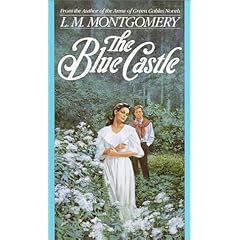
I have only the fondest of memories of you, and how delightful it is that you're even better with time. I'm practically Valancy's age now, when once she seemed impossibly old, and I can sympathize with here even more. How much more dreadful and petty and controlling her family seems than they did before! And how much sweeter it feels when you find out she's going to die and she flips her family the bird and does whatever she pleases. I particularly enjoyed her telling her family to eff off at a dinner party after being under their thumb all her life! And how much more appealing is Barney Snaith now, the man Valancy asks to marry? Most notable is the scene when he rescues her from a hillbilly dance by punching her assailant out and practically throwing her through a window. Now that's devotion! But what's with the awful prep boy on your cover? He is certainly no Barney Snaith!

Anyone who has a soul should read you, Blue Castle. You still have the most beautiful ending I've ever read - in fact, the last five or so chapters are sheer brilliance. Thank you for being there when I needed you, and I hope I may enjoy reading you many times to come. You are a true "A" novel.

Your humble admirer and longtime companion,
Kathryn

Sunday, February 24, 2008

9. Love in Excess


The title: Love in Excess
The author: Eliza Haywood (ed. David Oakleaf)
Publication: Broadview Press, 2000 (originally 1719)
Got it from: David, who got it at a university bookstore (Buffalo?)

Back when I was a fresh young undergrad, I remember reading Haywood's The History of Miss Betsy Thoughtless for my Writing by Women class. I could probably sum up all 500 pages of that book with: "Oh no! I have heedlessly gotten myself into this situation where I am about to be raped! Who will save me now?" Seriously, I wanted to kick that crap out of Betsy. Once or twice going off into the garden with sketchy guys? Okay, that I can forgive you for. Continuing to do so over and over and OVER again? That's just dumb. She is the original Too Stupid to Live heroine of modern romance novels.

Okay, this novel reads at a bunch of different levels. First, I feel like throwing a party for the author for beating down the doors of the men's literary world and continuing to write even in the face of intense criticism. That misogynistic schmuck Pope actually wrote a poem about her as the prize cow in a pissing contest, for which I hope someone pisses on his grave. Cheers to you, Eliza, for telling everyone to eff off by writing whatever the heck you wanted. This book is also frustratingly hard to read because it was published in 1719. It took me a good year to get through it because I kept getting bogged down by sentences that ran for half a page and characters that kept popping up out of nowhere.

In the end, though, as much as I admire the themes and sentiments tackled by this book, I was extremely frustrated by the characters. The book basically centres around this Count D'Elmont, who has women swooning all over themselves trying to get into his pants. Some of them actually die pining for him. There's all the usual 18th-century stuff: love triangles (x10), wailing and gnashing teeth and cursing over love, epic swordfights, main characters dying off left and right, seductions, attempted rapes, lots of letter writing and romantic misunderstandings that take place in gardens, horny heiresses and the inevitable cross-dressing woman. Which sounds like a good time, but again: 1719! Page-long sentences! Confusing grammar and syntax! A year's worth of reading! So I stamp thee, Love in Excess: B.