Wednesday, September 23, 2009

A Midsummer's Magic

The title: A Midsummer's Magic
The author: Mary Chase Comstock
Publication: Zebra, 1994
Got it from: DC, Xmas 2006

You know, for 217 pages, there's an awful lot going on in this book. The best way I can think to describe this is a mash-up of Jane Austen, Harry Potter and (naturally) A Midsummer Night's Dream. There are at least three couples in this book, as well as various interfering interlopers, but surprisingly it never seems to get overwhelming.

Are you ready to follow? Good. The story opens with two bratty kids being sent off to their mysterious aunt's in Cornwall. Brat #1 is a mischievous little boy, Brat #2 is a petulant sixteen-year-old girl who's recently been crossed in love. There's also some side story involving their nurse, who is a bit wackaloo crazy and "a-feered" of the ghosties of Cornwall.

Meanwhile, in Cornwall, Aunt Hippolyta (aka Polly) feels a shudder of foreboding. Polly, I might add, is a wrinkled old woman of twenty-seven, a magician, and the widow* of a very powerful wizard. What is this foreboding she senses? Oh, it's just that wacky niece and nephew of hers. Add them to the strange crew that's already assembled at her house for reasons I can't recall. There's her stepson, Edward. There's Lady Bristlethwaite and her two stepdaughters, who keep making goo-goo eyes at Edward. There's old Sir Geoffrey Mimms, who has a thing for Lady Bristlethwaite. And then there's Julian St. Ives (that's him holding the raven on the cover) who is studying magic while waiting for his great-uncle to die. Naturally, Julian is completely besotted with Aunt Polly and finds her absent-minded ways utterly charming.

What happens next are the usual shenanigans: the nephew becomes invisible, the niece and Edward flirt with each other and she dances with the fairies at midsummer, Sir Geoffrey attempts to break a family curse, some scowling and cape-twirling villain shows up and is easily dispatched with, everybody drinks punch and falls in love with the wrong person, etc. etc.

This is exactly the sort of silly book I shouldn't love but do anyway. I enjoyed it through and through. The plot was so thin you could break it with a fork, the characters were absolute caricatures and so much was left out I thought I'd only read the middle of a much larger book. But it was such good fun!

Q: Does Aunt Polly actually wear the dress on the cover in the book, or did some artist just put it there because it looks like what a lady magician would wear?
A: She actually does wear the dress in the book.

*Yep. She's a virgin widow, alright. The most dreaded character trope in Romancelandia. But it works here.

Monday, September 14, 2009

A Poisoned Season

The title: A Poisoned Season
The author: Tasha Alexander
Publication: HarperCollins, 2007
Got it from: TWBB, Toronto, April

This is the second book in the Lady Emily Ashton series, the first being And Only To Deceive, which I read and loved last summer. A Poisoned Season takes place the summer following the last novel's close. Emily has since returned from a holiday from her estate in Greece, undecided whether to accept the proposal of Colin Hargreaves, her late husband's best friend and spy for the royal crown. Meanwhile, a pompous gentleman has been making the rounds in London claiming to be a descendant of Marie Antoinette, and Emily has picked up a secret admirer who may be the thief stealing Marie Antoinette's property. Like every good British mystery, a murder occurs early on in the book and the victim's widow entrusts Emily with the task of solving it.

As usual, the charm of this series lies with the details of Victorian life. If you, like me, daydream about elegant balls, fancy dresses, tea parties, leisurely promenades and traveling the continent one art gallery at a time, you will not be disappointed. If you crave excitement, there's plenty of that too. The heroine is forever getting involved in dangerous situations that involve drugged wine, thieves in the night and attempted carriage overturnings.

Be warned, though: even if you've read the first book, the cast of characters in huge and difficult to keep track of. Thankfully there is a listing of them in the front of the book to help sort them out. Emily continues to be an enjoyable heroine. She only slightly borders on Mary Sue territory (another man in love with me? ho hum), but her intelligence and curiosity help redeem her.

Sadly, I will probably not be continuing on with this series. The except from book three at the back of this one did not seem like my cup of tea, and from the descriptions and reviews of the rest of the series I've read online, I don't think I would enjoy them all that much to put in the huge amount of concentration it takes to appreciate them. Still, I enjoyed these first two books and have already recommended them to others with very positive feedback.

Monday, September 7, 2009

The White Mare


The title:
The White Mare
The author: Jules Watson
Publication: Orion, 2004
Got it from: RH, August 2005

I finally got around to reading this book, four years after a friend gave it to me for my birthday. Four months and 600 pages later, I'm finally done.

Why did it take me so long to read this book? I kept picking it up, putting it down, picking it up, tossing it aside, and finally at the end saying, "to heck with this, let's just get this done."

I'm reluctant to say anything bad about this book. It's obvious that Jules Watson is a talented writer who did a lot of research and worked really hard to make this work. But to be honest, it was a bit like pulling teeth for me. The beginning was especially difficult for me to get through, since the two main characters are so unsympathetic. The heroine, Rhiann, is a Scottish priestess who has suffered a Big Bad Thing that she hasn't gotten over. I tried to feel for her, but she was so cold and angry for the first 3/4 of the book that I just got frustrated and wanted to yell at her to share her secret already. The hero is Eremon, an Irish prince who is wed to Rhiann to forge an alliance between their two peoples. Oh yes, and he spends most of the book sexxoring every woman except Rhiann. Their romance at the end seemed forced and I still can't understand what Rhiann sees in Eremon. He acts selfishly through most of the novel and comes across as a total ass.

The historical details were fine, but without a good romance the novel just fell apart for me. I wouldn't discourage anybody from reading this book, though. It just wasn't for me. I can't see myself reading the other two books in the trilogy, and I probably wouldn't have finished this one if it hadn't been given to me as a gift.

Monday, August 31, 2009

Rude Awakenings of a Jane Austen Addict

The title: Rude Awakenings of a Jane Austen Addict
The author: Laurie Viera Rigler
Publication: Dutton, 2009
Got it from: The library

Back when I started this blog, I reviewed the book that came before this one, Confessions of a Jane Austen Addict. I gave that book a poor grade because I didn't care for the heroine. Luckily, I enjoyed this second outing much more.

In the first book, 21st century L.A. woman Courtney Stone time-travels back to Regency England in the body of one Jane Mansfield. In this book, Jane awakens in our time in Courtney's body. She gets to deal with all sorts of new and interesting things: hot showers, Facebook, TV, cars and Courtney's messed-up love life. I rather enjoy time-travel stories where people from the past get to see our world, rather than the other way around. Jane is a much more likable character than Courtney, and her Regency dialogue in modern-day L.A. is highly amusing. I zipped through this book in two days, anxiously hoping that Jane would get Courtney's love life sorted out.

*NEXT PARAGRAPH SOMEWHAT SPOILER-ISH*

My original complaint of neither Jane nor Courtney having interesting lives still holds, though I give points to Jane for having some backbone. My real complaint, however, is the ending. I really, really, REALLY* didn't like it. In my head, they returned to their own lives with the lessons they'd learned and applied it to their own times. Instead, we're left with ambiguity. What was the point of them switching and learning if they couldn't make it work in their own times? The ending just didn't work for me and left me with a sour feeling I'd have been better off without.

* I can't stress this enough.

Tuesday, August 25, 2009

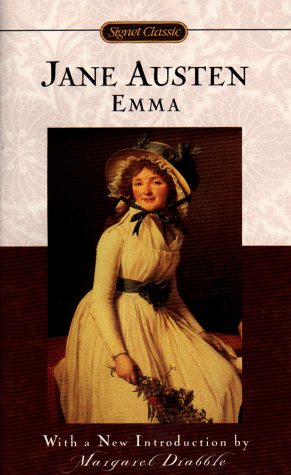
Emma

The title: Emma
The author: Jane Austen
Publication: Crown, 1981 (org. 1815)
Got it from: Mom, Easter 1996

And so August belongs to Emma. Austen once said that she had created a character that nobody would like, being such an insufferable snob. I must protest, and vindicate her. I cannot help but feel, given the same circumstances, that I would be just as snobbish. She lives in a narrow society, in a boring village, with nobody around who can equal her wit and vivacity and only Mr. Knightly her equal in intellect. After reading page after page of Miss Bates prattling on, who wouldn't get frustrated and be tempted to make a joke at her expense? After enduring Mrs. Elton's pretensions and selfishness, who wouldn't loathe her as much as Emma does? After putting up with years of praise of Jane Fairfax, and then receiving only coldness from the same lady, who wouldn't roll her eyes at the mere mention of her name? In short, Emma is a snob, but does it necessarily follow that snobbery is a bad thing?

As to the novel itself, I must give credit where credit is due. Nobody creates more memorable characters than Jane Austen, and nowhere does she do this better than in Emma. The trick, I think, lies in her ability to draw her caricatures from recognizable people. Mr. Woodhouse is a hoot in his self-inflicted infirmity and feebleness, but who hasn't known somebody who invents obstacles when there are none? Likewise, we all know people like Miss Bates, good-hearted and selfless to a fault but agony to be around because of their pointless chatter. It makes one shutter to think of all the nonesense Austen herself and other Regency ladies endured in the name of politeness.

I found the first part of Emma to be the best, with everything up until Mr. Elton's botched Christmas proposal just ducky. Unfortunately, it drags after Frank Churchill's arrival and I confess I found the book overly long and meandering in parts. However, the last few chapters picked up the pace and the book was finished with satisfaction.

Monday, August 10, 2009

Borrower of the Night (Vicky Bliss #1)


The title: Borrower of the Night
The author: Elizabeth Peters
Publication: HarperCollins, 1973
Got it from: Chapters

There have been few authors as consistently enjoyable for me as Elizabeth Peters. I am still working my way through the brilliant Amelia Peabody series, but a crazy notion (must be the August heat) had me reaching for Vicky Bliss instead. I'm sorry I haven't tried reading the Vicky Bliss series earlier. Vicky's no Amelia Peabody, but she's a pretty bad-ass modern counterpart.

Peters is the master of the romantic comedy mystery, no matter which era. As usual, the mystery is enjoyable but takes second place to the (sarcastic, wonderful, lovable) main characters. This book was written in 1973, but remains fresh 36 years later. Vicky is an American professor - tall, blonde, buxom and determined not to marry. Like Jacqueline Kirby, Peters' other droll heroine, Vicky flirts and spars with her male counterparts but rejects them all in favour of her independence at the end (though not without a bit of self pity. As she runs for help at the end of the novel, she muses in what may be one of the best paragraphs I've ever read: "I was sick. I was thirsty. I was all covered with dirt, and nobody loved me.") Supposedly she takes on a lover later in the series, someone more worthy of her. I can't wait.

The mystery feels a bit Agatha Christie-ish, with some Indiana Jones thrown in. Vicky and some of her university colleagues go to Germany in pursuit of long-lost shrine. A crumbling medieval castle plays a large role, as does the ubiquitous knife-wielding suit of armor. Of course it's all very silly, with moonlit chases in graveyards and fainting damsels, but I ain't complainin'. There's something comforting about a good mystery on a thunderstorming summer night (and we've had one every night for about a week). I am very much looking forward to reading more Vicky Bliss.

Saturday, August 1, 2009

Stars

The title: Stars
The author: Kathryn Harvey
Publication: Avon, 1992
Got it from: Freemont Books

Stars follows the trials and tribulations of Phillipa Roberts, the long-lost twin sister of Beverly Highland, the heroine of the fantastic Butterfly. While Stars is by no means as good Butterfly, it has quickly become one of my favourite summertime reads. It was so delicious I could hardly put it down and could easily have read it in one sitting.

Warning: do not attempt to read the sequel until you've read the original first. So much of the plot hinges on the events of the first book, you'd be totally lost. The villain of the first book, the psychopathic Danny McKay, comes back from the dead and begins stalking the main character, whom he mistakes for her twin. Phillipa Roberts has become the head of a highly successful weight loss empire, and is almost as rich and powerful as her twin, who is now the owner of a posh resort called Star's. The plot follows a similar route as Butterfly, with the story of the main character's troubled childhood and rise to fame interspersed throughout present-day events.

There are two things I love very much about this book. One is the jumpy timeline, where the reader gets to guess who in the past is who in the present with a new identity. It's fun to guess right and watch the puzzle pieces fall into place. The other is that this story focuses almost solely on women's lives. The men never become more than passing romantic interests and are never called to rescue the women, who can fend for themselves, thankyouverymuch. In fact a lot of the story focuses on the love between older women/younger men, which is a complete turnaround from most romances of the day. In this and in Butterfly, the women hold all the power and control their own companies, and that's awesome.

In short, it's the perfect cracktastic summer read. The only jarring scenes belong to the villain, who's so creepy I could almost feel the slime coming off him. I almost wish he hadn't been in the book at all, there was plenty of conflict without him.

Four and a half Stars (heh) out of five.